How do I prepare and use Halloween lacing cards for a quiet party table?
Quick answer: Pick a few card ideas from the printable list that suit your guests. Draw large outlines on card stock, cut them out, then punch and reinforce the holes. Cut a 2-foot or 3-foot lace for each card, as its description suggests. Tape one end of the lace and knot the other. Lace one sample card all the way through before you prepare the rest. At the party, give each child one card and one lace in a bag. Show them the first stitch from a star-marked hole, ask for whisper voices and have a tray ready for finished cards. Stay nearby to help. The table should feel calmer, but it won't be silent.
24 Halloween lacing card ideas
Print these shape descriptions to use while preparing your cards. The pack contains written instructions, not cutout templates.
Draw one when the room is ready
Candy corn - 8 holes - 2-foot lace - mark the start near the yellow tip; work around the outline
Starter cards: 8 holes, 2-foot lace
Start with a wide shape and let beginners thread the holes in any order.
- Candy corn - 8 holes - 2-foot lace - mark the start near the yellow tip; work around the outline
- Full moon - 8 holes - 2-foot lace - a wide round outline for a first lacing card
- Ghost - 8 holes - 2-foot lace - space the holes around the wavy hem
- Witch hat - 8 holes - 2-foot lace - punch the brim corners square so the lace turns cleanly
- Pumpkin - 8 holes - 2-foot lace - leave the stem hole for last, it is the tightest
- Skull - 8 holes - 2-foot lace - the eye holes are decoration, not stops
- Candy apple - 8 holes - 2-foot lace - the stick is a straight run, an easy place to try an up-and-down stitch
- Round spider body - 8 holes - 2-foot lace - lace it, then draw the legs on with a marker
Spooky favorites: 10 to 12 holes, 2 to 3 feet
Try these after a child can lace around a simple outline. Check each card for its lace length.
- Black cat - 10 holes - 2-foot lace - the ear corners are the two tightest turns, slow down there
- Bat - 10 holes - 3-foot lace - punch half an inch inside the wing points and reinforce the holes
- Haunted house - 12 holes - 3-foot lace - lace the roofline first, then fill the walls
- Owl - 12 holes - 3-foot lace - the two eye holes get a loop each, like sewing a button
- Broom - 10 holes - 2-foot lace - alternate up-and-down through the bristles for straw texture
- Cauldron - 12 holes - 3-foot lace - leave the top edge unpunched so bubbles can be drawn in
- Crescent moon - 10 holes - 2-foot lace - hold the card while threading around the inner curve
- Candy bucket - 10 holes - 2-foot lace - lace the handle as its own mini loop
Tricky stitchers: 14 to 18 holes, 3-foot lace
More holes and extra stitching for children who want a harder card.
- Spider web - 18 holes - 3-foot lace - spiral from the center out and keep the tension loose
- Skeleton - 16 holes - 3-foot lace - rib holes run straight across, arm holes run around
- Scarecrow - 16 holes - 3-foot lace - cross-stitch the patch corners for the stuffed look
- Witch - 14 holes - 3-foot lace - mark hole 7 for both the hat and shoulder loops
- Frankenstein - 14 holes - 3-foot lace - the flat hairline is one straight stitch across six holes
- Vampire cape - 16 holes - 3-foot lace - thread slowly around the scalloped hem
- Tombstone - 14 holes - 3-foot lace - letter RIP after lacing, in silver crayon
- Grinning jack-o-lantern - 14 holes - 3-foot lace - the zigzag mouth is six short runs, not one long one
What's in the printable lacing card list
The printable list has 24 Halloween card ideas: eight starter shapes, eight middle-tier shapes and eight harder shapes. Each description gives a hole count, a suggested lace length and a detail to try. They range from an 8-hole full moon to an 18-hole spider web.
Use Print all 24 to print every description, or Draw another card to get a random idea. The random picker can choose a card from any difficulty level, so check what it gives you before you hand that card to a child.
These are written card ideas, not ready-to-cut shape templates. You draw the outlines yourself. A full moon is a simple circle, and a candy corn is a broad triangle with rounded corners. For the more detailed designs, you'll need to mark the stitching route yourself. You don't need to make all 24. Choose a few that suit the children coming.
If drawing outlines and marking stitching routes is too much preparation, a Halloween paper chain is simpler: you cut strips from letter paper and loop them together, with no shapes to draw. The same pack also offers a figure garland, but its pumpkins, bats and ghosts need outlines drawn first. Its printed pages are instructions, not cut-out outlines. See how to make Halloween paper garlands.
| Difficulty | Holes per card | Suggested lace length | Examples from the list |
|---|---|---|---|
| Starter | 8 | 2 feet | Full moon, candy corn |
| Middle tier | 10 to 12 | 2 or 3 feet, depending on the card | Black cat (2 feet) |
| Harder | 14 to 18 | 3 feet | Scarecrow (16 holes), spider web (18 holes) |
How long should the yarn be for lacing cards?
Quick answer: Start with 2 feet for starter cards. Middle-tier cards use 2 or 3 feet, depending on the shape, and harder cards use 3 feet. Lace a sample with the stitching pattern you plan to use before you cut all the laces.
Middle-tier lengths vary from card to card, so check each description. For example, the black cat uses 2 feet, while the bat, haunted house, owl and cauldron use 3 feet.
A web pattern, crossing stitches or a sewn seam that goes back through every second hole can use up more yarn than going once around the edge. Lacing a full sample first shows whether the length works for your outline.
How to make the cards and laces
Make and lace one sample card before you prepare the whole table. The suggested measurements need to fit the outline you draw and the way the children will stitch it.
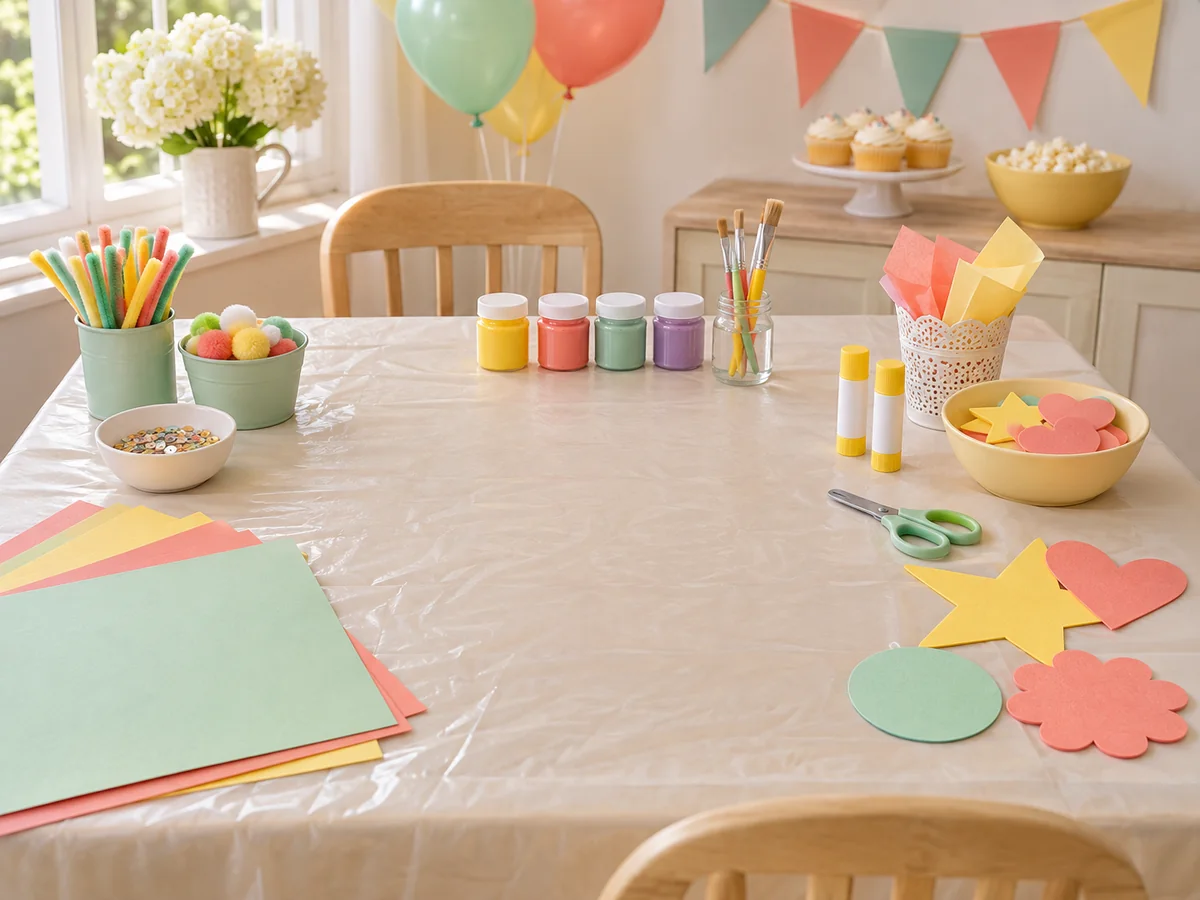
- Supplies listed: 200 gsm card stock, a pencil, scissors, a quarter-inch hole punch, reinforcement rings, worsted-weight yarn, clear tape, bags, markers and a tray for finished cards.
- Draw large outlines and cut them out. If you print an outline you already have, check its size and the printer margins first. Only turn borders off if the outline fits your printable area. Keep each difficulty level on separate sheets or in separate piles.
- Mark the suggested number of holes about 1 inch apart and half an inch in from the edge. If that many holes won't fit, change the outline rather than crowding holes into narrow points.
- Punch the holes and add a reinforcement ring to each one to help protect the edges.
- Draw a star by the starting hole near the bottom left. For candy corn, the card description suggests starting near the yellow tip, so put the star there. Keep any decorative eyes off the lacing route unless the card says to stitch them.
- Cut each lace to the length in that card's description. Lace your sample all the way through to check the length before you cut the rest.
- Put one card and its lace in a bag for each seat. Keep the difficulty levels separate, and keep two spare laces per level in a box for yourself in case of tangles or breaks. If guests will want a second turn, make extra cards.
Once you've chosen your cards, write each material, the quantity, any spares and where it's stored on one sheet, so a helper can find things. Our printable supply list has a section for activity supplies.
Before setting out bags, count the usable seats, check that each child has room for their elbows and pick a spot for the finished-card tray. Make a sample card ahead. See our kids party table setup guide.
How do you make Halloween lacing cards at home?
Quick answer: Draw a large shape on card stock, cut it out and punch holes around the outline. Use the card descriptions for suggested hole counts and lace lengths. Lace one card as a test before you make the rest.
Simple shapes are the easiest place to start: a circle for the full moon, or a rounded triangle for candy corn. Detailed shapes take more drawing and planning, because you also have to mark the order the holes are laced in.
How do you stop yarn from fraying and slipping?
Quick answer: Wrap 1.5 inches of clear tape tightly around one end to stiffen it for threading. Tie a knot in the other end so it stays behind the first hole. Then check that the taped tip fits through the punched hole.
Check the knot on a real card too. It needs to catch behind the hole and not pull through. If the taped tip is too thick to go through the hole, rewrap it more tightly before you prepare the other laces.
How to show children how to lace their cards
Give each child a card and its matching lace. Show them the star, then push the taped end through that hole and pull gently until the knot catches at the back. Bring the tip through the next hole from the other side, and keep going up and down around the outline. Keep the yarn loose enough that the card stays flat.
Decide which adult will show the first stitches and help children who start later, and keep spare laces within their reach. Prepare anything needing adult help ahead. See how to organize a craft station at a party.
Ask the children to write their names on the back of their cards so each card goes home with the right person. If you use helper badges, offer one to any child who wants to help hand out the next cards. Finishing a hard design doesn't need to be a competition.
Since each named card already goes home, it can be the party favor, so you don't need a separate one. Children take home a card they made themselves. See party activities that double as the favor.
Offer helper badges and harder cards to children who want them, without ranking who finishes first or comparing results. Hand out next cards in a set order rather than by speed. See how to keep party games from getting too competitive.
- Use whisper voices while people are lacing.
- Keep one lace at your seat and keep your card flat on the table. Don't wave your lace at the person next to you.
- Ask for help or another card instead of reaching across someone else's work.
- Put finished cards in the tray for finished cards, then ask for another bag if you want another turn.
How do you keep six kids quiet at a lacing table?
Quick answer: Ask for whisper voices, give each child one card and one lace, and put finished cards in a tray. Show them the first stitch and stay close enough to help. The activity won't make the table silent.
Post the table rules above where the children can see them. Having one lace per seat and a set place for finished cards cuts down on reaching and swapping. The most useful thing you can do is stay close by to help with knots and first stitches.
If lacing doesn't suit a child and the room needs to stay low-noise, a seated drawing or whisper game can work alongside it, though no game keeps a room silent. Count seats first. See quiet party games for shared walls.
How to choose a card for each child's age
These ages are starting suggestions. Adjust them for each child's experience.
Before relying on an age band, think about each child's actual skills and whether they want to try. The same applies to every activity, and none has to include everyone. See how to choose party games for children's ages.
A pipe cleaner pushed through larger holes is another threading option for young children. It uses different materials, so make a sample before you prepare all the cards.
- Ages 3 to 4: an 8-hole starter card, such as the full moon or candy corn. Help with the first stitch and let them lace the holes in any order.
- Ages 5 to 6: a 10-hole to 12-hole card. Have them follow the outline and practice going up and down through the holes.
- Ages 7 and up: a harder shape. They can go back through every second hole for a sewn-seam look, or try the crossing stitches described on the scarecrow card.
- Mixed ages: a younger child with a full moon can sit next to an older child working on a 16-hole scarecrow. They can share the table without needing to finish at the same time.
In the next shared game, keep children together but give them different jobs: a younger child searches while an older one reads the clue, then they swap. At this table they still lace at their own pace. See how children of different ages can play together.
How many holes should a lacing card have for a 4-year-old?
Quick answer: Try an 8-hole full moon or candy corn to start with. Let the child lace the holes in any order and help with the first stitch. Offer a card with more holes when they want something harder.
Using a set order doesn't matter at this level. Getting the lace through each hole is what counts. Keep a few middle-tier cards ready in case a confident 4-year-old asks for a harder one.
When to prepare the cards, with an example 15-minute session
Spread the preparation over the days before the party: a week before, pick the shapes, print the descriptions and check your card stock, hole punch and yarn. The weekend before, draw and cut out the outlines, then mark, punch and reinforce the holes. Two days before, test a sample, then cut, tape and knot the remaining laces, bag the cards and sort them by difficulty. On the morning of the party, put a bag at each seat and the tray for finished cards at one corner, and show your helper where the spare laces are.
Decide when the lacing table is open and how your helper will direct children who'd rather move to an active area. Children don't need to finish together. See our party plan for high-energy and quiet kids.
Example only: picture a table of six children, made up of two 4-year-olds and four 6-year-olds. In this example, the six includes the birthday child and doesn't include the adult helper. You would bag two starter cards with 2-foot laces and four middle-tier cards, each with the lace length its description gives. Following the spare-lace suggestion, you'd keep two spare laces for each level you use, so four spares here. Make extra cards too if anyone will want a second turn.
| Example time | What happens | Minutes |
|---|---|---|
| 0:00 to 0:03 | Hand out the bags and show the first stitch from the star-marked hole | 3 |
| 0:03 to 0:12 | Children lace while you help. Children who finish early can write their names on their cards or try another shape | 9 |
| 0:12 to 0:15 | Finished cards go in the tray. Unfinished cards stay with their laces for later | 3 |
What to do after lacing
Have one next activity ready instead of opening several new stations at once. Keep unfinished cards with their laces so the children can finish them later or take them home. Clear away the lacing supplies before you use the same table for anything else, such as decorating food. If the group wants to move around after sitting, choose an active game for the next activity.
For an active next game, Halloween acting cards let children move around after sitting. Choose a prompt pile that suits the group before you start, rather than sorting cards during play. See our Halloween acting cards for kids.
A short routine helps the switch: children put each unfinished card back in its bag with its own lace, finished cards go in the tray, and any spare or unused laces go back in your box. Once the table is clear, give one simple first instruction for the next activity. Party transitions between activities covers warnings and stop cues.
Checklist before the children sit down
- You laced a sample card all the way through and checked the lace length.
- Each seat has a bag with one card and its matching lace, sorted by difficulty.
- Each lace has a taped tip that fits through the holes and a knot that holds at the back.
- Starting holes are marked with a star.
- The table rules are posted, and the tray for finished cards is in place.
- Spare laces are in your box, and your helper knows where to find them.
- Markers are out so children can write their names on their cards.
- Your next activity is ready.
| Card or shape | Number to prepare | Holes per card | Lace length | Prepared? |
|---|---|---|---|---|
| __________________ | ______ | ______ | ______ | ______ |
| __________________ | ______ | ______ | ______ | ______ |
| __________________ | ______ | ______ | ______ | ______ |
| __________________ | ______ | ______ | ______ | ______ |
Guests at this table: ____________________ Helper: ____________________
Activity start: ____________________ Next activity: ____________________
Spare laces are kept: __________________________________________________
Finished cards go: _____________________________________________________
Cards to finish later: __________________________________________________