How do I choose party games for the children’s ages?
Quick answer: Use age to narrow your choices, then check what the game asks the children to do. For a first birthday or toddler party, organized games are optional: free play with toys and caregivers is fine, and you can add short adult-led play if you want to bring everyone together. Younger children usually do well with a shared movement game such as Freeze Dance. Relays and clue hunts suit children ready to follow several steps. Question and story games are options for tweens and teens. Check reading, movement, turn-taking and interests, and show one practice turn. For preschoolers through teens, start with three games: an easy arrival game, a main game and a quieter backup.
How to match a game to the children who are coming
An age range on a game is a starting point. It does not prove that every child of that age can manage the game or wants that level of challenge. A better test is to look at what the game asks children to do: read clues, wait for a turn, remember several rules, throw or catch, move quickly, or handle small pieces. Compare that list with the children on your guest list.
Broadly, toddlers do best with adult-led play they can watch or copy. Younger children enjoy a shared movement game like Freeze Dance, where nobody has to wait or be out. Children who like several steps can try relays or clue hunts. Tweens and teens often prefer question games, stories, team challenges and photo hunts. These are tendencies, not rules. Your own child's interests, and what their friends enjoy, matter as much as the number on the invitation.
Whatever you choose, show one practice turn before the real game starts. If the group struggles with it, make the task simpler there and then rather than pushing on with the full rules.
How do I decide whether an age label fits the actual children coming?
Quick answer: Check the actions the game needs, such as reading, waiting, remembering rules, throwing or handling small pieces, then run one practice turn and simplify if needed.
Picture the specific guests trying it. A treasure hunt with written clues is fine for confident readers but frustrating for children who are not reading yet; picture clues solve that. A game with a long queue may not suit children who find waiting hard, even if they are the 'right' age.
Treat the listed ages as a guide. If the practice turn shows the game is too hard, cut a rule, shorten the task or switch to pictures. If it looks too easy, see the question below on games that feel too young.
Choosing games for toddlers and first birthdays
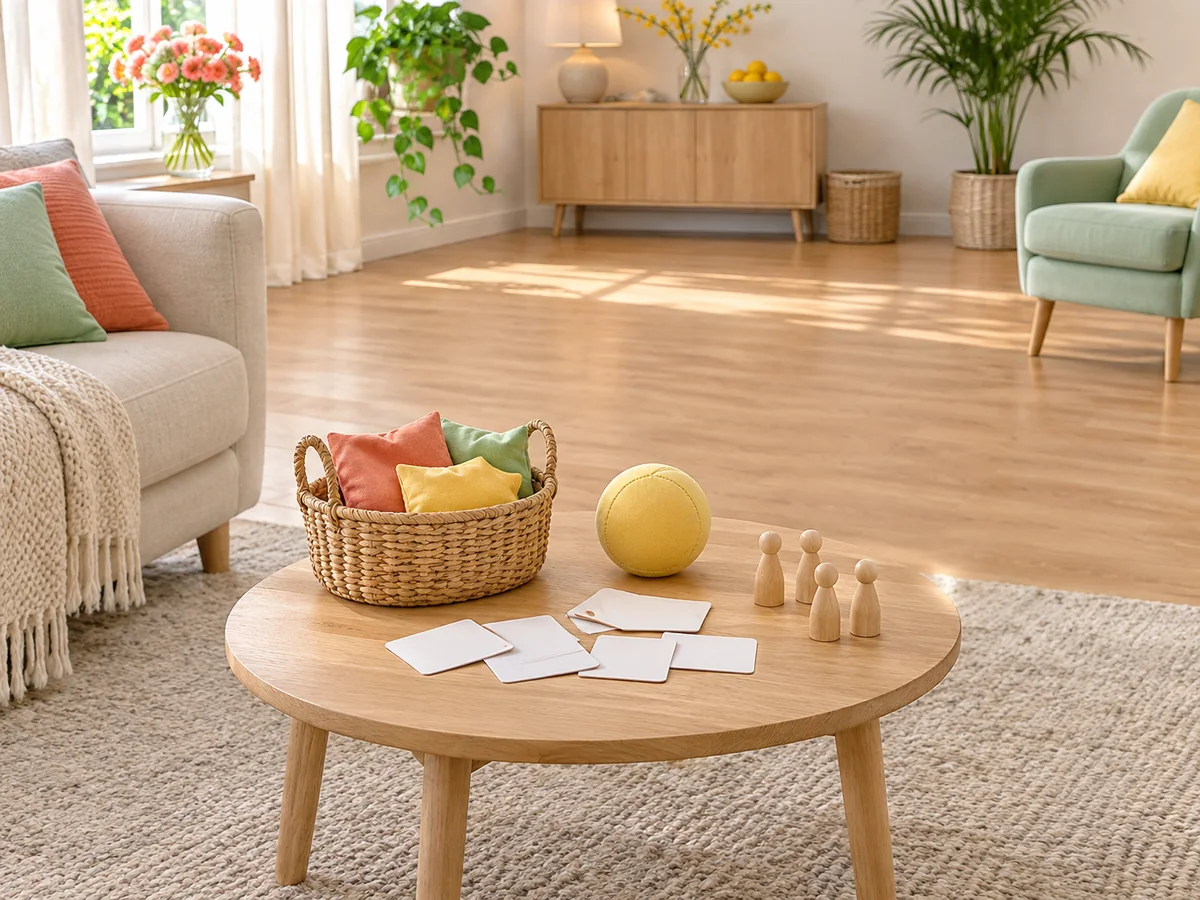
You do not have to plan organized games for a first birthday or a toddler party. Leaving familiar toys or a few simple activities out, and letting children explore while adults chat, is a perfectly good plan. There is no required number of games per hour.
If you want a moment that brings everyone together, keep a few short activities ready and skip them if the children are already happy. Keep everyone in the game when they miss a cue, and let children watch from the side or a lap.
Do I need games at a first birthday or toddler party?
Quick answer: No. Toys, a few simple activities and time with caregivers are enough; organized games are optional.
Have one or two short activities ready in case you want to gather everyone, and skip them if the children are already enjoying themselves. There is no set number of games to fit into each hour.
How do you entertain 1-year-olds at a party?
Quick answer: Offer familiar toys, bubbles to watch, or simple sounds and movements with a caregiver.
A child can watch from a lap or copy just part of an action. You do not need every child to follow the same instructions or finish anything.
What games do 2-year-olds play at a party?
Quick answer: Try Bubble Chase, Animal Parade or Freeze Dance, with an adult showing the action, in a short round children can watch or join.
Start small and let children join when they want. Nobody is out after a missed cue. This guide does not give full rules for Bubble Chase or Animal Parade; for those, use the instructions in Toddler Party Games for Short, Simple Rounds, listed in the sources. The shuffle-and-freeze round below shows step by step how a toddler version of Freeze Dance can run.
Can a simple shuffle-and-freeze game work for toddlers?
Quick answer: Yes, as an adult-led movement round with no elimination: take a few small steps or wiggle while music plays, then pause together when it stops.
Stand beside the children and do the moves yourself so they can copy you. Let them watch or join at their own pace. Nobody has to freeze perfectly, and nobody is out.
Example round: start the music and wiggle in place with the children, stop the music and say 'freeze' as you hold still yourself, then smile and start again. Keep the round short. When the children are ready for more, start the music again. If they wander off, that is a fine place to stop.
What if the birthday child is not interested?
Quick answer: Let them watch, take a break or do something else.
The activities are options. The party does not depend on the birthday child trying each one.
Choosing games for preschool and elementary-age children
From preschool onward, many children can join simple group games, as long as the rules are quick to explain and nobody sits out for long. Freeze Dance, Pass the Parcel and picture-clue treasure hunts work well because missed cues don't knock anyone out. As children get older, add games with more steps, teams or written clues.
The suggested ages below come from a list of ten birthday party games. Use them to narrow your choices, then check them against your actual guests and room. Full rules for each game follow in the next section.
| Game | Suggested ages | Space | What it asks of children |
|---|---|---|---|
| Freeze Dance | 3+ | Room to move, indoors or out | Moving and stopping when the music stops; no elimination |
| Pass the Parcel | 4+ | Seated circle | Passing, waiting for the music, unwrapping a layer |
| Mystery Bag Guess | 4+ | Seated | Guessing an object by touch |
| Balloon Keep-Up | 4+ | Open floor | Tapping a balloon in a small group |
| Treasure Hunt | 4+ | Route through house or yard | Following picture clues (younger) or written clues (older) |
| Cup Stack Challenge | 5+ | Table or floor | Building and unbuilding a cup tower |
| Relay Switch | 5+ | Yard or hallway with room for the route | Carrying an object to a marker and back, then handing over |
| Photo Pose Dash | 5+ | Photo area | Copying poses; anyone can skip a picture |
| Quiet Bingo | 5+ | Table | Marking called items; picture cards for non-readers |
| Would You Rather Corners | 6+ | Two places to stand, or seats | Choosing between two answers; nobody has to explain |
How do I know if a game is too young for my child’s party?
Quick answer: Ask your child whether they would enjoy playing it with their friends. If they like the idea but want more challenge, offer a harder version without making every guest take it.
Ways to raise the challenge include written clues instead of pictures, a harder carrying task in a relay, or longer story contributions, while keeping turns equal.
Guests who prefer the simpler version should still be able to join in.
How to play each game in the table
These are short party versions. Agree on the finish before starting, show one turn and let children watch or sit out.
Freeze Dance. Supplies: speaker and playlist. Play music, pause it suddenly and everyone freezes in place. Cheer funny poses instead of putting anyone out. Start the music again for the next round; new arrivals can join at any time. To finish, announce one last freeze, stop the music and gather everyone for the next activity.
Pass the Parcel. Supplies: a small prize wrapped in layers, and music. Children sit in a circle and pass the parcel while music plays. When it stops, the child holding it removes one layer. A prompt between layers, such as 'Everyone wave to the birthday child', gives the group something to do together. Start the music again after each prompt. The game ends when the last layer reveals the prize. Gather the wrapping before moving on; wrap a second parcel beforehand if you want to play twice.
Mystery Bag Guess. Supplies: a bag and familiar objects suited to the children, such as a large spoon or a soft toy; choose objects that are easy to clean and not too tiny. Put one object in the bag. A willing child feels it without looking, describes it, guesses, then reveals it. Change the object for the next child. There is no score. Finish after everyone who wants a turn has had one.
Balloon Keep-Up. Supplies: balloons, a timer and spares. Give each small group one balloon and challenge them to keep it off the floor for one minute, counting taps together if they want a shared score. If it drops, pick it up and start again; nobody is out. Add a second balloon only if there is room and the group wants it. When the timer sounds, catch the balloons and put them aside. Stop sooner if the game turns into a chase.
Treasure Hunt. Supplies: picture or written clue cards and a small prize or shared treasure. Hide clues that lead from one agreed spot to the next, ending with favors or dessert. For example, a picture of a sofa leads to a card beside the sofa, which shows a picture of the party table where the treasure is. Walk the route first, keep a copy of the clues and let different children reveal each card. The hunt ends when the group finds the treasure; collect the cards afterward.
Cup Stack Challenge. Supplies: plastic cups and a timer. Show how to build and unbuild a small tower: for example, three cups along the bottom, two above and one on top, then back into one nested stack. Give each team the same number of cups, and make the tower shorter for younger children or taller for older ones. One complete build and unbuild is a turn; then pass the cups to the next teammate. Finish when everyone has had a turn, or when the timer sounds. For a race, give teams the same number of turns; the first team to finish wins and ties are shared. Nest the cups to reset.
Relay Switch. Supplies: marker cones and a beanbag, spoon, ball or costume piece. Mark a start and a turning point. A player carries the object to the marker and back, then hands it to the next teammate. Keep teams small so each child gets more turns, show the route first and give everyone the same carrying task. Finish when every teammate has made one trip. For a race, use equal-sized teams; the first team finished wins and ties are shared.
Photo Pose Dash. Supplies: a phone camera and a backdrop. Call out a pose, team shape or silly face, such as a superhero pose or a group wave, and take a photo before the next prompt. Children stay in the photo area; nobody has to race. Anyone can skip a picture, and there is no score. Announce the last pose, take the photo and move on. Keep the camera with the adult taking pictures, and agree with parents before sharing photos.
Quiet Bingo. Supplies: picture or word bingo cards, markers and a matching caller list. Explain the winning pattern before starting, for example one complete row. Call one item at a time; children mark it if it is on their card. Use pictures for children who are not reading yet. When someone completes the pattern, check their card against the items called, and that finishes the round. Clear the markers to play again.
Would You Rather Corners. Supplies: a list of questions. Name two choices and show which side of the room stands for each. Children walk to their choice or point from their seat. Ask whether anyone wants to explain, then read the next question. Nobody has to move, give a reason or pick either answer, and there is no score. Finish after a few questions, or after any answer once the next activity is ready.
Choosing games for tweens and teens
Age alone won't tell you what a group of tweens or teens will enjoy, so ask. Your teen, or the teen helping you host, is your best guide. Let them help decide which games to have ready.
Start with a short round and repeat it if people are enjoying it. Ask before including solo singing or dancing, and let guests sit out instead of making anyone perform.
What games do 14-year-olds actually like?
Quick answer: Ask the guests or the teen helping you host. Most Likely To, a photo hunt and team challenges give you three different formats to offer.
Try a short round first and repeat it if people want to. Age alone does not tell you which game a particular group will enjoy.
What party games are not babyish?
Quick answer: Games your guests actually want to try, with questions and challenges that fit their interests, such as a photo hunt, a familiar board game or a team challenge.
Ask before including solo singing or dancing, and let guests sit out rather than requiring a performance. For children who find a favorite game too easy, an optional harder version can help, as described above.
What are good no-supplies games for teens?
Quick answer: Most Likely To with spoken questions, Hot Seat, and Two Truths and a Lie can all be played without equipment.
For Two Truths and a Lie, each player who wants a turn says two true statements and one made-up statement, and the others guess which one is made up. Then the player reveals the answer and the next volunteer goes. Play without points. Finish once everyone who wants a turn has had one.
Keep turns voluntary so nobody is put on the spot. The related guides to Most Likely To and Hot Seat explain how to run those two.
Handling mixed ages, siblings and the birthday child
When ages are mixed, give younger children simple jobs and older children an optional challenge, rather than splitting the party into separate rooms. Use picture clues alongside written ones, or shorter cup towers next to taller ones. Pairing children of different ages can help, but older guests should not end up responsible for the whole game.
What can older siblings do at a first birthday or toddler party?
Quick answer: Offer them a separate activity, such as coloring, a simple craft or a game suited to the children attending.
If they want to, they can also help an adult stack cups or lead a song.
How can older siblings help without taking over a younger child’s game?
Quick answer: Give them one clear job, such as showing the first cup stack, reading a clue aloud or resetting props, and let the younger child make the choice and finish the turn.
A defined job keeps the older child involved without them doing the turn for the younger player.
If older children want more, offer them a harder round afterward instead of changing the whole game partway through a turn.
How can I include the birthday child without making them win every game?
Quick answer: Let them choose the first prompt or start the music, keep the same rules for everyone, and save the special attention for the birthday song or a group cheer.
After the first round, rotate leader jobs among the guests so everyone gets a turn at something.
How many games to plan, with an example party
Illustrative example: this made-up birthday party runs from 2:00 to 4:00 p.m., 120 minutes in total, for children old enough for a picture-clue hunt and cup stacking. Each game block includes explaining the rules and putting supplies away.
Check the total: 20 + 15 + 25 + 10 + 20 + 15 + 15 = 120 minutes. Shorten the bingo block if food or cake takes longer. Adjust the whole plan for your guests and food.
- 2:00 to 2:20 p.m. (20 minutes): Arrivals and cup stacking. Guests try short turns as they arrive; keep these cups separate from the main game's supplies.
- 2:20 to 2:35 p.m. (15 minutes): Main treasure hunt. Gather the group, show the first clue and finish at the shared treasure.
- 2:35 to 3:00 p.m. (25 minutes): Food. Put the hunt cards away first.
- 3:00 to 3:10 p.m. (10 minutes): Freeze Dance or group photos. Announce the last round before bringing out the cake.
- 3:10 to 3:30 p.m. (20 minutes): Birthday song and cake, with time to serve and clear plates.
- 3:30 to 3:45 p.m. (15 minutes): Quiet bingo or questions, the quieter backup.
- 3:45 to 4:00 p.m. (15 minutes): Belongings, favors and pickup.
How many party games should I plan?
Quick answer: For preschool, kindergarten, elementary, tween and teen parties, start with three: an easy arrival game, a main game and a quieter backup. For first birthdays and toddlers, games are optional.
For preschoolers, make the main game one everyone can play together and the backup a seated one. For kindergarten, pick three from a list of ideas rather than trying to play them all. For tweens and teens, choose one guests can join as they arrive, and let your teen help decide which ones to have ready.
For preschoolers, our preschool party games collection includes arrival activities, group games and seated backups to choose from. Pick only a few, and see how they go with the children who are actually coming rather than planning to play the whole list.
For kindergarten, choose your three from our list of kindergarten party games: one for arrivals, a main game and a seated backup. The list also covers getting the room and game supplies ready, which helps you leave out games that don't suit your space. You won't need the whole list.
If a game goes down well, play it again, with new songs or prompts for older groups, instead of preparing more. Keep other ideas on hand rather than scheduling a whole list. Leave room for food, cake and pickup, as in the example schedule.
How do I choose the first birthday game when guests arrive late?
Quick answer: Start with a game that is easy to restart, such as Freeze Dance or a cup-stack attempt, and save the clue hunt or Pass the Parcel for when everyone has arrived.
Late arrivals can join a restartable game without waiting for anyone to win. Keep arrival supplies separate so you can put them away without taking apart the main game.
Running the games and changing course
Before guests arrive, practice explaining each game in about a minute and show one turn. If a game needs a long explanation, simplify the rules. Agree on how each game ends before you start, and let children watch or sit out.
Use the checklist below once you have chosen your games.
- Pick an arrival game, a main game and a quieter backup that suit the children's reading, movement and interests, or plan free play for a first birthday or toddler party.
- Run one practice turn and decide how you'll simplify each game, or make it harder, if needed.
- Put props, timers and spare supplies where each game will happen.
- Agree on a finish rule or stop signal for each game.
- Tell your helper the setup, the finish rule, where the spares are and what comes next.
- Decide who will help a child who needs a break.
- Ask someone to gather game supplies and clear the play area before pickup.
What should a helper know before leading one of the birthday games?
Quick answer: How to set it up, exactly how it ends, where the spare supplies are and what comes next.
Show your helper one turn before guests arrive, and agree on who will help a child who needs a break.
What should I do if a game isn’t working?
Quick answer: Stop and switch to the quieter backup, take a food break or move on to another planned activity. You don't need to finish a round that has stopped being fun.
It helps to work out why the game stalled: the rules, the children's interest or who could join in. Our guide to what to do if a party game is not working covers moving on clearly. It also notes that you can end organized activities early and move on to food, cake or relaxed conversation.
Avoid adding more rules to a game the children no longer want to play. Stop at a clear point and move on.
Before pickup, ask someone to gather the game supplies and clear the play area.
Sources and further reading
- Party Games by Age: What to Play and How to Run Each Game
- Party Games by Age: From Toddlers to Adults
- Birthday Party Games
- Birthday Party Games by Age and Space
- First Birthday Games
- Toddler Party Games for Short, Simple Rounds
- Preschool Party Games
- Kindergarten Party Games
- Elementary Party Games
- Tween Party Games
- Teen Party Games
- 10 Teen Party Games with Rules and Supplies
- The Big List of Teen Party Games