How do I prepare and use New Year's Eve bingo to print?
Quick answer: Print the 26 caller entries and the blank board grids. Add a matching picture to each caller card and to the boards, then cut the cards apart. Print one board per player plus two spares and set out markers. To play, shuffle the paper caller cards, show the winning pattern and draw one card at a time. You get caller descriptions and blank templates, not finished picture boards, so allow time to add the pictures before guests arrive.
26 New Year bingo calls
Print these words and picture descriptions, then add matching drawings to the caller cards and boards. The picker can repeat earlier calls; use a shuffled paper deck when you need each call only once.
How to play
- Give each player a prepared picture board and markers. Cover the free Midnight Clock center on full-size boards.
- Show the winning pattern before you start. For the mini-board, cover all nine pictures to win.
- Shuffle the paper caller cards. Draw one, show its picture for at least three seconds and say the word twice.
- Players cover the matching picture. Aim for one call every 20 seconds, pausing when someone needs more time.
- Set each called card aside. When a player finishes the pattern, check their pictures against those cards; players finishing on the same call share the win.
Draw one when the room is ready
Midnight - a clock face with both hands pointing straight up
Caller deck - 26 New Year picture calls
The word is for the caller; use the description to draw the picture players will see.
- Midnight - a clock face with both hands pointing straight up
- Fireworks - three dotted bursts over a dark roofline
- Countdown ball - a glittery sphere lowering on a pole
- Party hat - a polka-dot cone with a pom-pom tip
- Noisemaker - a bright horn with a curled end
- Balloon drop - a net of balloons falling mid-air
- Streamers - curly paper spirals hanging from the ceiling
- Confetti popper - an opened tube with paper bits bursting out
- Sparkling cider - a plastic flute with rising bubbles and one cherry
- Mirror ball - a hanging ball covered in mirror tiles
- Calendar flip - a December page turning to a January page
- Resolution list - a notepad with three boxes and two checks
- Gold crown - a three-point tiara with jewel dots
- Glow stick - a bent bracelet glowing green in the dark
- Ribbon wand - a short stick with two curling ribbons
- Big Ben - a tall clock tower with a lit clock face
- Snow globe - a dome with a tiny city and falling flakes
- Night owl - a wide-awake owl on a branch beside a moon
- 11:59 - a digital clock one minute before twelve
- Star banner - a string of stars hung across a wall
- Cheering poms - two fluffy pom-poms crossed at the handles
- Time capsule - a sticker-covered box with a label
- Crescent moon - a yellow moon with three star friends
- Cocoa mug - a steaming mug topped with three marshmallows
- Paper countdown chain - ten links with the last one torn halfway
- Family hug - stick figures with arms around each other
What is in the New Year's Eve bingo printable?
The printable has 26 caller entries, each with a word and a description of the picture that goes with it. It also has two blank board layouts: a full-size 5x5 grid with a free Midnight Clock in the center, and a nine-square mini-board for younger children. The print control prints the page itself. There is no separate board PDF.
The boards come blank, so you decide how to make the pictures. You can draw them, glue them on or copy one set of drawings. Use the same picture for an item on every board and on its caller card. That way children match identical images and don't have to work out what a different drawing means.
Other holiday bingo printables on Party Whammy can differ in their contents and board styles. Everything here describes the New Year's Eve set only.
Are these finished picture bingo boards?
Quick answer: No. You get printable caller words with picture descriptions and blank board grids. There is no separate finished-board PDF.
If children can't read yet, add matching drawings before you play. If you want picture-only play, keep words off the children's boards and keep the word on the caller card so the caller can read it out.
If you want other activities for the same children later in the evening, party games with no reading required include options with matching cues or copy-the-leader moves. This bingo set still needs pictures added before it works for nonreaders.
How to print and prepare the bingo boards
Count the players before you print. Allow time to add the artwork as well as cut the cards. How long this takes depends on how you make the pictures.
Once you know the player count, write down each quantity separately: boards, artwork supplies, caller cards and markers. A printable supply list keeps them in one place and can be updated as plans change.
For a full-size board, choose 24 of the 25 calls other than Midnight and put the Midnight Clock in the center as the free square. Draw it as a clock with both hands pointing to twelve. For a mini-board, choose nine pictures other than Midnight. Arrange the pictures differently on each board. Lay each set out before gluing, compare the boards and move a few pictures if two layouts match. Different layouts can make players win at different times, but two players can still win on the same call.
If you draw the boards by hand, make squares 3.5 cm wide and 3.5 cm high with thick outlines. The full-size grid will then measure 17.5 cm across before margins. The on-screen grid is a blank template, not a drawing to scale, so check print preview if you need exact measurements.
Print one board as a test and measure it before printing the whole set, and check print preview again if you change anything. Keep host-only details, such as contact numbers, on your own copy rather than on guest sheets. Preparing printable party games covers this setup.
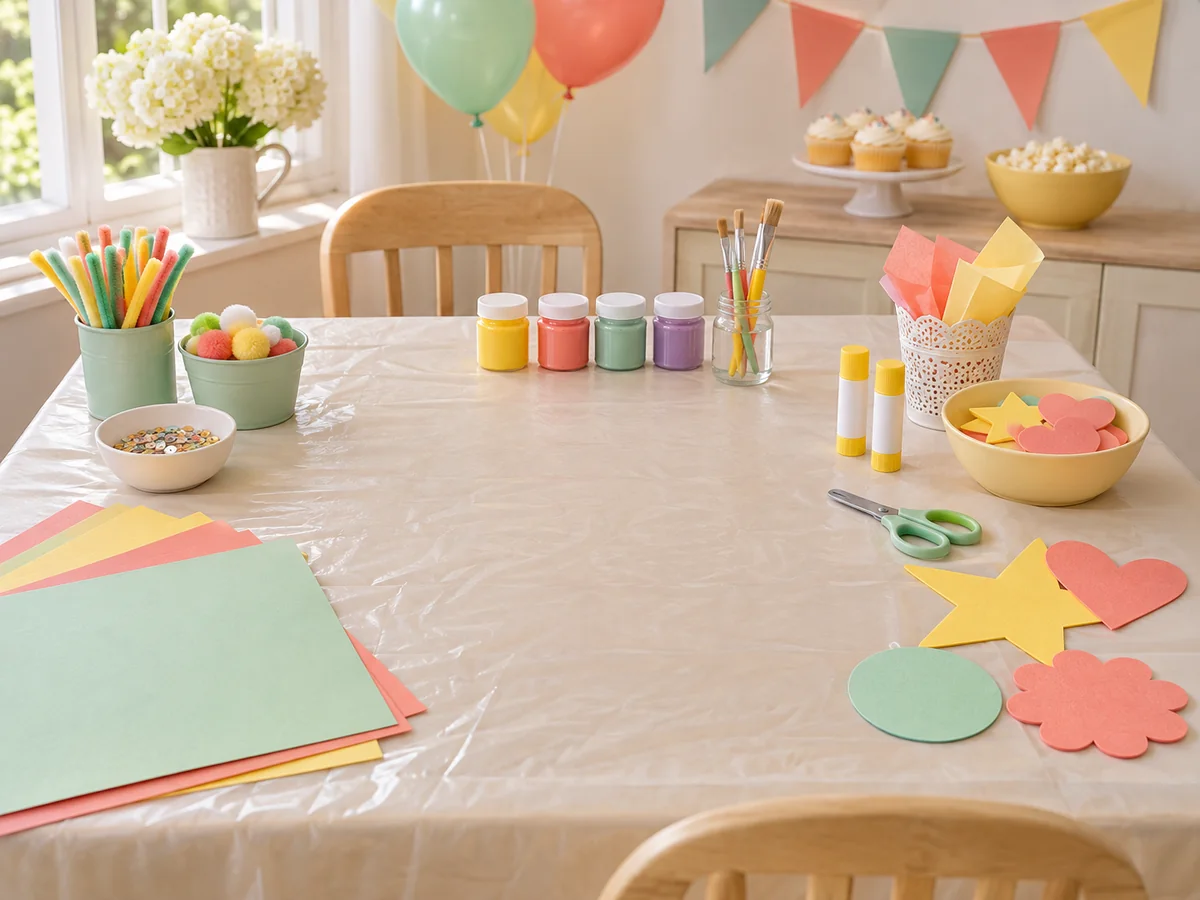
- Print the 26 caller entries. Add each picture beside its word, then cut the entries into separate cards.
- Print the blank grids. Use 65 lb card stock if you have it, and number each board in a corner.
- Make matching picture copies for the boards.
- Make a card showing the first winning pattern and put it where everyone can see it.
- Set out a tray for markers, a place for used caller cards and, if you like, sticker prizes.
- If another adult will take over calling, leave the rules with the pile of used cards.
- Laminated boards can be marked with dry-erase pens, so you can use them again next year.
How many boards should I print?
Quick answer: Print one board per player plus two spares. For example, 8 players need 10 boards, 14 players need 16 and 16 players need 18.
Count everyone who will hold a board, including your own children, siblings and any adults who will play. Don't count an adult who is only calling. Add the two spares after that count. Spares cover a late guest or a damaged board. You can also cut up a spare prepared board to make replacement caller cards. That gives you a smaller deck rather than all 26 calls, so use that same picture set on every board in the replacement game. Otherwise, a square on someone's board could never be called.
What can you use as bingo markers?
You need enough markers for every square, and a few extras.
What can we use as markers?
Quick answer: The original suggestions are pom-poms, buttons or cereal pieces. Choose markers that suit your guests. Count 25 for each full-size board or nine for each mini-board.
The count of 25 includes the marker for the free center. Keep extras nearby, especially if players might eat the cereal. With young children, choose markers that suit their age and stay with them while they play. Keeping markers on a tray makes them easier to collect afterward.
How to call the pictures and check a winner
Shuffle the paper caller cards and show everyone the winning pattern. On full-size boards, players cover the Midnight Clock in the center before the first call. If you draw the Midnight card, nobody adds another marker.
Draw one card and hold its picture where everyone can see it for at least three seconds. Say the word twice. Start with a call about every 20 seconds, but wait if players are still looking. Set each called card aside face up so you can check a winning board.
When someone completes the pattern, they can say "Happy New Year!" or raise both hands instead. Check every square they need against the used cards. If more than one player finishes on the same call, they share the win. Hand out a sticker if you're using prizes. A winner who wants to can draw the next card while the caller keeps showing and reading it out. Keep mini-board wins separate from full-size wins, because the rules for winning are different. Clear the markers and shuffle all the cards back together before the next round.
Tell players before the first call that anyone finishing on the same call shares the win, and whether a sticker goes to winners. If every child is getting a take-home favor anyway, keep that separate from bingo results. Announce mini-board and full-size wins separately. The checklist on keeping party games from getting too competitive covers ties and prizes.
| Pattern (full-size board) | Squares to cover |
|---|---|
| Top row across | All five squares in the top row. A good first round. |
| Middle column down | All five center-column squares, including the free clock. |
| Four corners | Top-left, top-right, bottom-left and bottom-right. |
| Corner-to-corner diagonal | Five squares through the free clock. Say which diagonal counts, or that either one counts. |
| Letter L | The left column and bottom row, nine squares in total. |
| Zigzag | A stair-step path. Mark the exact squares on the pattern card before you play. |
| Border frame | All 16 squares around the outside edge. |
| Blackout finale | Every square, including the free clock. Save it for a last round if there's time. |
Can I use the picker for a whole round?
Quick answer: It's better not to. The on-screen picker can repeat a call from earlier in the round. If you don't want repeated calls, shuffle the printed caller cards, draw one at a time and set each used card aside.
The picker works well for previewing calls. The paper deck also gives you a pile of used cards to check a winner's board against.
How long should I allow for a round?
Quick answer: Allow about ten minutes, then adjust for your players and the winning pattern.
At 20 seconds per card, calling all 26 cards takes 8 minutes 40 seconds (26 x 20 = 520 seconds). That doesn't include extra pauses or checking a winner. A single row may finish much sooner, while a blackout can need nearly the whole deck.
Adapting bingo for young children and quiet rooms
Ages 3 to 4 are a suggested starting point for the mini-board, not a promise that every child that age can play. Watch how your guests manage and help where needed.
For a quieter round, keep the same cards and rules, but call in a stage whisper. Winners raise both hands instead of shouting, and players can wave their pom-poms instead of clapping. Use lamp light only if everyone can still see the pictures clearly. Whispering cuts the noise from calling and winning, but it can't guarantee that a sleeping baby will stay asleep.
If whispered bingo still feels too loud for the room, switch to a different quiet game rather than pushing on. Party games for quieter guests or a quieter room has options, though no game can promise silence or that a sleeping baby won't wake.
Can three-year-olds play?
Quick answer: Try the nine-square mini-board with matching pictures, and help as needed. Show each caller picture for at least three seconds.
In this version, a player wins by covering all nine pictures. The mini-board has no free center. Because the rule is simple, young players don't need to learn a pattern. An older child or adult can sit beside them and help with matching.
Adjust the game to each child rather than by age alone: some may want a helper beside them, others a slower pace or a seat at a table instead of the floor. Adapting party games for different abilities has more ideas. Keep mini-board and full-size wins separate.
Example 45-minute bingo schedule before a countdown
This is an illustrative example running from 8:15 to a 9:00 countdown. It has three ten-minute rounds, five minutes to explain the game and ten minutes to put everything away and gather. If someone wins early, finish that round sooner. If a round hasn't finished by its stopping time, end it without a winner rather than delaying the countdown. End the last round ten minutes before your countdown.
Fit the bingo block around food, other activities and your countdown rather than adding rounds to fill time. A New Year's Eve family party plan shows a full evening schedule, with time after the countdown for quieter activities and finishing up.
- Total: 5 + 10 + 10 + 10 + 10 = 45 minutes.
- For an 8:00 countdown, move every time 60 minutes earlier: start at 7:15, stop the last round at 7:50 and use 7:50 to 8:00 to put bingo away and gather. Or play fewer rounds.
Choose the countdown time first, based on naps, bedtimes and when families need to leave, then shift or cut bingo rounds to fit. Planning a New Year's celebration that works for children explains how to put the start, countdown and finish times on the invitation.
| Time | What happens | Minutes |
|---|---|---|
| 8:15-8:20 | Hand out boards, cover the free centers, show the top-row pattern and show how long you'll hold up each picture | 5 |
| 8:20-8:30 | Round 1: top row on full-size boards, all nine on mini-boards. Check winners, clear markers and reshuffle | 10 |
| 8:30-8:40 | Round 2: middle column. The mini-board rule stays the same and its winners are announced separately | 10 |
| 8:40-8:50 | Whisper finale: blackout, or repeat a simpler pattern. Stop at 8:50 even if nobody has won | 10 |
| 8:50-9:00 | Collect boards and markers, then gather for the countdown | 10 |
Checklist before guests arrive
- Boards counted: one per player plus two spares, each numbered
- Pictures added to all 26 caller cards and matching pictures on every board
- Board layouts compared so no two match
- Markers counted: 25 per full-size board, nine per mini-board, plus extras
- Pattern card for round 1 ready and visible
- Paper caller deck shuffled, with a spot for used cards
- Marker tray and any sticker prizes set out
- Stopping time agreed: ten minutes before the countdown
Other games for New Year’s Eve
You do not need to fill the whole evening with bingo. New Year’s Eve games for kids includes a seated ball pass, a freeze-dance game and quiet table activities you can play before or after it.
Leave paper and coloring supplies nearby for anyone who wants to stop playing. The low-demand party activities guide offers activities guests can join or leave without a turn or timer. If you need a short activity while someone prepares the countdown, use ten-minute backup games and agree on a stopping signal before starting.
| __________ | __________ | __________ | __________ | __________ |
| __________ | __________ | __________ | __________ | __________ |
| __________ | __________ | FREE: Midnight Clock | __________ | __________ |
| __________ | __________ | __________ | __________ | __________ |
| __________ | __________ | __________ | __________ | __________ |
| __________ | __________ | __________ |
| __________ | __________ | __________ |
| __________ | __________ | __________ |
Board number: __________ Player: ____________________
Board number: __________ Player: ____________________