How do you play a left-right gift-passing game?
Quick answer: Seat everyone in a circle. Give each player one gift, or give one shared prize to one player. Then read a story aloud. Each time the reader says LEFT or RIGHT, everyone passes the gift they are holding one seat that way, all at the same time, and waits for the next cue. After the final cue you announced, stop passing. Players keep the gift they are holding, or the person holding the shared prize follows the sharing rule you set. Nobody scores points and nobody is out.
How the left-right passing game works
The reader sets the pace. Players never take separate turns. Everyone either starts with one gift, or one shared prize starts with any player. Each player uses their own left and right, not the reader's.
On LEFT, pass the gift you are holding to the person right next to you on your left. On RIGHT, pass it to the person on your right. Everyone passes at the same time, holds whatever arrives and waits for the next cue. If you are playing with one shared prize, only the person holding it passes.
Read to the end of the story, then give the final cue you announced before you started. After that pass, everyone stops and keeps or opens the gift they are holding. If you used one shared prize, follow the sharing rule you announced instead.
This is a gift exchange, not a contest. There are no points, nobody is eliminated and there is no single winner. The goal is to finish the story together.
If you'd rather have players take individual turns, a dice gift exchange works differently: each player rolls, and the roll decides what happens, with its own swap and steal rules. Those rules belong to that game, so don't mix them into this story version, where everyone passes at once. See how to play a dice gift-exchange game.
Keeping everyone in isn't limited to gift exchanges. If you want another activity later in the party with the same approach, party games with no elimination include options without scoring, such as a group story relay or a shared-finish scavenger hunt.
How does the left-right gift passing game work?
Quick answer: Guests sit in a circle and pass one seat left or right whenever the reader says a cue. Everyone passes together and waits for the next cue. After the announced final pass, players keep their gifts, with no points or eliminations.
A wrong-way pass does not put anyone out. Pause, fix that pass and carry on. If several people lose track, stop passing, make sure everyone has one gift again and start again at the next paragraph. End at the final cue you announced, even if some passes went wrong.
What to prepare before guests sit down
Most of the preparation is deciding who brings or gets a gift and counting players carefully. Decide this first, because it affects what you put in the invitation.
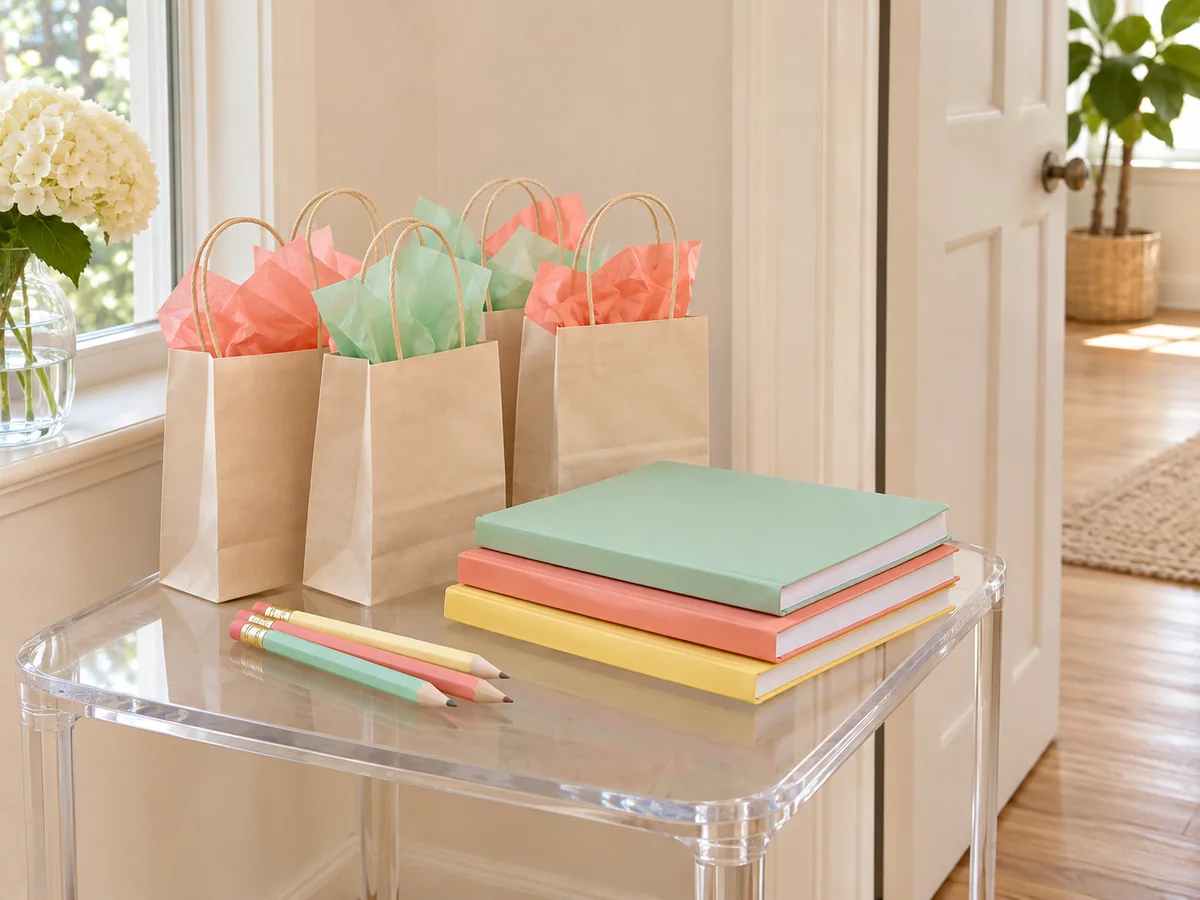
- Decide whether each player will start with a wrapped gift or the circle will pass one shared prize.
- Count the players and prepare one gift for each of them, plus one wrapped spare for a guest who needs it. For a shared prize bag, count one item per guest.
- Set the seats in a complete circle and choose a reader who can see every player.
- Print the story, or keep it open where the reader can see the LEFT and RIGHT cues clearly.
- Explain who keeps the gifts. Show one left pass and one right pass, and wait until each pass is finished.
- Have a backup game ready in case the group wants to play something else.
Can we play without buying gifts?
Quick answer: Yes. Pass a stuffed animal or a pencil case, and have the final holder start the next activity. Nobody keeps the borrowed object.
If you still want everyone to get something, use one shared prize bag with one item for each guest. The final holder hands the items out. Tell the group before you start if the holder also gets an extra item.
If families bring one gift each, each family can play as one unit. If every adult and child wants a separate gift, count each of them as a player. Include any spending limit in the invitation. A limit tells guests what to aim for, but it does not make every gift the same.
If children are exchanging gifts, a spending limit won't stop them noticing that one gift looks bigger or better. Decide ahead how you'll respond, and keep these game gifts separate from presents for the birthday child, which you might save for after the party. There's more on preventing gift comparisons at a kids party.
The story to read aloud: The Great Cupcake Chase
You can read The Great Cupcake Chase, which is printed in full in the left-right gift passing game guide. In the story, Biscuit the cat steals a cupcake and Mrs. Alvarez chases him through a garden, a barbershop, an alley and a park. Before you begin, tell players: "There will be one final LEFT pass after the story, then you can open your gifts." Pause after each cue until every gift has arrived.
The story has 12 LEFT cues and 12 RIGHT cues. If everyone follows every cue and the circle does not change, each gift ends up back in its starting seat. The extra final LEFT then moves each gift to the next seat. If you do not want guests to start with the gift they brought, collect the gifts in a basket and hand them out before you begin. This mixes the starting places, but it is not a random shuffle.
How long should the story take to read?
Quick answer: Read the story aloud before the party and leave time after each cue for the pass. No tested reading time is available.
The example plan below gives five minutes for the reading. That is an estimate you can change, not a measured time. Groups that pass slowly will need longer.
Can I personalize the story with the couple's names?
Quick answer: Yes. Change the character names and setting details, but keep every LEFT and RIGHT cue where it is.
Before the shower, read the edited version aloud once, including the final cue. Leave out private stories or jokes that only a few guests would understand. If you add or remove cues, the gifts may not end where the original story says they will.
Example: a 10-minute game with eight players
This is an illustrative plan for the classic version with eight players. It assumes everyone is already seated together, for example after food. Eight gifts go into the circle and one wrapped spare stays aside. The blocks add up to ten minutes: two for setup, one for practice, five for reading and two for opening. This plan does not cover a three-round team game.
- If guests are still arriving, play a drop-in game first rather than stopping the exchange again and again.
- If food arrives in the middle, pause between paragraphs and put the gifts aside.
Before you stop, ask each player to keep hold of the gift they have, or to leave it on their own seat, so the circle stays as it was. Note the paragraph you reached, then say what happens next: "We're pausing the game. Leave your gift on your seat and come to the food table." After eating, everyone returns to the same seat and you carry on from the next paragraph. These party transitions between activities have more lines for the move to food.
| Illustrative time | What happens |
|---|---|
| 0:00 to 2:00 | Seat eight players, hand out eight gifts, explain who keeps them and point out each player's left and right. |
| 2:00 to 3:00 | Practice by calling LEFT once and RIGHT once, waiting for everyone each time. |
| 3:00 to 8:00 | Read the story and the final LEFT cue, pausing after each direction. |
| 8:00 to 10:00 | Open the gifts or share out the prize, and finish this round before starting anything else. |
How to keep one gift per person
When everyone passes at the same time and the circle is complete, each person should always be holding one gift. If someone has two and the person next to them has none, a pass was missed.
A late guest can join between paragraphs. Give them a seat and either their own gift or the spare, and explain the cues before you carry on. If there is no gift for them, they can share a seat and gift with a willing player, or help the reader until the next round. Do not add someone without a gift to a game where everyone holds one.
Keep any unused spares out of the exchange. Decide separately whether to save them or give them away.
What happens if gifts end up uneven?
Quick answer: Pause before the next cue. Ask anyone holding two gifts to finish the missed pass so everyone has one again.
Keep the wrapped spare for an extra player instead of adding it to the circle during normal play. Adding it would leave one person with two gifts again.
Choosing a version for your guests' ages and space
The guide suggests ages for each version. Treat them as starting points, and use a practice pass to see what your group can manage. Some examples: the Younger-Kids Slow Pass, suggested for ages 3 and up, uses a small circle of six to eight children, one group prize bag and only the first two paragraphs of the story plus the final cue. The reader pauses at every cue, and an adult helps with the passes. The Classroom Desk Pass, suggested for ages 5 and up, uses a route through the desks instead of physical left and right. Before reading, walk the class through one continuous loop: the end of each row connects to the start of the next row, and the last seat connects back to the first. Show each desk which neighbor is next along the route (that is RIGHT) and which is the previous one (that is LEFT). If the route is confusing, have the class sit in a circle on the floor instead. Pass one object, such as a pencil case or plush, one desk along the route on each cue. After the final cue, the child holding it may choose a sticker, and the object itself stays at school. For a repeat round, start the object with a different child. Make sure the reader stands where every row can hear. The Stand-Up Action Pass, also suggested for ages 5 and up, has players take one small step in the called direction as they pass. If stepping makes the passes harder to follow, switch back to sitting.
For a second round, agree to keep the gifts wrapped before anyone opens them. Collect them, hand them out again and restart the story. Anyone who wants to keep their gift can sit out.
What ages can play?
Quick answer: Treat the age notes as suggestions, not firm limits. Players need to follow a direction and pass an object to a neighbor. They do not need to be able to read.
Because an adult reads the story aloud, players only need to listen for left and right. If you want more activities that work for children who aren't reading yet, party games with no reading required include options like a cooperative copy-the-leader relay.
Younger children can try the slow version with help. If the group still finds it hard, choose another game that suits their ages, and remember that age alone does not decide whether a child can join in.
Children of different ages can often stay in the same game if the help varies: one child passes with an adult beside them, another passes alone, or two children pass together. Check each game's own age guidance too. Our guide to children of different ages playing together has more ways to vary roles.
Playing at a bridal shower
The game works at a shower if the game prizes are separate from the presents for the guest of honor.
Can I use this left-right game at a bridal shower?
Quick answer: Yes. Use a seated circle and separate game prizes. The cupcake story works without any changes.
Explain whether each guest starts with a gift or the group passes one shared prize.
Should guests pass the bride's shower gifts around the circle?
Quick answer: No. Use separate game prizes so presents for the guest of honor are not mixed into the exchange.
Label the basket of game prizes and explain who keeps them. If you ask guests to bring a game gift, send that request separately from the registry details.
Checklist before you start reading
- You have told the group who keeps the gifts, how the shared prize will be shared, or that the borrowed object will be returned.
- If everyone starts with a gift, there is one gift per player in the circle and one spare set aside. If you are passing one shared prize bag, it holds one item per guest. If you are passing a borrowed stuffed animal or pencil case, one object is in play.
- The reader can see the cues and every player.
- You have announced the final cue.
- You have practiced one left pass and one right pass.
The Great Cupcake Chase
Read the story below aloud. Pause after each bold direction until the gifts have arrived. Tell players beforehand: “There will be one final LEFT pass after the story, then you can open your gifts.”
Mrs. Alvarez pulled her double-frosting cupcakes out of the oven to cool. Her cat, Biscuit, waited for the door to close, then leapt up, grabbed the tallest cupcake, and bolted into the yard. Mrs. Alvarez ran LEFT past the tomato plants, but Biscuit was already under the hedge.
He streaked out and turned RIGHT along the garden wall. Mrs. Alvarez went RIGHT after him while the sprinkler soaked her slippers.
At the end of the wall, Biscuit cut LEFT through a gap in the fence. Mrs. Alvarez squeezed LEFT through the same gap and landed in the neighbor’s petunias.
Mr. Reyes looked up from his watering can. “That furry thief ran RIGHT past my mailbox,” he said. Mrs. Alvarez hurried RIGHT, following the frosting dots.
Halfway down the block, Biscuit darted LEFT into the barbershop and hopped onto the spinning chair. Mrs. Alvarez slipped in LEFT behind him, and half the kids on the street followed to watch.
The barber reached for the cat. Biscuit sprang RIGHT over a stack of towels and out the back door. Everyone turned RIGHT and poured into the alley.
Biscuit wove LEFT around a recycling bin, ducked RIGHT between two parked bikes, cut LEFT down the narrow end, then burst RIGHT out onto the street while the kids shouted directions.
He burst onto the park lawn, ran LEFT around the big oak, and looped RIGHT around the sandbox while three toddlers cheered.
At the fountain, Biscuit slowed. He looked LEFT at the gate, then RIGHT at the crowd, and sat down. Mrs. Alvarez stepped LEFT to block the gate, and the kids fanned out RIGHT in a wiggly line.
Biscuit let her come close. Mrs. Alvarez scratched his ears and carried him home while the street clapped. In the kitchen she set the cupcake on a saucer, carried the spares LEFT to the freezer, and taped a Cat Approved note to the counter. Biscuit nudged the saucer LEFT across the floor toward the kids at the door, so Mrs. Alvarez sliced it RIGHT down the middle and shared it out.
Final cue to read aloud: “One last pass to the LEFT. Stop passing. The gift you have now is yours!”
The story itself has 12 LEFT cues and 12 RIGHT cues, so it returns gifts to their starting seats when everyone follows every cue in an unchanged circle. The extra final LEFT moves each gift to the neighboring seat. Distribute gifts from a basket at the start if you do not want guests beginning with the gifts they brought; this is not a random shuffle.
10 ways to play
These are suggested versions. Pick one before reading and explain any change to the usual rules. The age notes are starting points; use a practice pass to see what your group can follow.
Classic Left-Right Circle Pass
Suggested ages: 5+ · Supplies: one wrapped gift per player and the story. Use the passing rules above, with everyone seated. Demonstrate one left pass and one right pass. End after the final cue, with one gift each and no score.
Younger-Kids Slow Pass
Suggested ages: 3+ · Supplies: one group prize and a shortened story. Try a small circle of six to eight children. Read only the opening two paragraphs, then the final cue. Pause at every cue, let children point or repeat the direction, and help with the pass. Use a bag with one item each so the final holder can hand something to everyone. Nobody is eliminated or scored.
Classroom Desk Pass
Suggested ages: 5+ · Supplies: a pencil case or plush, story and optional stickers. Before reading, show a single continuous route through the rows: each row end connects to the next row, and the final seat connects back to the first. Identify each desk’s next neighbor for RIGHT and previous neighbor for LEFT; this route replaces physical left and right. If that is confusing, use a floor circle instead. Pass one object along the route on each cue. At the final cue, the holder may choose a sticker; the classroom object stays at school. Start with a different holder for a repeat round. Keep the reader where every row can hear.
Birthday Prize Pass
Suggested ages: 4+ · Supplies: one prize bag with an item for each guest. Pass the bag around a seated circle. After the final cue, the holder opens it and hands one item to every player. If you include an extra item for the holder, announce that before starting. There are no points; sharing the contents finishes the round.
Everyone-Brings-One Exchange
Suggested ages: 5+ · Supplies: one wrapped gift per participating family or individual. State who is bringing a gift and who counts as a player on the invitation. Collect gifts in a basket, distribute one to each playing unit and use the classic rules. Adults can join. End after the final cue; each unit keeps one gift. A family playing together does not get a separate gift for every member.
Across-the-Circle Twist
Suggested ages: 7+ · Supplies: one gift per player and an even circle of twelve or more. Pair each seat with the seat opposite it before starting. Between the fifth and sixth story paragraphs, say “ACROSS”: each pair exchanges gifts once, then waits. Use only this one extra across cue. Practice handing the gifts between partners first; return to ordinary left/right cues afterward. End after the final LEFT, with one gift each. Skip this twist if guests cannot agree on clear opposite pairs.
Two-Circle Team Race
Suggested ages: 6+ · Supplies: gifts, story and a score sheet. Make two equal circles with one gift per player and one observer per circle. Both hear the same reader and pass on the same cues. Play three rounds of the full story plus final cue. A circle earns one point for a round with no dropped gift or wrong-way pass; both circles can score. Pause to fix errors, then continue; an error only removes that circle’s point for that round.
After each round, redistribute gifts within each circle and start again. After three rounds, the higher total wins. Equal totals are a shared win, including 0–0 if neither circle completes a clean round. Do not add extra rounds to break a tie. Everyone keeps the gift held after round three regardless of the score. For other formats, browse team party games.
Stand-Up Action Pass
Suggested ages: 5+ · Supplies: gifts and the story. Players stand in a circle and take one small step in the called direction while passing to the same neighbor. Keep the circle together; this is not a race. If someone passes the wrong way, pause and correct it. They may do a silly stretch before rejoining, but nobody sits out. End after the final cue and keep the gifts as usual. Use the seated version if stepping makes the passes harder to follow.
Music Pause Pass
Suggested ages: 4+ · Supplies: a speaker, one shared object and the story. Keep the music low enough to hear the reader. Pause it once after paragraph three and once after paragraph seven, after the current pass is complete. The object holder has five seconds to name an animal. If they cannot, the reader gives an example and continues; there is no penalty or score. No more than two music pauses are used. Finish after the final LEFT. Return a borrowed object, or use a prize bag and share one item per guest.
Mystery Swap Finish
Suggested ages: 6+ · Supplies: one wrapped gift per player. Start by collecting gifts in a basket and handing them out. Make three separate one-seat LEFT passes before reading, waiting after each one. This changes the starting positions but does not make the gifts’ origins secret. Read the full story and final cue. Then go clockwise once from the reader’s chosen starting seat: each person may offer a trade to one neighbor, who may accept or decline. Each gift can be traded only once during this lap. Stop after every player has had one offer opportunity, even if nobody accepts, and open the gifts. No score is kept.
For other games to try with a larger crowd, see large group party games. For alternatives when children need different levels of help, browse party games by age without treating age alone as a test of whether they can join in.