How do I plan food and activities for a graduation party?
Quick answer: Start by deciding how guests will arrive. At an open house, people come and go at different times. At a party with a set start, such as a shared meal or a planned activity, most guests arrive together. Choose a menu that matches your invitation, either a meal or snacks, and make sure guests can serve themselves. Then add short activities that people can join and leave whenever they like, such as a trivia board about the graduate, a guest book and yard games with quick turns. Ask helpers to watch the food and the games. If the graduate wants a toast, give it a set time and put that time on the invitation. Decide on your indoor or rain plan before you invite anyone.
Start with the graduate and how guests will arrive
First decide what kind of party you are hosting. Some families invite everyone at the same time for a meal or an activity. Others host an open house, where some guests stop in between other celebrations, some stay for a meal and some spend the whole afternoon catching up. If everyone arrives at the same time, you can plan the food and activities around that start. If you are hosting an open house, plan so that someone arriving at any point can find food, something to do and the graduate without waiting for a scheduled moment. The rest of this guide focuses on the open house, but the menu, game and toast ideas work for both.
At an open house, the food has to work for the last guest as well as the first. Set aside meal portions for later arrivals and bring out fresh dishes as people come through, rather than counting on one table to last the whole window. A food plan for guests arriving at different times shows how to divide and time those servings.
Start by asking the graduate what they would enjoy. Do they want yard games, questions about their school years or mostly time to talk with friends? Choose a few things they actually want to do. Some hosts invite guests for a two- to four-hour window, but base the length on your own plans rather than treating that range as a rule.
Tell guests on the invitation whether you are serving a meal or snacks. Put food, drinks and seating where new arrivals can find them easily, and keep the entrance clear for greetings. Leave enough room around the guest book for someone to stop and write without blocking people carrying plates.
Ask one helper to keep an eye on the food and serving supplies while you greet people. Ask another to show younger guests how to play the games. A station with a sign still needs someone to answer questions and notice when supplies run low. If you are celebrating outdoors in warm weather, the summer games and food guide has ideas for shaded activity and drink areas.
What can guests do if they only stay 20 minutes?
Quick answer: They can greet the graduate, get something to eat, answer a trivia question or write a message. Put these choices where guests can find them without joining a long game or waiting for an announcement.
Picture a family friend who has two other parties that afternoon. In 20 minutes they can say congratulations, pick up a plate, drop a trivia card in the box and write a line in the guest book. None of that depends on a game starting or a speech happening while they are there.
For this to work, put the food, the trivia board and the guest book close to the main route through the party, but not right in the doorway. If you plan to reveal the trivia answers later, say when, so short-stay guests know they don't need to wait around.
Choose food that guests can help themselves to
First decide whether your invitation time overlaps a meal. Don't assume guests will already have eaten lunch. If the party runs through a usual mealtime, plan a meal and say so on the invitation. If you are serving snacks, say that instead, so guests can plan accordingly.
Preparing food ahead can free you up to talk with guests, but it doesn't mean every dish can stay on the table for the whole party. Perishable food needs a plan for how long it stays out and what replaces it. Check the storage and serving instructions for each food you choose.
Use each dish's instructions to decide which jobs can happen the day before and which wait until party day, such as sandwiches or vegetable boards. Earlier preparation still doesn't extend how long food can sit out. See what party food you can prepare ahead.
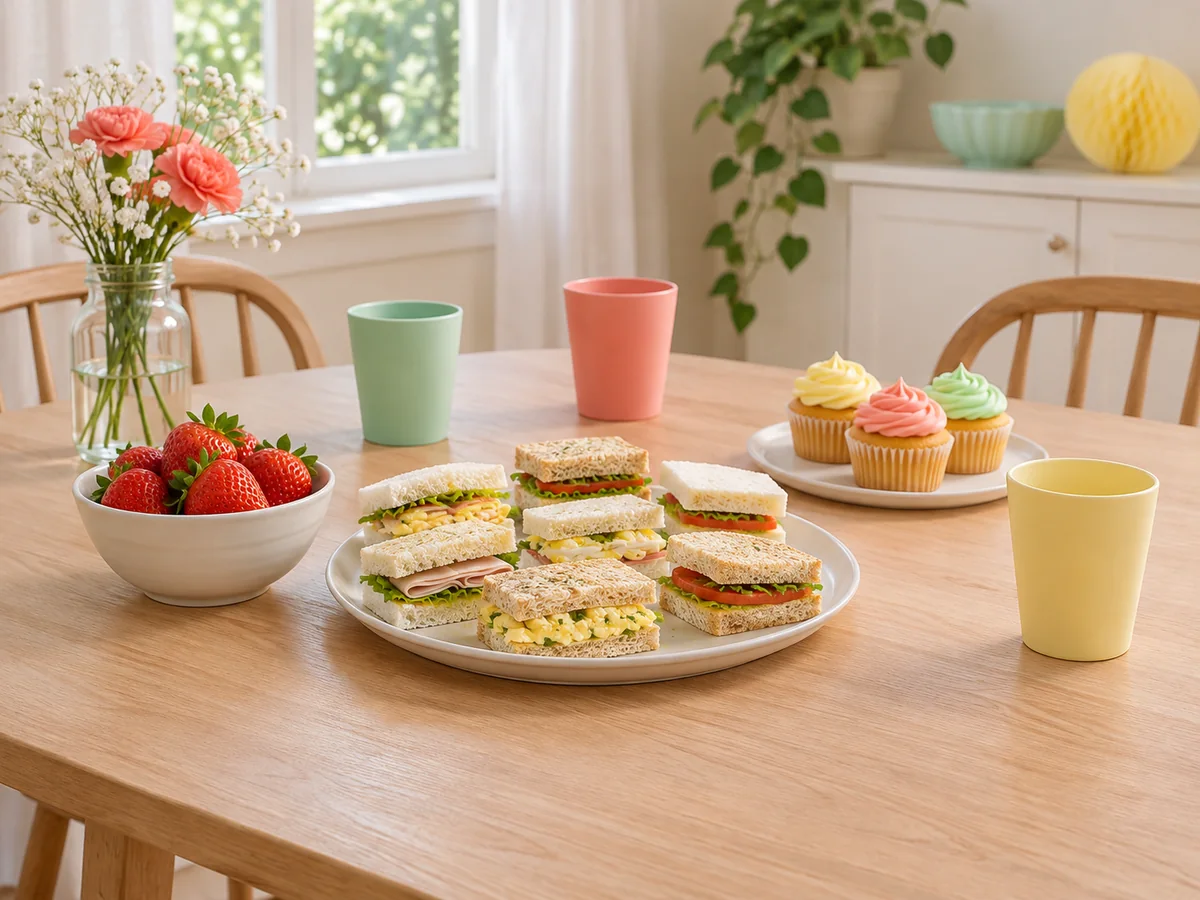
What menu works for a drop-in graduation party?
Quick answer: A self-serve taco bar, a make-ahead main such as sandwiches with sides and fruit, and individual desserts all suit guests who arrive at different times. Pick one main option and keep the menu small enough for one helper to manage.
Taco bar with sides: offer tortillas, fillings such as chicken or beans, and toppings such as lettuce, salsa and cheese. Add a side you want to serve, such as rice, and list the equipment and serving utensil each dish needs. Put plates at the start of the line so guests don't have to reach back for them. The taco bar ideas guide covers fillings and serving order.
Make-ahead main: if you would rather not set up tacos, you could serve sandwiches with a side dish and fruit. Choose a main you can make or order ahead, then note what still needs assembling on the day. The make-ahead party food guide helps you organize trays, ingredient labels and serving tools. Write down where the backup food will be kept and who will bring it out, and leave that helper room to work in the kitchen.
Desserts: cookies, cupcakes or a cake decorated with graduation caps make the occasion clear. If you choose a cake, ask someone to cut and serve it. With cookies and cupcakes, guests can take one without waiting for that job. Tiered stands, labels and napkins or label cards in school colors are optional extras. The dessert table setup guide covers where to place things, and themed snack tables has ideas for adding height and a backdrop.
If you choose a cake, check how many servings it gives and who will cut it. Advice for birthday cakes applies here too: rinse and dry the knife between cuts on a frosted cake, and follow any cutting instructions that come with it. See how to choose and serve a cake.
How long can the food stay out during a long open house?
Quick answer: Not for the whole party. The FDA says perishable food left at room temperature for more than two hours should be thrown away, or after one hour if the temperature is above 90 F. Put out smaller dishes and replace them with fresh ones.
The FDA's buffet guidance says to keep cold buffet food at or below 40 F and hot food at 140 F or above while it is being held. It also says to replace a dish with a fresh one rather than adding new food to a dish that is already out. Follow any instructions on the food or package as well.
For a four-hour open house, that means you should time each dish that holds perishable food, such as cooked fillings, cheese, salsa or sandwiches. Keep the backup portions in the fridge or kept hot until they go out. Time spent outside proper temperature control counts toward the limit, so a dish that sat out, went back to the fridge and came out again should not be timed as if it were new. Shelf-stable items, such as packaged tortillas or wrapped cookies, don't need the same timing, but read their labels.
Count your guests and work out how much food to buy
Count everyone you expect to feed: the graduate, people who live with you, siblings, adults who stay and any helpers who will eat. Count each person once, even if they fit more than one group. Allow for everyone you expect to feed even though they won't all arrive at the same time.
A meal and an afternoon snack table call for different shopping decisions. For a meal, decide what one person's plate will include. For snacks, guests may only take a few items, but you still need enough for everyone who comes through over the whole window. Ask about food requirements before you finalize ingredients. Write down an amount for each dish rather than relying on a single number of plates. Then decide who will check the trays throughout the party, rather than assuming one refill halfway through will be enough.
How much food should I buy for a graduation open house?
Quick answer: Count everyone you expect to feed, including adults and siblings, and decide whether you are serving a meal or snacks. Then choose an amount per person for each dish, multiply it by your headcount and write down the totals before you shop.
Illustrative calculation: say you are expecting 40 people, counting the graduate, the household, siblings and staying adults once each. If you choose to plan for 2 tacos per person, that is 40 × 2 = 80 tortillas. If you decide on one cupcake each, that is 40 cupcakes. These per-person numbers are only examples to show the method, not a recommendation, so replace them with the amounts that suit your guests and menu.
For per-person portions and a worked example for meals and snacks, see the party food quantity guide. It also covers adults who stay for the meal.
Plan activities that guests can join and leave anytime
Choose games that can start with whoever is there and end when people need to go. Short rounds work well. A tournament that keeps the same teams all afternoon is hard to run when guests arrive at different times.
At an open house, guests coming at different times aren't late; they're arriving as invited. Games that run in short rounds with the same turn limits for everyone let them join the next round. See party games guests can join after arriving.
Cornhole or ladder toss: use a set you own or can borrow. Put a short instruction card beside it: take turns throwing the bags or pieces that come with the set, count the points using the set's rules, then let the next pair play. Guests can play one round or agree to play again. Keep food and seating out of the throwing area.
Bucket toss: for a simpler target game, set out a bucket and beanbags and let each person take three throws before passing them on. Guests count their own successful throws, so nobody has to keep an all-afternoon scoreboard. For more target games, see yard games using what you own. Outdoor party games covers space and taking turns, and outdoor games that work in wind can help on a breezy day.
Trivia board about the graduate: ask the graduate to approve five questions and an answer key. For example: What was their favorite school subject? Which club did they join? What song would they choose for the celebration? Use facts the graduate is happy to share, not guesses about their private plans. Number the questions on a poster and put answer cards, pencils and a collection box beside it. A guest writes their name and answers, drops the card in the box and carries on visiting. You can tally scores near the end and display the answers, or skip the scores and just reveal the answers for fun. Tell guests when the answers will go up. Trivia party games has other formats if the graduate prefers a short group round.
What can younger guests do?
Quick answer: Set out paper and markers so they can draw a congratulations card, or offer a bucket toss with a closer throwing line. Have an adult nearby to explain the activity.
A separate kids' corner doesn't supervise children on its own, so someone still needs to be there. Guests also don't have to be split into fixed age groups. An older child could read a trivia card while a younger child chooses the answer. The mixed-age games guide suggests different jobs within the same game, and easy party games has alternatives with short instructions. Keep a seated option available for anyone who prefers it.
If young children will be eating, the CDC lists foods such as whole beans, cookies, popcorn, pretzels, nuts and seeds, uncut grapes and berries, hard pieces of raw fruit or vegetables, and some hard, gummy or chewy candies as potential choking hazards for young children. Some of these may be on this menu, such as beans in the taco filling, cookies on the dessert table, berries or grapes in a fruit tray and raw vegetables among the sides. The CDC also advises preparing food to suit each child's development, including its shape, size and texture, and watching children while they eat. No single cut or age makes these foods safe for every child, so talk with parents about what their child can eat, whether it needs preparing differently, and whether to offer something else.
Set up a photo and message table, and decide whether to have a toast
Gather the photos the graduate wants displayed, a few awards or school keepsakes, and a guest book. Label photos with the year or occasion if you know it. Put out pens and a simple prompt such as "What's a school memory you'd like to share?" or "Leave a message for the graduate." If you don't want a bound book, blank cards and a box work too.
Guests can look through the photos, write a note or talk about a picture whenever they arrive. For optional conversation cards, try "Would you rather revisit your first day of school or your last?" The would-you-rather questions page has more, and you can use an easy prompt from never-have-I-ever questions. Let guests pass, and keep private stories optional.
Can we include a speech or toast?
Quick answer: Yes. If the graduate wants one, give it a time and include that time in the invitation so guests who want to hear it can attend. Keep the photos and guest book available for people who come earlier or later.
The photo table can go alongside a toast rather than replace it. Choose a time when the food and games don't need you, such as the 3:00 p.m. slot in the example schedule below, and ask a helper to keep an eye on the food while you speak.
An example four-hour open-house schedule
This illustrative example uses the taco bar menu for an open house with 40 guests, from 1:00 to 5:00 p.m. It is four hours in total. If everyone is arriving at the same time for a meal or activity, adjust the times to fit. The host greets guests. Helper A handles food and Helper B handles games. Guests can eat, play and visit at any time. Perishable dishes go out in smaller batches and are replaced with fresh dishes rather than topped up. The FDA's limit is two hours in total at room temperature, or one hour above 90 F, and the clock does not restart when a dish goes on the table. Before the party, write down how long each perishable dish has already spent out of the fridge or out of hot holding, for example while it was prepared, packed, driven over or set up. Take that time away from the limit to find how long the dish can stay out. For example, if salsa was out of the fridge for 30 minutes before it went out at 1:00 p.m., it has 90 minutes left, so Helper A removes it by 2:30 p.m. (or by 1:30 p.m. above 90 F). If a dish has already used up its limit before serving, throw it away instead of putting it out. Backup food stays in the fridge, or is kept hot, until it is needed.
- Check the totals: 60 + 60 + 60 + 30 + 30 = 240 minutes, which is four hours.
- Cleanup starts after 5:00 p.m. Throw away perishable food once its total time out, including time before serving, was more than two hours (or one hour above 90 F). Backup food that stayed chilled or hot can be stored according to its own instructions.
Before storing anything, sort what's left by how long it was actually out. Discard what passed the limit, and store chilled or hot backup food by its own instructions. Note what ran out for next time. See what to do with leftover party food.
| Time | Host | Helper A (food) | Helper B (games) |
|---|---|---|---|
| Before 1:00 p.m. | Set out the guest book, photos and trivia board | Set up plates, serving tools and labels. Keep perishable food chilled or hot until the start. Write down any time each dish has already spent out of the fridge or out of hot holding | Set up the toss games and instruction cards |
| 1:00–2:00 p.m. (60 min) | Welcome arrivals | Put out the first dishes of fillings and toppings, note the time, and write each dish's removal time: the time it went out plus whatever is left of its limit | Show guests where the games and trivia are |
| 2:00–3:00 p.m. (60 min) | Visit with guests | Replace each perishable dish with a fresh one by its written removal time (sooner in heat) and refill plates and utensils | Restock trivia cards and reset game pieces |
| 3:00–4:00 p.m. (60 min) | Optional brief toast at the time given on the invitation, then visit | Keep watch on the food during the toast and keep swapping dishes on time | Keep the games available for new arrivals |
| 4:00–4:30 p.m. (30 min) | Welcome the last arrivals | Put out a final fresh batch only if it is needed | Tally the trivia cards, if you are scoring, and display the answers |
| 4:30–5:00 p.m. (30 min) | Say goodbye and give late guests time to write a message | Remove perishable dishes once they reach their limit | Collect answer cards and loose notes |
Plan for rain or a move indoors
Make the indoor decision part of your planning, not a last-minute scramble. Most of the drop-in activities move indoors easily, but the yard games and the space needed for everyone may not.
What if it rains?
Quick answer: Decide which indoor space can fit the guests and the food before you invite everyone. Trivia cards, guest messages and conversation questions can move to a table indoors. If everyone cannot fit, agree on a different location or a change of plans and tell guests how you will contact them.
Walk through the indoor space with your guest count in mind. Where would the food go? Where would the guest book and trivia board go? Is there room for people to move between them? Throwing games may not suit an indoor room, so plan to leave them out rather than squeezing them into a small space.
Graduation party preparation checklist
Use the party supply checklist for a fuller supply list and helper notes. On a printed copy, write where the food and supplies are, so a helper can find them. For this open house:
- Agree on the invitation times and say whether you are serving a meal or snacks.
- Include the toast time on the invitation if the graduate wants one.
- Confirm your headcount, counting each person once, and ask about food requirements before shopping.
- Choose the menu and write down amounts, serving equipment and where backup food will be kept cold or hot.
- Plan when each perishable dish goes out and when it is replaced.
- Assign one person to handle food and another to help with games.
- Try each game and write instructions guests can follow when they arrive.
- Ask the graduate to approve the trivia questions, photos and message prompts.
- Put out ingredient labels, separate serving tools, pens and blank answer cards.
- Check the seating and leave room to move between the food, the games and the guest book.
- Confirm that your indoor space fits everyone, or decide on another plan and how you will tell guests.
- Set aside cleanup supplies and list any borrowed equipment to return.
| Food or activity | Amount or supplies | Storage or setup location | Helper |
|---|---|---|---|
| __________________ | __________________ | __________________ | __________________ |
| __________________ | __________________ | __________________ | __________________ |
| __________________ | __________________ | __________________ | __________________ |
| __________________ | __________________ | __________________ | __________________ |
Graduate: ____________________ Date: ____________________
Invitation start: ____________________ Finish: ____________________
Expected guests: ____________________ Meal or snacks: ____________________
Indoor alternative or change of plans: ________________________________________