How do I plan a sleepover that works for the guests and host?
Quick answer: Make a few decisions first: whether everyone is staying overnight, how many guests can sleep comfortably in your space, and the arrival and pickup times. Then choose one main activity with your child, plan dinner, snacks and breakfast around those times, and keep the extras simple. Write the arrangements on one host copy that another adult can follow, and send families a shorter message with the details they need.
Decide the guest count, sleeping space and times first
Most other choices depend on a few early decisions. Start with whether guests are staying overnight or coming for the evening only. Next, check how many people can sleep comfortably in the room, where they can sit and how many places you have at the table. Do this before you confirm the guest list. Then set the arrival time and the pickup time or window, and agree them with families before you send invitations.
Once you know the guest count and space, choose one main activity with your child from the things you can actually organize. This step comes before shopping, because the guest count, the activity and the meals decide how much food and how many supplies you need. Decide early whether dinner is included, since that affects the arrival time and the snacks you buy.
Ask what your child and their friends would enjoy, and adjust for their age. For a tween sleepover, first check how many guests can sleep comfortably in the room. For a teen sleepover, ask your teen what they want to do with their friends before you sort out the count, space and timing. For a larger group, check the sleeping space and seating before you confirm anyone, then pick an activity everyone can join.
Who should I include in the guest count?
Quick answer: Keep separate counts for the evening, overnight and breakfast, and decide whether each one includes your own child, any siblings and the adults who are staying.
A single number can hide important differences. The evening count covers everyone at dinner and activities. The overnight count is everyone who needs a sleeping space. The breakfast count is everyone eating in the morning. Note whether the birthday or hosting child, any siblings joining in and the adults eating with the group are included, and add each person only once.
A guest who goes home in the evening belongs in the dinner and activity counts. Leave them out of the sleeping and breakfast counts unless you have agreed otherwise.
Plan for guests who go home before bedtime
A sleepover does not have to mean every guest stays the night. A friend can join the fun and go home before bedtime if that works for you and their family. You can also make the whole party an evening-only lateover, or a pajama party such as a pancake breakfast, an afternoon craft or dinner and games in pajamas. If you choose that, put the finish time on the invitation and say clearly whether anyone is sleeping over.
Some guests decide during the party that they want to go home. Before the party, agree with each family how you will contact them and arrange pickup if that happens. Keep the contact details handy, and let a child tell you privately that they want to leave rather than in front of the group.
A child asking to go home during the party is different from a departure agreed beforehand. Listen privately, contact the parent using the method you agreed and keep the child company while they wait to be collected. Our guide on when a young guest wants to go home covers the steps.
Can a guest join the sleepover fun and go home before bedtime?
Quick answer: Yes. Agree the departure time with the family before the party, and schedule dinner, the main activity and any birthday dessert before they are collected.
Finish the shared activity before they leave, so they get the main part of the evening and don't miss it halfway through. Keep their bag easy to reach and make the goodbye ordinary. Do not ask them to explain to the group why they are leaving.
If someone doesn't want to stay overnight, they can join the food and games and leave at the arranged time. If your child doesn't want an overnight at all, other kinds of birthday party may suit them better.
Where should I record a guest who is staying late but not overnight?
Quick answer: Write their evening pickup time and the name of the adult collecting them next to their name on your host copy.
Put their bag somewhere easy to reach without disturbing the bedding. Include them in the dinner and activity counts, but leave them out of the sleeping and breakfast counts unless you have agreed otherwise. If they are taking home a favor, give it to them when they leave, not at morning pickup.
Set up one room for games, food and sleeping
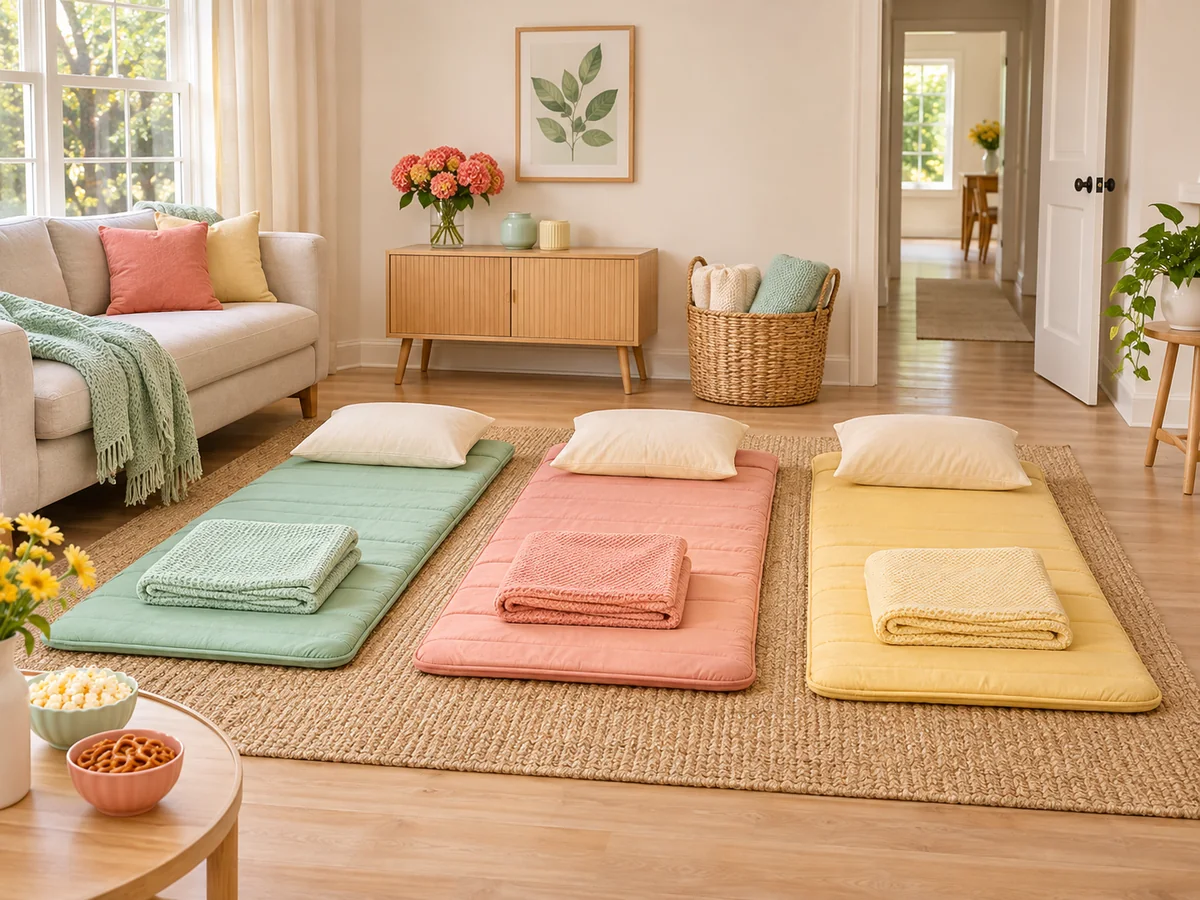
Before you decorate, decide where each guest will sleep, where bags will go and where food and activities will fit. Use the space that remains for decorations, such as one wall, a table or a corner, without taking the space needed for bedding.
If the planned game no longer fits, put loose props in a box, move tabletop decorations to a shelf and switch to a seated activity with paper and markers.
How should I set up a room for both games and sleeping?
Quick answer: Decide where each sleeping space will go before guests arrive, keep bedding at one side during games, and put bags in a separate row.
Keep the bags in their row so they don't fill the walking route. After the last active game, clear the supplies away together before rolling out the bedding.
How can the theme work when bedding takes up most of the room?
Quick answer: Keep the welcome sign and photo setup on one wall, and use a table for the activity before the bedding comes out.
Pack the activity supplies away before bedtime. Keep decorations off the route to the bathroom and away from the bag area.
Choose one main activity and an easy backup
You don't need several activities running at once. One shared activity can be enough, with paper and markers out for anyone who wants a break. Use separate stations only if you have the space and enough adults to run them. With two friends, a movie, paper bookmarks, a card game or taking turns adding to a story can work well. Pick something both guests and your child enjoy. A small group doesn't need teams.
For a screen-free evening, try paper towers, a clue hunt, drawing games, a blanket fort or a board game you already own. Explain one game at a time. If a teen doesn't want organized games, a movie, dinner together, a shared drawing or a familiar card game can be enough. Let your teen help choose the activity, music and food, and leave time for conversation. Guests can just watch karaoke, skip photos or pass on a question.
Keep activities optional. If some guests don't want a spa night, offer a craft or drawing activity alongside it, or drop the spa idea. Face masks and nail polish should always be optional. For guests of different ages, offer a simpler and a more involved version of the same activity. For example, some can decorate a sign with stickers while others add drawings and written details. Keep a quieter alternative available without making anyone explain why they want it.
What if a guest does not want to make the craft?
Quick answer: Offer a ready-made version or a different small item, such as a notebook.
Keep the craft optional, so getting a take-home favor doesn't depend on finishing a project.
What is an easy backup if the decoration activity ends early?
Quick answer: Keep paper and markers out for drawing, or offer a short seated game. Guests can leave their decorations as they are rather than making more.
Other easy options are repeating a game guests enjoyed, a short question round, adding to a group story, a shared poster, decorating take-home boxes, using photo props you already have, a snack break or changing the playlist. If guests are happy drawing or talking, an early finish doesn't always need another organized activity. You can also move on to the next part of the evening. Let guests watch, pass or stop when they have had enough. If you planned something outdoors, choose an indoor alternative the whole group has room to do.
Plan food and supplies without buying too much
Plan dinner, if included, then an evening snack and one main breakfast. Dinner might be pizza, tacos, sliders or pasta, with fruit or vegetables alongside. Waffles or bagels can work for breakfast. Confirm food requirements with families before shopping, and keep some extra main food for seconds. Keep evening snacks separate from the breakfast supplies so the morning food is still there.
If you give food playful themed names, write the actual food underneath, such as Popcorn under Moon rocks. Use separate labels when toppings differ, and keep the packaging information where the host can check it. Guests shouldn't have to guess what they are eating.
To avoid overbuying, choose the main activity before shopping, count everyone taking part, and check what you already own or can borrow. Activities that use paper, markers, games or equipment you already have keep costs down. For decorations, choose one thing you want guests to notice, such as a backdrop, a welcome sign or a paper-star wall. Repeat its colors on name cards or a snack-table sign rather than matching every plate, cup and blanket.
Tell families what guests should bring, such as pajamas, a change of clothes, a toothbrush and any agreed bedding or comfort item. Also say whether you will provide pillows, towels or other supplies. If you can provide extras, keep a clearly marked spare-supplies box and let guests know they can ask privately. Note what you lend so it comes back at packing time. If a child needs a personal item you can't supply, contact their family instead of improvising.
How do I turn the snack notes into a shopping checklist?
Quick answer: Write each snack next to its serving time, then add the package quantity you plan to buy and any bowls, cups or labels it needs.
Also note how many people each snack needs to serve, any family food notes, and whether it is bought or homemade. Add water and cups. Check the list against the confirmed guest arrangements before you shop, and mark what is already in the house so dinner, late snacks and breakfast don't each lead to duplicate purchases.
Keep the work, supervision and house rules manageable
Prepare one main thing well, and keep everything else simple enough that another adult could help with it. A movie with dinner, cupcakes and a card game can be a complete evening. Keep paper, markers or a card game nearby rather than preparing a second elaborate activity.
If two adults are helping, write one name beside each job, such as checking arrivals, serving breakfast or gathering bags. Use one current host copy and tick a job only when it is finished. When another adult takes over, point out unfinished jobs, overnight contacts and the family instructions they need. Don't assume they have read every message.
For supervision, stay at home, nearby and available. Tell guests where to find you overnight and how they can contact home. Give them space to talk while you keep an eye on food, noise and how the group is getting along. Activities such as swimming or a bonfire need their own adult supervision arrangements. Before guests arrive, explain which rooms and outdoor areas they can use, where they will sleep, what you expect about phones and photos, music volume, where food is allowed, quiet time and morning pickup.
Before guests arrive, check the house as a guest would: where they'll sleep, leave bags and find the bathroom, which rooms are open, how they can reach you overnight and any arrangements agreed with individual families. Our sleepover rules and host planning guide includes these checks.
How do I keep the party from becoming too much work?
Quick answer: Prepare one main activity, keep the rest simple, and give a helper a specific job such as serving breakfast.
A specific job is easier to hand over than a vague offer of help, and it stops you from having to run several activities at once. A finished craft or a boxed cupcake can be the take-home item, so you don't need to make separate favor bags.
How can two adults share the checklist without doing the same jobs twice?
Quick answer: Write one adult's name beside each job, work from one current host copy, and tick a job only when it is finished.
Jobs such as checking arrivals, serving breakfast or gathering bags each need one named person, so neither adult assumes the other is doing it. When another adult takes over, point out unfinished jobs, overnight contacts and the family instructions they need, rather than assuming they have read every message.
Example: an overnight with one guest leaving early
This example is illustrative only. Choose times that suit your household and the families involved. In this example, the hosting child is a tween, four friends stay overnight and one friend goes home at 8 p.m. Two adults are at home: Adult A runs the activities and stays with the group, and Adult B handles food and the door.
Counts: dinner and activities are 6 children (the hosting child, four overnight guests and the evening-only guest) plus the 2 adults if they eat dinner, making 8 people. Sleeping spaces are 5 (the hosting child and four guests). Breakfast is 5 children plus the 2 adults if they eat, making 7 people.
The order follows a simple pattern: a drop-in activity as guests arrive, then the main food and the shared activity. After that come bathroom turns, bedding and a quieter activity before the agreed wind-down. Breakfast and packing are part of the morning plan, not an afterthought.
| Illustrative time | What happens | Who |
|---|---|---|
| 5:00 p.m. | Arrival; drawing table with paper and markers | Adult B greets families; Adult A stays with the guests |
| 5:45 p.m. | Dinner: pizza with fruit (6 children, 2 adults) | Adult B serves; Adult A eats with the group |
| 6:30 p.m. | Main activity: decorated bookmarks, which guests also take home | Adult A |
| 7:30 p.m. | Birthday cupcakes, with the evening-only guest | Adult B |
| 8:00 p.m. | Evening-only guest is collected with their bag and bookmark | Adult B at the door; Adult A stays with the group |
| 8:10 p.m. | Movie with popcorn | Adult A; Adult B clears dinner |
| 9:45 p.m. | Bathroom turns, supplies packed away, bedding rolled out | Both adults |
| 10:00 p.m. | Quiet drawing, then the agreed wind-down | Adult A |
| 8:00 a.m. | Breakfast: bagels and fruit (5 children, 2 adults) | Adult B |
| 8:30 a.m. | Packing bags, shoes, bedding and favors | Adult A |
| 9:00 a.m. | Pickup | Adult B greets families; Adult A stays with the remaining guests |
Plan favors and morning pickup
Start each goodie bag with one keepsake. Add a small activity item or a snack only if you want to. There is no required number of items. Food is optional. If you include it, confirm the ingredients with the family first, keep the ingredient information with the item, and decide whether it is a take-home treat or part of breakfast.
Give prepared favors to guests as they leave. Earlier in the evening, put finished crafts in a collection area labeled with each guest's name, then gather them with each guest's belongings before pickup. A guest who leaves early gets theirs when they go. If a project isn't ready at pickup, keep it out of the packed bag, label it with the guest's name and tell the collecting adult where it is. If it can't go home yet, agree with the family how they will collect it later.
Keep a host copy and send families a shorter message
Your host copy should include the timing, guest replies, parent contacts, pickup details and exceptions, and sleeping arrangements. It also needs food times, food and allergy notes, relevant family instructions, supplies, adult jobs and cleanup. Write down where things are kept so a helper can find them without asking across the room. If fuller family instructions are on a separate sheet, note where it is. Write not yet confirmed for unanswered questions, so a blank space isn't mistaken for an agreed arrangement.
Use whichever version you will actually check. A printed copy works well during setup, and a document you keep yourself is easier to update as replies arrive. The Printable Sleepover Checklist has blank notes to print, and the Sleepover Checklist has more room. The checkmarks on those pages are not saved when you leave, so print the blank fields or copy them into your own document.
Update the host copy as RSVPs arrive, after shopping, the day before setup and on the day if anything changes. Check the morning packing and pickup details before families return.
The family message should include the date, address, arrival and pickup times, food arrangements, sleeping setup, what to bring and your overnight contact number. Ask families privately about individual food, medication or other arrangements. Keep budgets, supply locations, helper jobs and private family instructions on the host copy, not in the group message. The Printable Sleepover Checklist includes a family message you can adapt.
How should I use a sleepover checklist?
Quick answer: Fill in the details most likely to change: RSVPs, food, timing, supplies, adult jobs and pickup. Keep the current copy where you and your helpers can find it, and send families the shorter message.
Add names and locations wherever another adult would need them, such as who is serving breakfast and where the supplies are kept. Keep the host notes together in one place during the sleepover.
Should I print the checklist or keep it on my phone or computer?
Quick answer: Use whichever version you will actually check. A printed copy works well during setup, and your own document is easier to update as families reply.
The blank tables on the checklist pages are meant to be printed and filled in by hand, or copied into your own document. Any boxes you tick on those pages are cleared when you leave, so keep your notes on the printed copy or in your own document.
What should I put on the host copy?
Quick answer: Include the timing, guest replies, parent contacts, pickup details and exceptions, sleeping arrangements, food times and notes, family instructions, supplies, adult jobs and cleanup.
Write down where things are kept so someone helping can find them without asking across the room. If the fuller family instructions are on a separate sheet, note where that sheet is.
What should I tell guests' families before the sleepover?
Quick answer: Send the date, address, arrival and pickup times, food arrangements, sleeping setup, what to bring and your overnight contact number.
Ask about individual food, medication or other arrangements privately rather than in the group message. Keep budgets, supply locations, helper jobs and private family instructions on the host copy.
When should I update the checklist?
Quick answer: Update it as RSVPs arrive, after shopping, the day before setup and on the day of the party if anything changes.
Before families come back the next morning, check the packing and pickup details so each guest leaves with their belongings and the right adult.
Final sleepover planning checklist
- Decide whether guests are staying overnight, and agree the arrival and pickup times.
- Check the sleeping space and seating before you confirm the guest list.
- Keep separate counts for the evening, overnight and breakfast, and note who each one includes.
- Record any evening-only guest's pickup time and collecting adult.
- Agree with families how to arrange pickup if a child wants to go home.
- Choose one main activity with your child, plus paper and markers as a backup.
- Plan dinner, if included, the snacks and breakfast, and confirm food requirements with families.
- Check what you already have before you buy or borrow anything.
- Mark where bedding, bags and the walking route go before you decorate.
- Give each adult a named job, and explain the house rules before guests arrive.
- Keep one current host copy, and send families the shorter message.
Sources and further reading
- Printable Sleepover Checklist
- Sleepover Checklist
- Sleepover Ideas, Setup and Overnight Plans
- Sleepover Birthday Party Ideas
- Large Sleepover Ideas for 8 or More Guests
- Pajama Party Ideas
- Girls Sleepover Ideas
- Teen Sleepover Ideas
- Tween Sleepover Ideas
- Sleepover Theme Ideas
- Sleepover Decorations
- Sleepover Party Decorations
- 10 Teen Sleepover Ideas, Plus Food and House Rules
- Sleepover Goodie Bags
- Small Sleepover Ideas
- Boys Sleepover Ideas
- Sleepover Party Favors