How can I simplify a party without leaving out what guests need?
Quick answer: Before you buy or set up anything, ask whether it helps guests take part, eat, find their belongings or take something home. Keep those things: the supplies and instructions for the main activity, food you have promised, seating, a quieter option and clear arrival and pickup details. Skip whatever adds setup or cleanup without doing one of those jobs, such as decorations that crowd the activity table, extra stations nobody can run, a separate favor bag when guests already take home a project, and a formal program the birthday person hasn't asked for.
Decide what to keep by asking what each item does for guests
Making a party simpler doesn't mean making it smaller or less special. It means cutting the jobs that take your time without giving guests anything to do, eat, use or take home. One test works for most items on your list: does this help someone join in, eat, know where to go, find their belongings or leave with what they made? If yes, keep it. If it mainly adds another setup job, another shopping trip or more cleanup, it is optional.
The test works because guests notice different things than hosts do. A child at a craft party needs enough working space and supplies. They are unlikely to miss a second themed display. An adult at a dinner needs a seat, food they can eat and time to talk. A long run of speeches won't help them. If you start with what guests will actually do, you can drop the rest without worrying.
The test applies whatever the age group. At a children's party it usually points to one main activity, food, cake and a quiet option. At an adult or milestone birthday it usually points to a meal, conversation and one personal moment, such as a short toast or cake.
What should I keep even when I cut back?
Quick answer: Keep the supplies and instructions for the main activity, the food you have told guests about, enough seating and serving items, a quieter option, labels or a place for belongings, and clear start, finish and pickup details.
These are the things guests rely on. If the main activity is a craft, children need the materials, enough table space and somewhere for work to dry or be packed. If you have said food is included, serve it, and ask about food needs before you shop. Practical supplies such as serving utensils, trash or cleanup bags, water and packaging for projects belong on the list even when the decorations don't.
Also keep whatever helps guests find their way: a table sign, a few food labels so people know what's being served, and a spot for bags and coats. Keep the quieter alternative too. Some guests need a break from the main activity, and a quiet table gives them somewhere to go without leaving the party.
What you can skip, and when
Most of what you can safely skip falls into a few groups. Whether each one applies depends on your party, so check the condition attached to each before you cross it off.
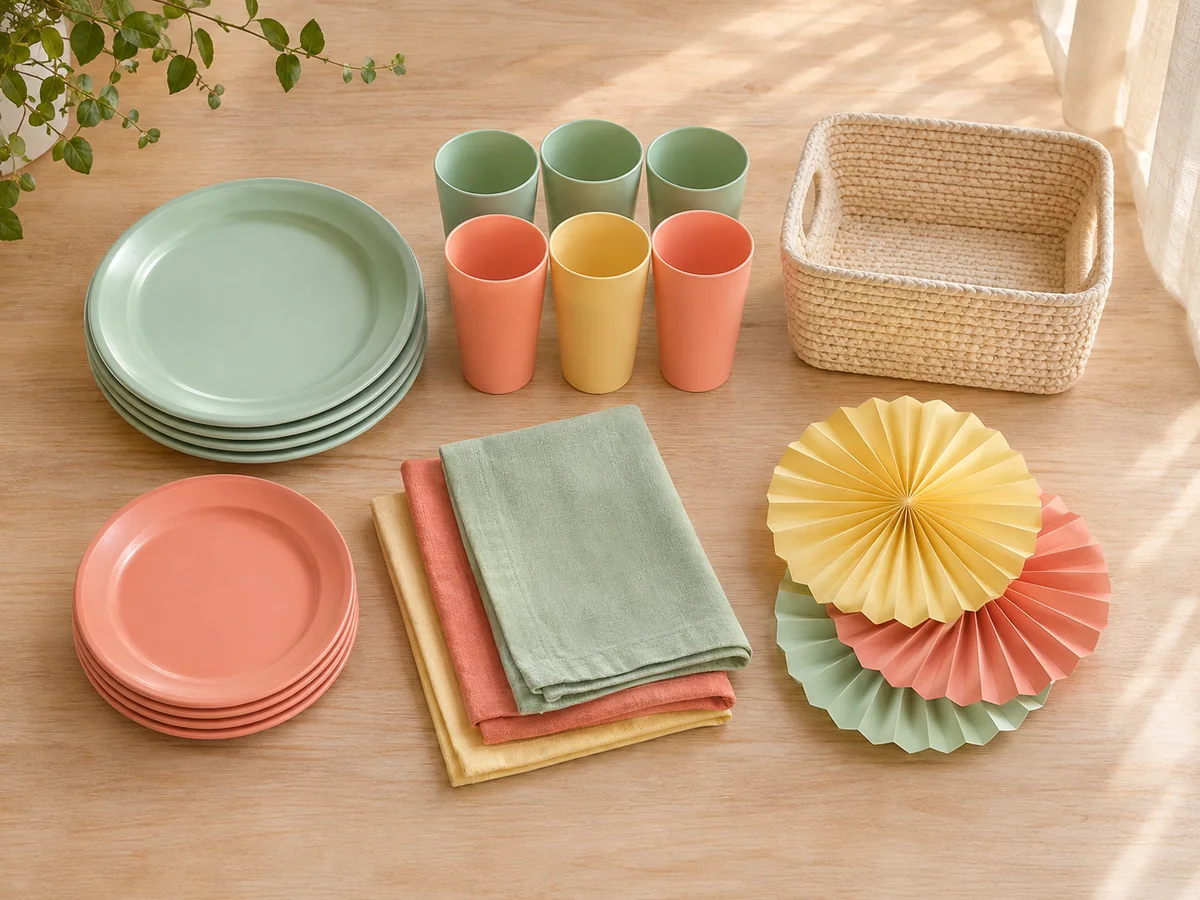
- Decorations that take up working, eating or playing space. Clear the activity table and the serving area first.
- Decorations for rooms guests won't use, and matching supplies for every room.
- Extra activity stations you don't have time or help to run. If you can't run several stations at once, lead one activity at a time.
- A second craft that needs different supplies. Extra materials for the first craft may be more useful.
- A separate favor bag, if guests already take home a project, a craft, a prize or something from the treasure.
- Themed versions of every dish, food changed only to match a color, and food labels so elaborate they hide what you're serving.
- Matching cups, plates and costumes. Costumes can be optional.
- Props that need a long explanation, and equipment for games you can't lead.
- A photo corner or backdrop if nobody wants to manage it, or if a banner or decorated wall already works as the photo spot.
- A formal program, speeches or a slideshow the birthday person hasn't asked for.
What can I skip?
Quick answer: Skip extra decorations, a second craft station, matching supplies for every room and a separate favor bag if guests already have a project to take home. Don't skip the supplies and instructions guests need to join in, eat, find their belongings and leave with their work.
At a craft-based party, the project itself can do several jobs. It gives guests something to do, carries the theme and works as the take-home item. A drawing table, a decorated activity table or a few food labels can carry a theme without a room full of decorations. At a pony party, for example, a stable sign, the main activity and a few food labels can be enough.
Be careful not to cut the things that look small but keep the party running, such as packaging so projects get home safely, a place to dry painted work, cleanup bags and labels for returning belongings.
Do I need a separate favor bag?
Quick answer: Not if each guest is already taking something home. A finished craft, a decorated card, a paper crown, a poster, a prize or a share of the treasure can be the favor.
A separate bag adds shopping, packing and handing out at the busiest point of the party, when families are leaving. If the project is the favor, put your effort into packaging it so it gets home in one piece, and have it ready by the door at pickup. If the project needs to dry, plan for that before guests leave.
A small spot by the door for finished crafts keeps them safe until pickup. Label each one with the child's name so families take the right one home. Our Favor Table Setup guide shows how to arrange it.
What to keep and skip in different kinds of party
The same test gives different answers depending on the format. Use this table as a starting point and adjust it for your guests, space and help.
| Party format | Keep | Often fine to skip |
|---|---|---|
| Craft, paint or slime party | Supplies, covered work surface, drying space, packaging for projects | Decorations on the work table, a second craft, a separate favor bag |
| Games or sports party | Equipment for the games you'll lead, water, a quieter activity | Equipment for games you can't lead, extra stations, decorations in the playing area |
| Treasure hunt or mystery party | Clues guests can understand with the help you have, a clear route | Hiding places you can't keep track of, a locked box (an envelope works), costumes |
| Movie party, indoors or outdoors | Seating everyone can see from, a tested screen and sound, food before the film | Decorations that block the picture or get in the way of seating, activities that don't fit around the film |
| Pancake or brunch party | Plain pancakes or a dish made ahead, a few shared toppings | Individual orders that keep you cooking the whole party |
| Adult or milestone dinner | A meal, seating, conversation, cake, one personal moment | A full program, several speeches, a slideshow nobody asked for |
Marking the birthday without a full program
Hosts often feel a milestone needs a schedule of speeches, a slideshow and planned moments. Usually one personal moment is enough, as long as the birthday person would enjoy it.
Do I need a formal program?
Quick answer: No. A short toast, a photo display, a cake moment or a guest book can mark the birthday without a full program. Ask the birthday person before you arrange speeches or a slideshow, and leave time for guests to talk.
A meal, conversation and cake can be the whole party. If the birthday person wants a tribute, a short toast, a photo display or a guest book is a better starting point than assuming they want several speeches. If they welcome speeches, arrange a few short ones and ask someone to introduce them. At a surprise party, let the birthday person decide whether to speak.
At a children's party, one main activity, a food break, cake and a birthday song can give the party enough shape. Add a short toast, a photo display or message cards only if the birthday child or family would enjoy them. Don't ask children to sit through speeches.
Some details stop the shared moment from getting lost. Ask a helper to gather everyone when it's time. Give one person the job of starting and finishing anything you include. If guests are coming and going, as at an open house or a large party, tell them when cake or a toast will happen so they can be there for it.
Worked example: a simpler two-hour craft party at home
This example is illustrative. Change the times, menu and activity to fit your own party. In it, 10 children are coming, and that number includes the birthday child. Two adults stay: the host and one helper. Parents drop off and collect their children, so they are not part of the count. If a parent or sibling stays, add them to the food and seating count only if they aren't already counted.
Kept: one craft (decorating a paper crown), its supplies, a covered table with room for 10, a drawing table for arrivals that also works as the quiet option, a named menu, cake, and labeled bags or a shelf for belongings and finished crowns. Skipped: a second craft, decorations in rooms the children won't use, a backdrop, and a separate favor bag, because the crowns go home. For the crowns, have ready: paper crown shapes or card strips cut before the party, crayons or markers, stickers, tape and a marker for names. Put one finished example on the table, but don't ask everyone to copy it. A small sign can say, “Decorate a crown, then ask for help fitting it.” Children decorate their crown with stripes, stars or their own symbol. When a child is finished, an adult fits the crown around their head and tapes it closed, then writes the child's name inside. Children can wear their crown or put it in the labeled spot before food. Crayons, stickers and tape don't need drying time, so the crowns are ready to go home as soon as they're made.
Menu, once you've checked food needs with families: cheese sandwiches and plain sandwiches, fruit, carrot sticks and water, then cake. Ask families about allergies and other food needs before you shop. Don't assume every child can eat every item.
- Total: 15 + 40 + 30 + 15 + 15 + 5 = 120 minutes, from 2:00 to 4:00.
- If you have no helper, drop the separate drawing table during the craft. Make the sandwiches and cut the fruit and carrots ahead, but keep them in the fridge, not on the table. Before guests arrive, set out only the plates, cups, water and anything that doesn't need chilling. At 2:55, bring the children to the table with you and take the food out as you serve it, so you never have to leave them alone. Put leftover sandwiches back in the fridge or throw them away when the food break ends.
| Time | What happens | Who does what |
|---|---|---|
| 2:00–2:15 (15 min) | Arrivals; bags go in the marked spot; drawing table open | Host greets families at the door; helper stays at the drawing table |
| 2:15–2:55 (40 min) | Crown craft | Host leads the craft; helper hands out supplies, then helps fit, tape and name crowns. At 2:45 the helper sets the table and takes the sandwiches out of the fridge to serve at 2:55, while the host stays with the children |
| 2:55–3:25 (30 min) | Food | Both adults at the table; host serves, helper refills water |
| 3:25–3:40 (15 min) | Cake and birthday song | Helper gathers everyone; host serves cake |
| 3:40–3:55 (15 min) | Free time at the drawing table or wearing crowns | Helper supervises; host packs crowns by the door |
| 3:55–4:00 (5 min) | Pickup | Host hands each child their crown and belongings; helper stays with children still waiting |
When effort, help or budget is the real limit
If you're short on time or help, it may be the number of activities that needs cutting, not the decorations. One activity you can actually run gives guests more to do than three stations nobody is watching. For example, a carnival game with clear instructions gives guests more to do than an elaborate display.
To keep costs and shopping down, buy the supplies for the main activity first. After that, decide which food, photo or decorating details you still have time and money for. Decide about extra treats after you've settled the food and cake. If you're buying something for a special effect, such as items that glow, test one before you order a full set. A video game party works the same way: test the main game before you buy supplies for anything else.
What if I don't have anyone to help?
Quick answer: Plan only what one adult can run while staying with the guests: one activity, food you've made ahead and can bring out quickly, and a quiet option that needs no supervision away from the main group.
Go through each job you're keeping and ask whether you can do it while still watching the group. You can still lead a game if everyone stays in one place. Our guide on hosting a children's party without a co-host covers arrivals, activities and food.
Walk through the party in your head and check who is with the guests at each point. If serving food would take you away from the children, make it ahead and keep anything perishable, such as sandwiches, in the fridge until you serve it. Take it out when everyone sits down to eat, with the children at the table where you can see them, and put it away again after the food break. Before guests arrive, you can set out plates, cups and food that doesn't need chilling. A pancake party, for example, works better with plain pancakes and shared toppings than with cooking to order.
Will an adult party feel too plain?
Quick answer: Not if the birthday person gets the kind of gathering they want. A dinner, a picnic, board games or an outing followed by cake can be the whole celebration.
For adult birthdays, the things guests need are mostly practical: seating, bathrooms, parking, access needs, music quiet enough for conversation, clear costs and a plan for getting home. A picnic doesn't need a second activity just to fill the afternoon. If cooking would take over the evening, order the main dish and make the sides yourself.
Check your list before you shop
- Name the main activity and buy its supplies first.
- Confirm the guest count, and note whether it includes the birthday person, siblings and any adults staying.
- Ask about food and access needs, then set a short menu you can serve without cooking for the whole party.
- Clear working, eating and playing space before adding decorations.
- Set up a quieter option and a place for belongings.
- Decide what guests take home; if it's their project, drop the separate favor bag.
- Choose one personal moment the birthday person wants, and pick who will start it.
- Tell guests the start and finish times, what food is included and, if they're coming and going, when cake will happen.
- Cross off any station, prop or decoration that has no one to run it or no job for guests.