What food should I serve at a pet-themed party?
Quick answer: Start with food your guests already like, such as sandwiches, chicken nuggets, crackers, fruit and a cake or cookies. Then give the menu a kitten, puppy or pet-adoption look with a few decorated foods and playful name cards. You don't need to decorate everything. One to three decorated foods is enough, and a decorated cake counts as one of them. Write the real food name under each themed name, and check ingredients and preparation with families before you shop.
Start with familiar food, then add the pet theme
A pet-themed menu works best when it's made of food the children would eat at any party. The theme can come from shapes, faces and names. For a kitten party, you might serve cat-face sandwiches or cookies with chicken nuggets, mac and cheese cups, fish-shaped crackers and fruit. For a puppy party, you might serve bone-shaped sandwiches, fruit cups, crackers and puppy-face cupcakes. For a pet adoption party, you might serve bone-shaped sandwiches, strawberries labelled as puppy noses and paw-print cookies.
Before you choose any decorations, decide whether you're serving a meal or just snacks. If the invitation says lunch or dinner is included, pick a main dish first, then add a side and a dessert. If the party falls between meals, choose the snacks and dessert and tell families what to expect, so nobody arrives hungry expecting a meal. Don't assume guests have already eaten.
Ask the birthday child which foods they want. Their favourites are a better starting point than a long list of themed recipes, and they make it more likely the food will actually get eaten.
What food do you serve at a kitten party?
Quick answer: Try cat-face sandwiches or cookies with chicken nuggets, mac and cheese cups, fish-shaped crackers and fruit. Confirm food requirements with families before you shop.
Choose foods your guests already enjoy. You might decorate the sandwiches and cookies and leave the nuggets, crackers and fruit plain, with kitten-themed name cards such as "Kitten kibble — chicken nuggets" or "Fish snacks — crackers."
You don't need to serve every item. Nuggets or sandwiches, one side and a dessert may suit your party better than two mains and several sweets.
What do you serve at a puppy kids party?
Quick answer: Try bone-shaped sandwiches, fruit cups, pretzels or crackers, puppy-face cupcakes and water. Add a themed drink if you want one.
Pretzels and crackers served in bowls take very little assembly, and fruit cups with puppy labels are another easy option. If you already have pretzels in bowls, you don't also need a tray of paw-shaped pretzels.
You can put puppy names or a paw-print label on familiar foods instead of decorating every dish.
What do you serve at a pet adoption kids party?
Quick answer: Try bone-shaped sandwiches, strawberries labelled as puppy noses, paw-print cookies and water. Add cereal snack mix or fish-shaped crackers if you want another snack.
These are six ideas to choose from, not a list you have to serve in full. Fish-shaped crackers need no cooking, and round cookies only need an icing pen to draw the paw design. None of these needs fondant or elaborate decorating.
Choose the foods your guests can eat, and confirm the actual ingredients with families before you shop.
How to give the food a pet theme without decorating everything
The easiest way to theme the menu is with name cards. Write a playful name at the top and the real food name underneath, for example "Kitten kibble — fish-shaped crackers" or "Puppy noses — strawberries." Guests still get the theme, and families can see exactly what's being served.
If you want a limit, decorate no more than three foods. One or two is fine if that's all your preparation time allows. If you decorate the cake, count it as one of them. Everything else can stay plain with a themed card.
Try each decoration on one sample before you do a whole tray. If a sandwich shape falls apart, keep the sandwiches plain and put a cat or dog drawing on the card instead.
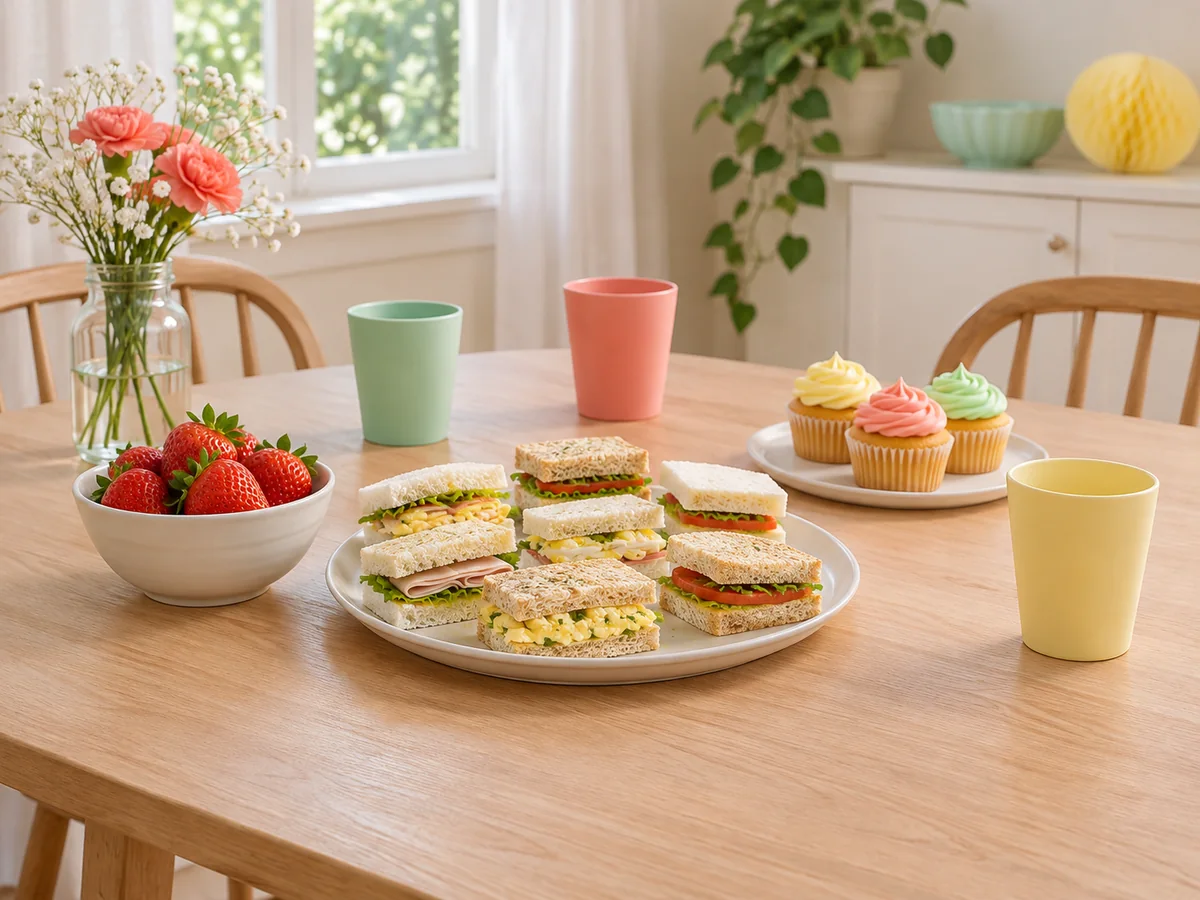
| Familiar food | Kitten card example | Puppy or pet card example |
|---|---|---|
| Chicken nuggets | Kitten kibble — chicken nuggets | Puppy kibble — chicken nuggets |
| Fish-shaped crackers | Fish snacks — crackers | Kitten kibble — fish-shaped crackers |
| Strawberries | Kitten treats — strawberries | Puppy noses — strawberries |
| Sandwiches | Cat-ear sandwiches — ham | Bone sandwiches — ham |
| Round cookies | Cat-face cookies | Paw-print cookies |
How do I connect food to the pet theme?
Quick answer: Serve familiar food with a pet-themed label, keep the real food name visible, and add one or two decorated treats if you have time.
A themed label doesn't change what the food is, and it doesn't make the food suitable for any particular guest. Confirm ingredients with families separately.
For a puppy theme, use puppy names, a paw-print label or one decorated treat. For a kitten theme, use a cat-face cookie, a simple cake design or playful labels beside plain dishes. Plain sandwiches and snacks still belong on a themed table.
Do all the foods need cat or puppy faces?
Quick answer: No. One to three decorated foods is plenty, and a decorated cake counts as one of them.
Putting name cards on everything else gives you more time to prepare and serve the main food, which matters more than decorating every tray.
Simple decorated foods and a cat cake
These are decorating ideas, not tested recipes. None of them needs a piping bag or fondant.
Ear-cut sandwiches: make sandwiches with a filling your guests like, such as ham or tuna. For pointed ears, cut a shallow V from the middle of the top edge so there's a point on each side. For a bone shape, use a cutter if you have one. List the filling beside the tray. Tuna needs a fish note, and the bread and other fillings need ingredient information too.
Icing-pen cookies: draw eyes, a nose and whiskers, or a paw print, on round cookies. Leave a few plain for guests who prefer them. Follow the pen's instructions on which surfaces it works on and how long it takes to set before you stack or pack the cookies. Cookies need the same age check as other foods; see the section on younger children below.
Rice cakes with banana ears: put banana slices near the top of a rice cake for ears and leave the face plain. Put these together close to serving time rather than the day before. Ask caregivers whether rice cakes and banana suit younger guests and how to prepare them.
How do you make a cat cake without sculpting?
Quick answer: Use one round cake with two cupcakes at the top for ears, or cut two triangular ears from a second thin cake layer. Then draw the face with an icing pen.
Arrange the pieces on the serving board and draw eyes, a nose and whiskers with an icing pen that works on your frosting. Check your recipe's yield, baking, cooling and storage instructions before you decide when to make it. The round pan shapes the face, but it doesn't tell you how many guests the cake will serve.
If you'd rather buy a cake, add a topper made for use on cakes, or buy a plain cake and draw the face yourself if its frosting works with an icing pen. For a puppy party, puppy-face cupcakes can do the same job as a cake.
What to serve to drink
Always have water out and easy to find, next to any themed drinks.
If you'd like one themed drink besides water, choose it once you know your guests' needs. Our guide to party drinks for kids compares practical options and amounts. It also suggests confirming ingredients and any separately arranged drinks with families before you buy.
For a kitten party, small milk cartons or bottles fit the theme without any decorating. Check how many guests actually want milk before you buy it, and confirm any non-dairy alternative with the families who need one. A non-dairy label alone doesn't show that a drink suits every guest.
If a guest needs to avoid dairy, check more than the drink. Cheese, frosting and other menu items matter too. Our guide to planning dairy-free party food helps you work through the menu with the family and plan when to shop and prepare.
An optional fishbowl punch is juice served in a bowl made for food, with the actual drink written under the theme name. One suggested mix is equal parts juice and water, for example a blue juice drink with floating fruit. Confirm the ingredients and how the fruit is prepared with caregivers before you include it. For a puppy party, a themed drink is optional; water is enough.
What drinks fit a kitten party?
Quick answer: Small milk cartons or bottles, water, and if you like, a fishbowl punch made from juice and labelled with what's in it.
Confirm any non-dairy drink with the families who need it, and keep the real ingredients written beside the punch bowl.
Allergies, younger children and other food needs
Share the menu with families before you shop, and confirm the specific ingredients, products and serving arrangements. Check everything, not just the main ingredient: bread, fillings, breading, frosting, icing pens, sprinkles and toppers. Keep the packaging from shop-bought foods, and write down what you used in homemade dishes.
Several foods often served at pet parties need particular care with young children. The CDC lists cookies, uncooked dried fruit such as raisins, pretzels, popcorn, hot dogs, marshmallows, nuts and seeds, spoonfuls of nut or seed butter, uncut grapes and berries, hard raw fruit and vegetable pieces, and some hard, round, gummy or chewy candies as potential choking hazards for young children. That includes the decorated cookies and paw-print cookies, pretzel bowls, whole strawberries or blueberries, and cereal snack mixes that contain nuts, raisins or candy. Don't use raisins as decorations for young children. The CDC also advises preparing food to suit each child's development and watching children while they eat.
For a drop-off party, agree which adult keeps each family's written food instructions, and make sure the person serving has them. Keep those instructions separate from the small themed name cards so important details don't get squeezed out.
How do I adapt the menu for guests with food allergies?
Quick answer: Share the menu before you shop and confirm specific ingredients, products and serving arrangements with each family. A swap or a label alone doesn't show that the whole menu suits a guest.
Gluten-free crackers or candy without nut ingredients may be options if the family confirms them. The same applies to recipe swaps. Using sunflower butter in puppy chow doesn't on its own make the dish suitable for every guest. Confirm the specific sunflower butter, cereal, chocolate and other ingredients with the family, and follow the serving arrangements you agree with them.
How should I adapt the menu for younger children?
Quick answer: Ask their caregivers which foods and preparation suit their child's development, and leave off foods and decorations that don't fit. Agreeing a plan with a caregiver doesn't remove a choking hazard.
Ask about fruit, sandwich pieces, cookies and decorations in particular. Don't assume a cat-face snack or a familiar party food suits every child. Cookies and raisins are on the CDC's list of potential choking hazards for young children, so leave raisin decorations off, and ask caregivers whether cookies belong on their child's plate at all and what they'd like served instead.
The playful name on a card is no reason to prepare food differently. Whatever you agree, an adult should watch children while they eat.
Worked example: a kitten lunch for 10 children
This example is for illustration only. The 10 children include the birthday child and any siblings or other household children who are eating with the group. Add only eaters who aren't already among those 10, such as adults who stay or a sibling you didn't count. The per-child amounts are example shopping figures to adjust for age, appetite and the other food you serve. They aren't predictions of what every child will eat.
The menu is a lunch: cat-ear sandwiches as the main, mac and cheese cups as the side, fish-shaped crackers, cat-face cookies, a cat cake, milk and water. The three decorated foods are the sandwiches, the cookies and the cake. Because cake is also on the menu, plan fewer cookies than you would without it. You can also leave the cookies out, which leaves two decorated foods, the sandwiches and the cake. That's still within the limit, so you don't need to add another food. If you leave them out, remove them from the shopping list and the serving plan too.
Choose one main. Don't automatically buy full amounts of both sandwiches and nuggets. If you used nuggets instead of sandwiches, an example allowance of 4 to 6 per child with sides gives 10 x 4 = 40 to 10 x 6 = 60 nuggets. For crackers, go by the package's weight or serving count, since a "large bag" isn't a consistent amount. For the cake, check that your recipe's yield covers everyone eating. The round cake and two ear cupcakes are only how you shape it.
Work out each item from its own portion and package information, not from vague bag sizes. Then buy for the one main you've chosen. Our answer on how much food to buy for a party explains using the recipe, package or caterer's serving information.
| Food | Example amount per child | For 10 children |
|---|---|---|
| Cat-ear sandwiches (main) | 1 whole sandwich | 10 sandwiches |
| Mac and cheese cups (side) | 1 cup of the size you choose | 10 cups |
| Cat-face cookies (optional with cake) | Up to 2 small cookies; use fewer because cake is served | Up to 20 cookies |
| Milk cartons | 1 carton, after checking who wants milk | Up to 10 cartons |
| Water | Available throughout | Water jug or bottles |
| Fish-shaped crackers | Follow the package serving count | Work it out from the package |
| Cat cake | Follow the recipe yield | Enough batches to serve everyone eating, according to the recipe |
When to prepare the food and how to serve it
Use this order as a starting point. Your recipes and product instructions decide what can be made ahead and how to store it. If a recipe says a dish can be cooked ahead, follow that.
Supplies, labels and dry snacks usually suit the day before. Most dishes depend on their ingredients, directions and how you'll store them. Our answer on what party food you can prepare ahead helps you sort those jobs before you follow the schedule below.
Two days before: confirm the menu with families. Shop for sandwich ingredients, mac and cheese ingredients or ready-made mac and cheese, cookies (if you're serving them), an icing pen, crackers, milk and cake supplies. Check which labels and serving dishes you already have.
The day before: decorate the cookies if their storage instructions allow it, and bake the cake and ear cupcakes if your recipe suits that. Write the food cards using the actual ingredients.
Party morning: make the sandwiches and prepare any fruit you're serving the way you've agreed with caregivers. Keep sandwiches, milk and any cut fruit in the refrigerator, at 40 F or below, until serving. Set out serving dishes, labels, napkins, wipes, spare utensils and a waste bag.
Mac and cheese: cook it following the package or recipe instructions so it's ready at serving time. If your recipe supports making it ahead, refrigerate it and reheat it following those instructions. Once it's cooked, any portion waiting to be served needs to stay hot at 140 F or above. Having it in an oven isn't enough on its own; the food itself must stay at that temperature. These are holding temperatures, so follow the recipe or package for cooking and reheating.
Serving time: have a helper bring out the food and handle refills. Keep ingredient information next to each dish.
- Example 30-minute lunch break, 12:00 to 12:30 (illustrative):
- 12:00 to 12:05: take the sandwiches and milk out of the refrigerator, bring out the hot mac and cheese, crackers and water, and seat the children.
- 12:05 to 12:20: eat the main food. Refill with fresh dishes rather than topping up filled ones. Take cold refills from reserves kept at 40 F or below, and hot refills from reserves kept at 140 F or above.
- 12:20 to 12:30: serve the cat cake and any cookies.
- Total: 5 + 15 + 10 = 30 minutes. Adjust the pace to suit the children.
- After the break: refrigerate or throw away sandwiches, mac and cheese, milk and any cut fruit within 2 hours of when each first left the refrigerator or stopped being held hot. Count all the time spent setting up and serving. Above 90 F, the limit is 1 hour. Shelf-stable crackers and packaged cookies can follow their packaging instructions.
Checklist before guests arrive
- Decide whether you're serving a meal or snacks, and tell families which.
- Confirm food choices, ingredients and preparation with families, including what suits younger children.
- Count the children eating, including the birthday child, then add only eaters not already counted, such as adults who stay.
- Pick one to three foods to decorate, counting the cake, and leave raisin decorations off for young children.
- Write the real food name under each themed name.
- Keep ingredient information and family instructions where the serving adult can find them.
- Put out water and label the other drinks clearly.
- Keep cold food at 40 F or below and hot reserves at 140 F or above, and note when each perishable dish first comes out.
- Agree who serves, refills and clears the table.