Should I provide food for adults who stay at a children’s party?
Quick answer: Usually yes, if adults are staying through the food. You rarely need a separate meal. Count only the adults who will actually stay and eat. Share the main food and dessert where it suits their needs, and increase the amounts to cover them. The party time decides how much you need: a party over a mealtime needs real food for adults too, while a short party between meals may only need shared snacks and drinks. If adults will be standing while they watch the children, or have nowhere to sit, give them portions they can hold and eat with one hand.
Deciding whether staying adults need food
Parents who stay at a children’s party are often there for the whole event, keeping an eye on their own child or helping out. Whether you feed them, and how much, mostly comes down to two things: how many adults are actually staying, and what time the party runs.
Start time matters more than it might seem. If the party runs over lunch or another mealtime, the adults present need something more than a coffee station. If the party falls between meals and is short, shared snacks and drinks may be enough. Do not assume most adults will have eaten before they arrive; base the decision on the meal your invitation suggests and the hours the party covers.
Feeding adults does not mean setting up a second spread. In most cases the same food can serve everyone, with quantities increased. Change how you serve it only if the adults need that, for example portions they can hold while they stand and watch the children.
Do I need to serve parents a separate meal?
Quick answer: Usually not. You can share the main food and dessert, increase quantities for the adults staying, and add a savory option if the menu is too light for the meal you’ve promised.
A mealtime party needs more than a coffee station for the adults. A short party between meals may only need shared snacks and drinks.
If you add something for the adults, have it ready to serve rather than setting up another meal or a second line. Count their portions when you shop or order.
What if only four parents stay?
Quick answer: Count four adults for the shared food and dessert, and ask how many want coffee or any savory addition.
Use those counts for the extra quantities. There is no need to buy adult portions for every invited parent if most are dropping off. Asking on the RSVP or when parents reply is a simple way to find out who is staying.
Using one menu for children and adults
Adults and children can usually eat from the same menu. Keep the base dish plain and put toppings, sauces or seasonings beside it, so each guest can finish their own serving. This also helps children who prefer plain food.
Make a second version of a dish only if your guests want it or someone’s food requirements call for a separate option. Check individual food needs with families before assuming the plain version works for everyone.
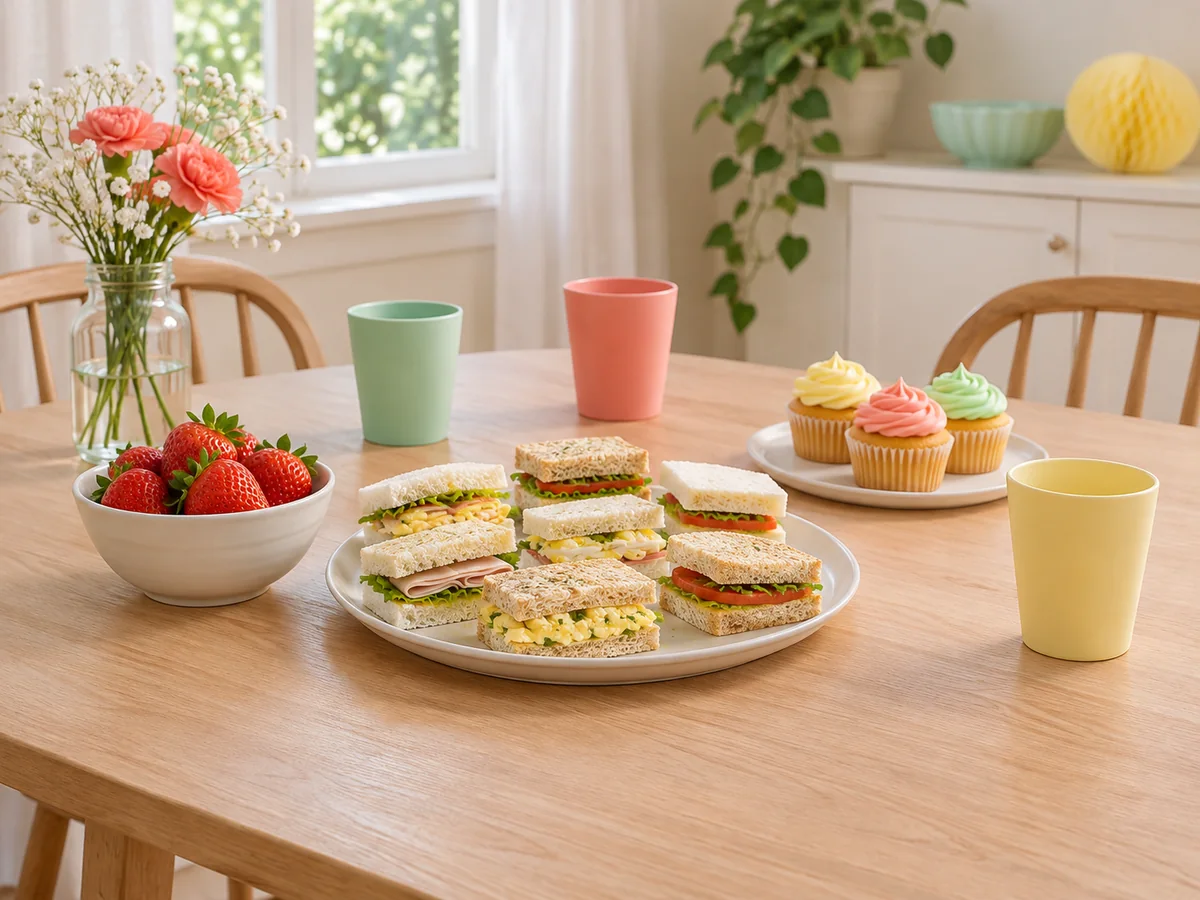
Do adults need a different menu from the children?
Quick answer: Not necessarily. Use the same sandwich fillings or other ingredients, and adjust the amounts for the adults who will eat and for any food requirements.
If adults will be sitting down, they can eat the same food the same way as everyone else. If they will be standing and watching the children, give them portions of the same food that they can pick up without a plate. Either way, the difference is usually in how the food is portioned, not what it is.
Can I use the same ingredients for children and adults?
Quick answer: Yes, where they suit the guests. One fruit tray with toppings beside it, or one pancake bar with shared toppings, can serve everyone.
Increase the base quantities for everyone eating. Adding honey or mint as an adult topping does not make the original fruit go further.
What if I’m feeding a mix of ages and can’t fit two trays?
Quick answer: Choose a plain dish such as sliders or cheese pizza and offer a few toppings on the side.
You do not need a second topped tray just to give guests a choice. The toppings provide the choice.
What if an adult guest wants something with more spice?
Quick answer: Keep hot sauce and spicy salsa in labelled bowls at the end of the food line.
Guests can add heat to their own serving without changing the shared dish that children are also eating.
What if some children only want plain food?
Quick answer: Leave a plain portion available and put sauces or toppings beside it; adults can use those same additions.
Check individual food needs before assuming the plain version suits everyone.
When adults are standing: food they can eat with one hand
This applies when adults will be standing while they watch the children, or there is nowhere for them to sit. A parent watching children may not get to sit down with a full plate. Food they can hold and eat while the other hand stays free makes it easier for them to eat at all. Try picking up a prepared portion with one hand: can you take a bite without holding a container, adding sauce or catching loose filling?
Wrapped sandwich halves, small wraps and food on a skewer usually pass this test. Leave enough parchment around the bottom of a sandwich half to hold it and catch some crumbs. Cups of crackers, popcorn or trail mix are easy to carry but need two hands to hold and eat from, so put them on a nearby surface where guests can pick up one piece at a time.
For standing guests, leave off loose pasta salad, soup and dishes that need cutting. A shared dip pot asks guests to serve themselves as well as hold their food, so keep it at a table or offer an option without dip. If the adults have seats, these dishes can work at the table.
- Works one-handed: wrapped sandwich halves, small wraps with the bottom wrapped in parchment, fruit-and-cheese skewers, meatball skewers without sauce, individually wrapped cookie bars.
- Needs a surface: charcuterie cups, popcorn cups, trail mix cups, chips with individual dip cups.
- Better at a table: sauced meatballs that drip, loose salads, soup, anything needing a knife.
Are individual dip cups really one-handed?
Quick answer: Only when the cup sits on a surface and the guest uses one hand to dip and eat a chip.
Carrying a cup while reaching for chips normally needs both hands. Offer plain chips when there is nowhere to set down the dip.
Can someone hold a snack and a drink while keeping a hand free?
Quick answer: Usually not; food and drink together occupy both hands.
Give guests somewhere nearby to put down a drink, or let them finish one before picking up the other.
Worked example: a lunchtime party with some parents staying
Illustrative example only. Say the party starts at 12:00, so it covers lunch. Twelve children are invited and four parents reply that they will stay; the rest are dropping off. In this example the parents will mostly be standing near the play area.
Main food for everyone: sandwiches with plain fillings, cut into halves. Because the adults will be standing, wrap the bottom of their halves in parchment so they can eat with one hand. If they had seats, plates would do. Alongside: a fruit tray with toppings beside it, cheese cubes, and plain chips. Dessert: the birthday cake, shared.
Because this is a lunch party, check that the shared food is filling enough for the adults. If it feels light, add one savory option, such as small meatball skewers without sauce, sized for the four adults. Ask the four parents whether they want coffee; if two do, plan coffee for two.
To work out amounts, count everyone who will eat: twelve children plus four adults, so sixteen people. Adjust any recipe or example amounts for dish size, appetites and the other food on the table. Because toppings stay separate, you make one shared batch rather than guessing how many plain and topped trays to make. For cutting, remember that each whole sandwich gives two halves, so six whole sandwiches make twelve halves. That is only how the cutting works out. It is not the amount to make for these sixteen guests; decide that from their appetites and the rest of the menu.
| Item | Who it is for | How it is served |
|---|---|---|
| Sandwich halves, plain fillings | Children and 4 staying adults | Adult halves wrapped at the bottom in parchment, because they are standing |
| Fruit tray with toppings beside it | Everyone | One tray, toppings in separate bowls |
| Plain chips | Everyone | Tray; no dip needed to carry |
| Meatball skewers, no sauce (optional) | 4 staying adults | Added only if the lunch feels too light |
| Coffee (optional) | Adults who asked for it | Small spot at the end of the table if there is room |
| Birthday cake | Everyone | Served at cake time |
How do I know how much of each tray to make?
Quick answer: Count the children and adults who will eat, then adjust example amounts for dish size, appetites and the other food.
If toppings stay separate, you can prepare one shared batch rather than guessing a ratio of mild to spicy trays.
Is coffee the first thing I should add?
Quick answer: Only if the staying adults want it and you can prepare it alongside the rest of the menu.
If there is already plenty of savory food, coffee may be the only extra item you need. If the food is too light for a promised lunch, fix that first. Coffee is an option, not a substitute for food.
If the shared food needs more substance for staying parents, a small ready-to-serve savory addition may be enough without doubling the children's menu. How to Feed Parents Without Doubling the Kids Menu suggests options and keeps coffee as something to add only if adults want it and you can manage it.
Where to put the food for adults
Adults can use the shared food table. If space allows, put adult portions at one end so guests can take a sandwich without reaching over children. Keep the food near the area the adults are watching, rather than setting up a separate gathering spot across the yard.
Leave room to set down cups and drinks, with napkins and a bin nearby. Keep the setup clear enough that guests can see which dishes and toppings they want, and keep filling and ingredient information with the right food.
Can adults eat from the same table as the children?
Quick answer: Yes, if there is room to reach the food without crowding.
A separate end of the table can work when you do not have space for a second table. Keep the adult portions near where adults are watching.
Should parents have a separate food table?
Quick answer: No, they can use the shared food table.
A small separate spot for coffee supplies may make serving easier if you have room, but it does not need its own food spread.
Can adults and children eat from the same buffet?
Quick answer: Yes, they can share dishes that suit their food needs, choosing different portions.
Keep toppings or sauces separate where practical. A shared buffet still needs ingredient information and any separate arrangements agreed with families.
Should I still make a separate kids’ table?
Quick answer: You can seat children and adults separately if that suits the space.
They can still take food from the same serving table, with help for children who need it.
When to prepare and serve the food
Choose a time when adults can actually take a portion, such as just before guests arrive or just before cake. Have the food ready beforehand, and follow the recipe or product directions for preparation, serving and storage.
Illustrative timeline for the noon party above: two days before, confirm how many adults are staying, settle the menu, check food requirements and buy wrappers and ingredients. The day before, prepare labels and trays, and do any advance preparation the recipes allow. On the morning, assemble sandwiches and skewers as their directions allow. Around 11:45, put out the prepared food so it is ready as guests arrive. If someone can help, ask them to handle refills so the adult watching children is not also assembling servings.
If the venue gives you a fixed food slot, set out food that is already portioned and keep any adult addition ready to serve rather than setting up a second line.
When should the adult food come out?
Quick answer: At a time when adults can take a portion, such as just before guests arrive or before cake.
Prepare it beforehand and follow the recipe or product directions for serving and storage.
Does this menu work outdoors?
Quick answer: Wrapped sandwiches and other food you can hold can work outdoors too.
Cups still need a surface, and the menu must fit the storage, transport and serving arrangements you have. Being outside does not stop drips or spills.
Cost, effort and food needs
A shared menu often means less duplicate shopping and preparation, but it is not automatically cheaper. Toppings, package sizes and any separately required food all affect the total.
Ask families about food requirements before you shop. A separate cup or wrapped portion does not mean a food suits a particular guest; check ingredients, especially for items like nuts.
Is a shared menu actually cheaper than two spreads?
Quick answer: Not always. Compare the complete shopping lists for your own guest list before deciding.
One main dish may reduce duplicate ingredients and preparation, but toppings, package sizes and separately required food affect the cost.
Do I really need two versions of every dish?
Quick answer: No. Keep the base dish plain and offer toppings separately.
Make a second version only if your guests want it or food requirements call for a separate option.
Checklist before you put out the food
- Confirm how many adults are staying and which foods suit them.
- Check whether the party covers a mealtime and plan enough food for adults if it does.
- Decide whether adults will sit or stand; if they will be standing while they watch the children, wrap or portion their food so they can eat it with one hand.
- Put adult portions where guests can reach them without crowding the children.
- Leave a surface for snack cups, dip cups and drinks.
- Keep ingredient information with each dish and toppings in labelled bowls.
- Set out napkins and a bin, and decide who will refill trays.
- Choose the serving time and follow each dish’s preparation and storage directions.