How do I organize activities for a family reunion?
Quick answer: Set the meal time first, then plan a few activity blocks around it instead of filling every minute. For a park or backyard reunion of about 20 to 60 relatives, one option is lawn games before lunch, a seated family-story round after lunch, and a tournament and relay in the afternoon. Put people from different households and ages on each team. Let each guest choose whether to play, coach or keep score. Confirm an indoor or covered space in case it rains, and give each household a named potluck slot so you don't end up with five of the same dish.
Questions for sharing family stories
Read a question aloud or pick one with the button. Print the questions if you would rather pass them around the table.
Draw one when the room is ready
Name one meal this family always ate growing up and who cooked it.
Meals and places
- Name one meal this family always ate growing up and who cooked it.
- Tell the story of how our family arrived in this town.
What we learned and what comes next
- Share one thing your grandparent taught you that you still do.
- Predict one thing about this family in ten years.
Plan the day around lunch and leave time to talk
A reunion is mostly a chance for relatives to catch up, so activities should give people something to do together without taking over the day. Start by choosing the meal time. Then put one activity block before it and one or two after it, and keep a loose stretch of time for rest, photos and conversation.
The example below is for a park or backyard reunion of roughly 20 to 60 relatives, children and adults together. It runs from 9:30 a.m. to 4:45 p.m.: 7 hours 15 minutes, or 435 minutes in total. A full day is optional. Shorten or drop blocks to fit your venue hours and your guests. Post the times on poster board at check-in and give each helper a copy.
Give a short warning before each change of activity, and use the same announcement every time so people know what it means.
| Time (example) | What happens | Length |
|---|---|---|
| 9:30 to 10:00 a.m. | Check-in: coffee, name tags with a family-branch color plus a written name or symbol, and a quick explanation of the schedule | 30 minutes |
| 10:00 a.m. to noon | First activity block: lawn games and the four first-round bracket matches, plus an unscored game for anyone not in the tournament | 120 minutes |
| Noon to 12:45 p.m. | Potluck lunch, with time to sit down and eat | 45 minutes |
| 12:45 to 1:30 p.m. | Second activity block: family stories, with a wooden spoon passed to show whose turn it is | 45 minutes |
| 1:30 to 2:30 p.m. | Photos and rest: optional photo prompts, conversation or a seated game | 60 minutes |
| 2:30 to 4:30 p.m. | Third activity block: the semifinals and final, then the water-cup relay and repeat games | 120 minutes |
| 4:30 to 4:45 p.m. | Group photo for anyone who wants to be in it, then packing up leftovers and game equipment | 15 minutes |
What family reunion activities work for all ages?
Quick answer: Try a target toss where players choose their throwing distance, family trivia, or a seated story round. Ask guests what they'd like to do and offer different jobs, because no single game suits everyone.
Mixing active and seated choices lets grandparents, toddlers' parents and teenagers each find a way to join in. The rest hour in the example is there so people can take a break without missing a scored round. Some guests would rather keep score, time a round or take photos than play, and those jobs count as joining in too.
Mix ages and households on each team
Spread relatives from different households across the teams so cousins get to meet each other. If enough willing guests in those age groups come, a lineup with one player under 12 and one over 60 can work well. If they don't, use the mix you have.
Keep score by team and give every team the same number of scored turns. Some families add house rules, such as adults throwing with their other hand or children's rings counting double. These are optional. Whatever you choose, explain it before the first match and stick to it all day. Change lineups between games so the same few people don't take every turn.
Write names or symbols next to the colors on rosters and name tags, so guests who have trouble telling colors apart can still find their team.
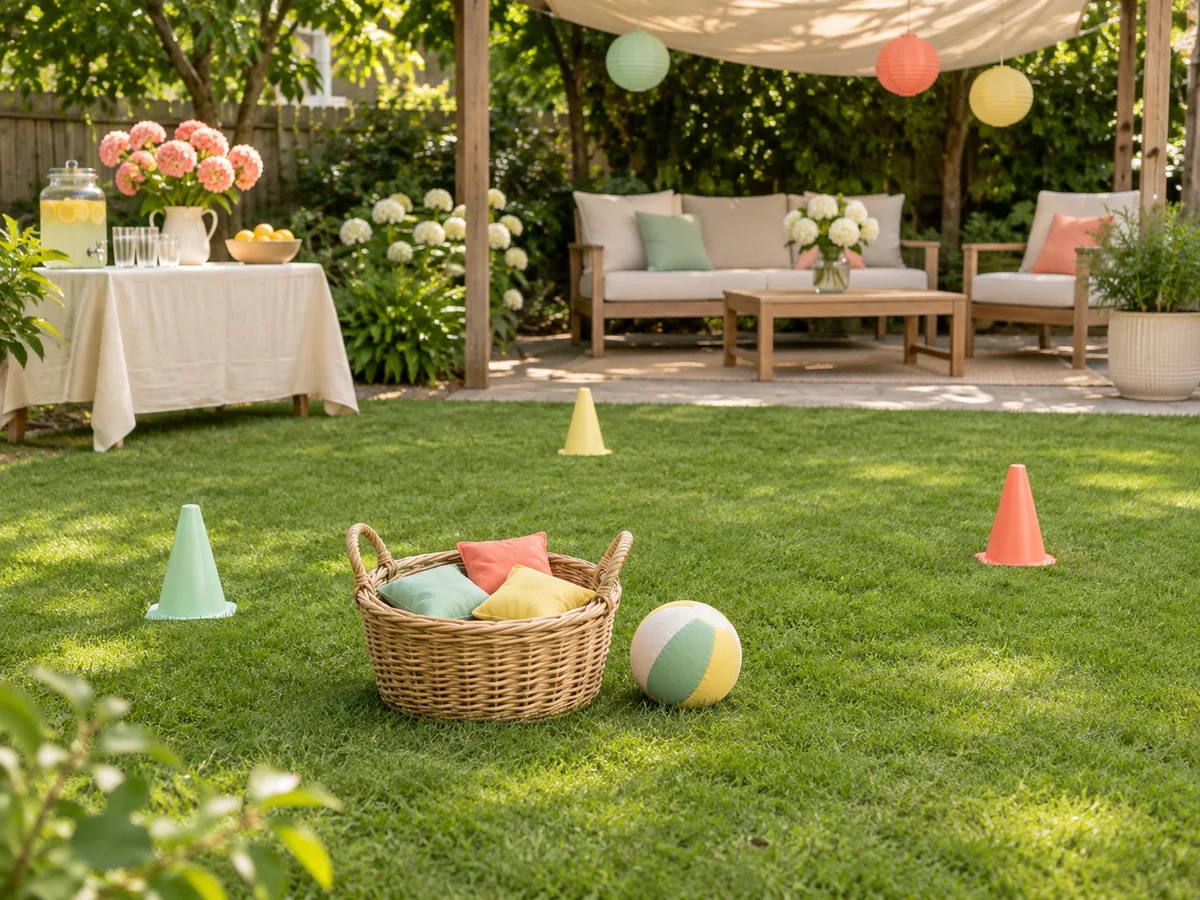
How do I keep teams fair with big age gaps?
Quick answer: Mix households and ages, agree on any scoring adjustments before play starts, and give every team the same number of scored turns. Rotate jobs and let guests choose whether to throw, coach or keep score.
Ask people which job they want instead of assigning jobs by age. A grandparent may want to throw, and a ten-year-old may enjoy keeping score. Fairness mostly comes down to equal turns and rules everyone hears before the first throw.
Run an eight-team lawn-game bracket
Pick cornhole or ladder golf and draw eight team names from a hat into numbered slots. A single-elimination bracket for eight teams has seven matches: four in round one, two semifinals and a final. Tape the bracket where people can read it, such as the side of the game table.
Suggested house rule: a match ends after 15 minutes or when a team reaches 21, whichever comes first. Use the scoring rules that come with your game, plus any reunion adjustments you announced. When time runs out, finish the current round so both sides have had equal turns. If the score is tied, give each side one more turn, and keep going until one side leads.
Worked example, with one court: the four first-round matches take up to 60 minutes (4 matches x 15 minutes). The three afternoon matches take up to 45 minutes (3 x 15). Changeovers and tie-breaks come on top of that, which is why each block in the example schedule is 120 minutes long. If you have fewer teams, mark the empty slots as byes before play starts. Five teams need three byes and six teams need two. Always put a bye opposite a real team, never opposite another empty slot.
If you have another helper and a second game set, you could run a separate children's bracket with half the throwing distance and a ribbon for everyone who plays. Keep open games going for anyone whose team is knocked out.
For the water-cup relay, give equal-sized teams a cup, a water container and a collecting jug. Players pass a full cup down the line, and the last player pours it into the jug. Refill at the front and keep going for three minutes. When time is up, compare how much water each team collected; tied teams share the win. Guests can pass, pour, refill or keep time, including from a seat if your setup allows. This is a suggested version, so show everyone how it works before you start.
Before you offer anyone a seated job, ask which job they'd like. Check that the table is a comfortable height and the cups and jug are within reach. A willing helper can pick up anything that's dropped. For more, read how to adapt party games for different abilities.
| Match | Teams | Winner |
|---|---|---|
| A: round one | 1 vs. 2 | ______ |
| B: round one | 3 vs. 4 | ______ |
| C: round one | 5 vs. 6 | ______ |
| D: round one | 7 vs. 8 | ______ |
| E: semifinal | Winner A vs. winner B | ______ |
| F: semifinal | Winner C vs. winner D | ______ |
| G: final | Winner E vs. winner F | ______ |
Share family stories after lunch
Ask three older relatives ahead of time whether they'd like to share a story. Invite the eldest willing guest to go first, then offer turns around the circle. Whoever holds the wooden spoon talks, and anyone can pass. Don't ask someone to repeat a story that has already been told, but leave room for another relative to add their own memory of it.
Ask permission before recording anything, offer people the option of a turn that isn't recorded, and put one person in charge of the phone. Don't record anyone who has said no. Label any recording with the date before you leave.
For photos during the rest hour, you could have a group of cousins copy one pose, or pairs make matching faces. Check with people before you share any pictures.
If you set up a photo spot, choose someone to take the pictures and give each pair or group an equal turn. Nobody has to pose. These photo booth pose games offer more ideas for the rest hour.
Being in a photo isn't the same as agreeing to have it shared. Ask before you post or send pictures, and leave out any photo if the answer is no or you haven't heard back. Our guide on asking before sharing party photos has message examples.
How long should the memory round run?
Quick answer: The example allows 45 minutes. Cap it at 24 answers of up to 90 seconds each, which leaves nine minutes for introducing the questions and passing the spoon. If more people want a turn, split into smaller circles.
The math: 24 answers x 90 seconds = 36 minutes, plus 9 minutes = 45 minutes. With four questions, that works out to about six answers per question, not every person answering all four. In a larger group, give each smaller circle its own host and spoon so more relatives get to talk.
Plan what to do if it rains
Before you count on a covered or indoor space, check that it will actually fit your group. A park shelter or a garage may not hold 60 people. Write down where everyone will meet instead and who will send the update. If there's no suitable space, decide ahead of time how you'll tell relatives that the reunion is postponed or cancelled.
Set a time to decide whether to use the rain plan, and choose who will send the update, so relatives hear before they leave home. If the backup space won't fit everyone, arrange another location or a postponement. See when to activate the rain plan for an outdoor party.
If you can still meet, move the story round earlier and swap open lawn games for family trivia. For example, teams could name the relative in an old photo or say who cooks a well-known family dish. Gather the answers from relatives beforehand, let each team talk it over, and give one point per correct answer. Six questions is enough, and tied teams share the win.
Before you start, agree on team sizes, how long teams get to answer, how scoring works, the tie rule and who writes down each round's answers. These tips for hosting trivia for a mixed group cover those details.
| Rain arrangement | Write it here |
|---|---|
| Alternative location and how many it holds | ______ |
| When we will confirm a change | ______ |
| Person sending the message | ______ |
| Indoor activity and helper | ______ |
What happens if it rains?
Quick answer: Move the story round and family trivia to an indoor or covered space you've already confirmed fits the group. Pause any unfinished outdoor matches. Pick them up again only if the venue and conditions allow; otherwise, leave the tournament unfinished.
If you can resume, carry on from the recorded bracket. If round one is already done, a shorter afternoon can still fit the semifinals and final. If it isn't done, leave the tournament unfinished instead of pretending some teams have advanced.
Organize the potluck with named slots
Send the potluck sheet out with the invitation. The example sheet has 18 slots: four mains, four desserts, eight sides and two households bringing drinks (4 + 8 + 4 + 2 = 18). These are slots for contributions, not serving amounts. Change them to suit your headcount, how much people eat and what dishes are coming, and ask each household how many portions it plans to bring.
Write down one household and one dish for each slot, and mark the slot as taken as soon as someone signs up for it. For example, a filled-in line might read: Main 1, the Garcia household, chicken and rice, about 12 portions. That is only an illustration. Your own list will depend on what relatives offer to bring.
Ask about food allergies with the RSVP before you settle the menu. Keep ingredient details with each dish, and put out a table card showing the dish, who brought it, and the relevant ingredient or allergen information. A label alone doesn't mean a food is suitable for every guest. Follow each dish's own storage and serving needs; keeping food in the shade doesn't replace chilling food that needs it. Ask a willing helper, such as a teenager, to refill drinks so the organizer doesn't make every trip.
How do I keep the potluck from doubling up?
Quick answer: Give each household a named slot and write down its dish. The example sheet has four mains, eight sides, four desserts and two drink households. Adjust the numbers for your guests and mark slots as taken as replies come in.
Mark a slot as taken the moment someone claims it, so the next household can see what's still open. Follow up on empty slots or missing ingredient details about a week before the reunion.
Reunion preparation checklist
Use this as a short countdown. Adjust the timing to your own plans.
- Two weeks before: send invitations with the potluck sheet and ask about food, access and activity needs.
- Two weeks before: count the expected players, decide how many teams to make and borrow the lawn-game equipment.
- Two weeks before: walk the site and check how far it is from parking, plus shade, table height, seating and the route to the bathrooms.
- Two weeks before: confirm the rain backup and ask three older relatives whether they'd like to share stories.
- One week before: confirm potluck replies and print the bracket, name tags and story questions.
- One week before: give check-in, games, food, recording (with permission) and photos to willing helpers, and tell relatives the meal time, the finish time and how any weather update will reach them.
- Reunion morning: mark out the playing area and put out shaded seating before check-in, then post the schedule and bracket.
- Reunion morning: label the tables for mains, sides and desserts, and leave the spoon, the printed questions and a timer where the story host can find them.
If a relative uses a wheelchair, ask what they need, then add those checks to your walk-through. For example, check how far accessible parking or the drop-off point is from the entrance and whether the route is covered. This wheelchair-accessible venue checklist is written for birthdays but works for a reunion site too.
| Team | Relatives playing | Roles or agreed adjustments |
|---|---|---|
| 1 | __________________ | __________________ |
| 2 | __________________ | __________________ |
| 3 | __________________ | __________________ |
| 4 | __________________ | __________________ |
| 5 | __________________ | __________________ |
| 6 | __________________ | __________________ |
| 7 | __________________ | __________________ |
| 8 | __________________ | __________________ |
| Match | Teams | Winner |
|---|---|---|
| A: round one | 1 ______ vs. 2 ______ | __________ |
| B: round one | 3 ______ vs. 4 ______ | __________ |
| C: round one | 5 ______ vs. 6 ______ | __________ |
| D: round one | 7 ______ vs. 8 ______ | __________ |
| E: semifinal | Winner A vs. winner B | __________ |
| F: semifinal | Winner C vs. winner D | __________ |
| G: final | Winner E vs. winner F | __________ |
| Rain arrangement | Write it here |
|---|---|
| Alternative location and capacity | ______________________________ |
| When we will confirm a change | ______________________________ |
| Person sending the message | ______________________________ |
| Indoor activity and helper | ______________________________ |
| Slot | Household | Dish or drinks / portions | Ingredient notes |
|---|---|---|---|
| Main 1 | __________ | __________ | __________ |
| Main 2 | __________ | __________ | __________ |
| Main 3 | __________ | __________ | __________ |
| Main 4 | __________ | __________ | __________ |
| Side 1 | __________ | __________ | __________ |
| Side 2 | __________ | __________ | __________ |
| Side 3 | __________ | __________ | __________ |
| Side 4 | __________ | __________ | __________ |
| Side 5 | __________ | __________ | __________ |
| Side 6 | __________ | __________ | __________ |
| Side 7 | __________ | __________ | __________ |
| Side 8 | __________ | __________ | __________ |
| Dessert 1 | __________ | __________ | __________ |
| Dessert 2 | __________ | __________ | __________ |
| Dessert 3 | __________ | __________ | __________ |
| Dessert 4 | __________ | __________ | __________ |
| Drinks 1 | __________ | __________ | __________ |
| Drinks 2 | __________ | __________ | __________ |
| Reunion detail | Write it here |
|---|---|
| Date, address and meeting point | ______________________________ |
| Confirmed guest count | ______________________________ |
| Arrival / lunch / finish times | ______________________________ |
| Check-in helper | ______________________________ |
| Game host and equipment location | ______________________________ |
| Potluck coordinator / drink refill helper | ______________________________ |
| Story host / recording helper | ______________________________ |
| Photo helper / packing-up helper | ______________________________ |
| Seating and access arrangements | ______________________________ |