How do I light a backyard or evening party?
Quick answer: Start by working out where guests will sit, eat, do activities and walk, including the entrance, steps, bathroom and exit. Then test the lights you already own or can borrow in those spots after dark. Add or buy lights only where guests still can't see what they need. Check each product's instructions and any venue rules before using a light outdoors, and decide on a backup before guests arrive.
Work out where guests will need to see
Set up the furniture and decide where activities will happen before you put up any decorative lights. Walk the route a guest would take: from the entrance to the seats, the food table, the bathroom and the exit. Include steps and the place where guests will leave coats, shoes, gifts and bags.
The food table needs enough light for guests to read the labels. Test the lights with the trays and serving utensils in place, and make sure a centerpiece doesn't hide a label or take up serving space. Bathroom and exit signs also need to be readable from where guests will approach them, under the lighting you'll actually use.
In a backyard, apply the same check to the seating area, the food table and the walking routes separately. A glowing strand over the chairs doesn't tell you whether people can see the path to the door.
Walking through the yard helps you check each area on its own. Start at the entrance and ask what you can see on the way to the chairs, then do the same for the food table. Our backyard party lighting guide sets out these walkthrough questions so you can check each area before guests arrive.
What should I decide first for party lighting?
Quick answer: Decide where guests will sit, eat, do activities and walk. Check those places before choosing decorative lights.
The plan for the party comes first. Decide what guests will do and where they'll gather, count the seats or activity places, and then choose the area to decorate. Food timing and pickup need to fit the same plan, so the lighting has to work for those moments too, not just for the main activity.
Using string lights in a backyard
String lights can make a yard feel ready for a party, but they're only one part of the lighting. Use them where they suit the space, following the equipment and mounting instructions, and keep other lights available while you compare arrangements. Judge the seats, plates and route to the food table, not only how the glowing background looks.
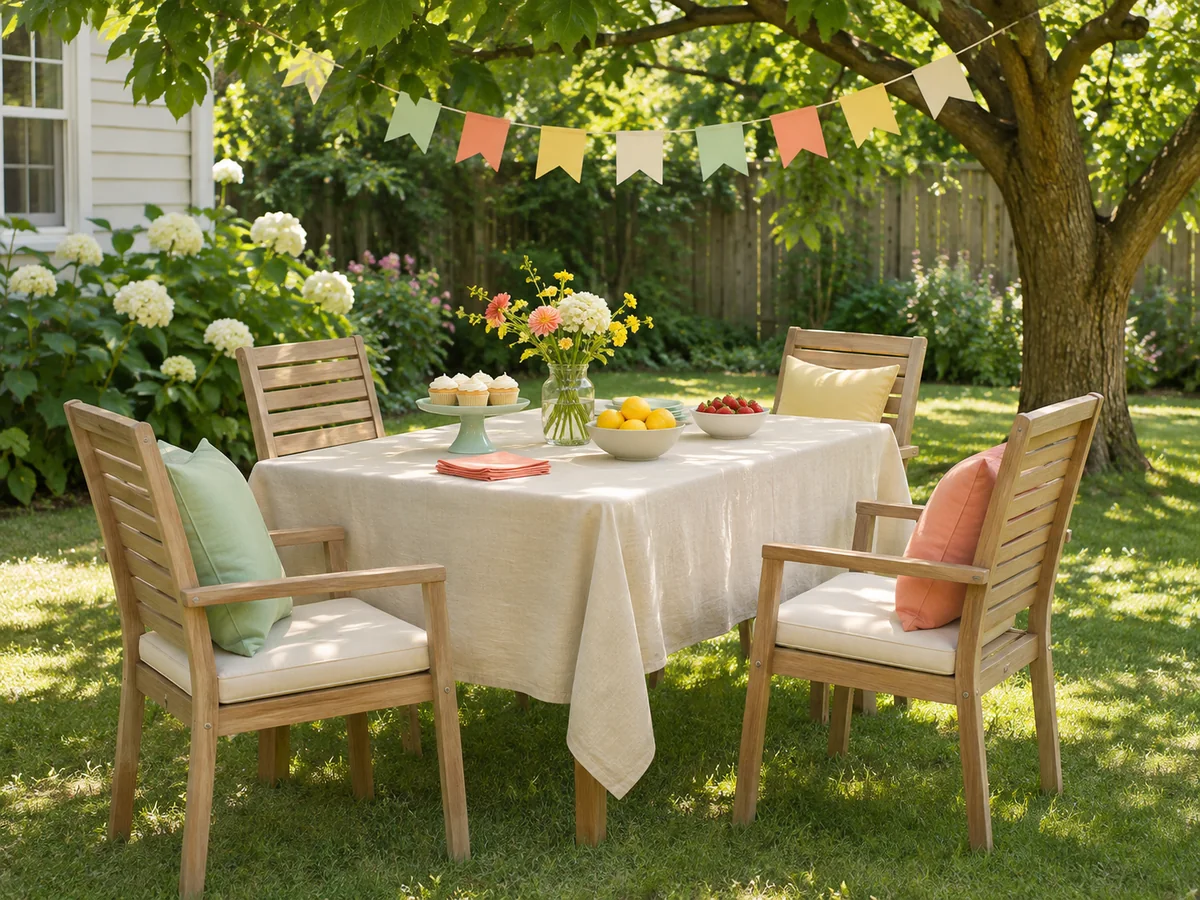
Are string lights enough for a backyard party?
Quick answer: They may be enough over a small seating area, but check the food table and walking routes separately.
Test the arrangement after dark. Can guests read the food labels, see their plates and find the door? Wherever a task is hard to do, add light there. Don't assume one strand lights the whole yard.
Can I use any string lights outside?
Quick answer: No. Don't assume a set is suitable for an outdoor party. Check the exact product's instructions and the venue's requirements first.
If you can't confirm that a set suits the location, use it in an indoor display instead or leave it out. This guide doesn't cover electrical specifications, power connections or weather ratings. Those questions are settled by the product's instructions and the venue, not by where a light looks best.
How high should I hang backyard string lights?
Quick answer: There isn't one right height. It depends on the equipment, the supports and the location, so follow the manufacturer's instructions for the lights and the mounting equipment.
Plan the party so guests aren't walking or playing under low-hanging lights. If a game area ends up under a strand, move the game rather than relying on guests to keep clear.
Lighting ideas to try in your own space
These are arrangements to test with suitable equipment in your own space. They aren't installation instructions. Try each one before deciding what to buy.
- A table party with lamps nearby: for a craft, board game or small dinner, try the room's usual lights plus a lamp beside the seats. Put out the actual supplies and sit at each place. Can guests read cards and see their work? If dimming the room makes the activity harder, keep the brighter setup. A battery light can decorate the centerpiece, but it may not light the whole table.
- String lights behind a seating area: hang them along a suitable backdrop behind the chairs, following the instructions. Repeat a color from the table if you want the decorations to go together.
- A photo corner with room for props: choose a background, then test the lights with the actual camera. Leave a separate space for the prop box and guests waiting their turn.
- A movie night with a separate snack table: test the screen and the lights together. If a light makes the picture hard to see, move the light or the seats. Then walk from a seat to the snacks and the bathroom with the movie playing.
- A quieter corner for an overnight party: keep a lit table for drawing or a board game while the group winds down. Check which lights will stay on and whether the bathroom route can still be seen. Don't assume the decorative lights used earlier will light that route.
Should I turn off the ceiling lights?
Quick answer: Try the room with them on and off before you decide.
Leave them on if the other lights don't let guests read labels, use the activity table or find their way around. You can still keep the decorative lights on as an accent.
How do I check the lighting for photos?
Quick answer: Take a test picture with the actual camera while someone stands where guests will pose.
Check faces, whether the whole group fits and the background. Then adjust the lighting or move the photo spot. If photos still don't look right, try another position and take a new test picture before adding more equipment.
What to check before buying lights
Make a list of the lights you own or can borrow, where you want to use each one and how it's powered. Check the product instructions for suitability, placement, mounting and any limits on connecting sets together. Sort out these questions before a light goes into your plan.
Once a light passes those checks, add it to your party supply list with where it will go, whether you own it or are borrowing it, and which helper is responsible for it. Any spot on your plan that still has no light beside it is a gap to fill. Our guide to party supplies to buy, borrow or prepare shows how to record each item's status and helper.
A light that works for the photo backdrop may not suit the food table or the yard. Check each use separately rather than buying several matching sets first. If your lamps and room lights already do the job, extra decorative lights are optional.
Do I need to buy special party lights?
Quick answer: Not necessarily. Start with lights you already own or can borrow, test them where you plan to use them, and buy only for a spot that still needs suitable light.
This keeps the cost tied to an actual gap rather than to the idea that a party needs new lights.
How many lights should I buy?
Quick answer: Buy for the gaps you find, not for every fence or tree. Start with the areas guests will use, the lights you already have and the distances in your setup.
The length on a box doesn't tell you how well an area will be lit. Measure the planned arrangement, write down each spot that's still too dark after your test, and check the equipment details before buying for those spots.
Example: an evening birthday in the backyard
Illustrative example: a family hosts an evening birthday in the yard, with seating on the patio, a food table by the back door, a game on the lawn and the bathroom indoors. They already own one set of string lights and two lamps. A neighbor can lend a second set.
The evening before, at about the time the party will start, they put out the food with its labels and walk the routes. The string lights over the patio seats work well. The food table is too dark to read the labels, so they put a lamp just inside the back door where it can light the table. The second set of string lights doesn't say whether it's suitable for outdoor use, so they use it inside to decorate the backup room. The lawn game would put children under a low strand, so they move the game to the other side of the lawn. That keeps children out from under the strand, but it doesn't show whether they can see in the new spot. So they set out the actual game pieces there after dark and try playing. If the light already reaching that spot doesn't let players see the pieces and the edges of the play area, they add a light they've confirmed is suitable for that spot, or move the game to another place they've already tested after dark.
They choose the living room as the backup space and check that everyone fits there, not just a small table. One adult is named as the person who changes the lights and moves people inside if needed.
| Place that needs light | Light used | Borrow or buy | Test result or change |
|---|---|---|---|
| Patio seating | Own string lights | None | Fine after dark |
| Food table | Lamp near the back door | None | Labels readable after adding the lamp |
| Back door and bathroom route | Usual house lights | None | Leave these on all evening |
| Lawn game | Light already reaching the new spot, if the test shows it's enough | None | Moved away from the low strand, then tested after dark with the actual game pieces. If it's too dark, add a suitable light or use another spot already tested |
| Indoor backup room | Borrowed string lights, room lights | Borrowed set | Checked: the whole group fits |
When to get the lighting ready
The test after dark matters more than sticking to a set number of days.
- When you choose the location: mark the food table, seats, activities, entrance and exit. Confirm any venue rules before deciding on decorations.
- About a week before: list what you own, can borrow and still need. Check the equipment details and assign setup jobs.
- The evening before: test the arrangement at roughly the time guests will be there. Put food labels out, test the camera and check the movie screen if you're using one. Write down any changes.
- Before guests arrive: put supplies where they'll be used, check everything again and confirm who will change the lights when activities finish.
Rechecking the lights is one part of a wider check before guests arrive. Drinks, any food guests will have on arrival, the first activity and a spot for bags and coats need to be in place, while later food such as dessert can be gathered to bring out later. Our guide on what should be ready before guests arrive covers that room check; the lighting steps above stay the same.
How can I keep the setup simple?
Quick answer: Plan one main activity and decorate one gathering area first. Check what you already have before buying more.
Keep the supporting jobs simple enough to explain to another adult, such as which lights to switch on and when to move inside. That makes it easier to hand a job over during the party.
If the lighting doesn't work as planned
If a space is too dim for eating or an activity, switch on the usual lights and keep the decorative lights as an accent. If the weather changes an outdoor setup, move to an indoor arrangement you've already tested. At the end of the party, make sure the route out is still lit while guests collect bags, favors and crafts.
What is a simple lighting backup?
Quick answer: Keep the usual room lights available and pick another place for food, photos or a quieter activity.
If an outdoor setup has to change, use an indoor arrangement you've checked beforehand rather than working one out on the spot.
What should I do if a light stops working?
Quick answer: Move to an area that's already lit, take the activity indoors, or finish the party earlier if what's left doesn't work.
Decide which option suits your space before guests arrive, so you aren't trying to rebuild the lighting during the party.
What is an easy backup activity?
Quick answer: Drawing, a seated guessing game or a birthday poster need little space. A snack break or photo prompt can fill a short pause.
If you'd like a drawing game ready, you could print a few drawing prompts in advance and read them aloud for players who need help with the words. Set up the backup activity where there's enough light to draw and see. Our guide to preparing printable party games includes prompts you can print.
If the whole party has to move indoors, check that the room fits everyone rather than relying on a small backup table.
Check the lights before guests arrive
Go through this list after the furniture, signs and activity supplies are in place.
- Entrance, steps, seating and the place for coats, gifts and bags are visible.
- Each food label can be read from where a guest will stand.
- Guests can see the activity supplies from their seats.
- Bathroom and exit signs can be read under the planned lighting.
- A test photo has been taken with the actual camera.
- Outdoor lights are confirmed as suitable in the product instructions and allowed by the venue.
- No game or walking route passes under low-hanging lights.
- The bathroom route is still lit with the lights you'll leave on later.
- The backup space is checked and an adult is named to change the lights.