How do I keep children occupied at a Thanksgiving gathering?
Quick answer: Set up an activity room away from the kitchen before guests arrive, with a craft table, a few games the children already know and some paper activities they can pick up and put down. Choose activities by what each child can do, ask a guest who isn't cooking to explain the rules and keep the timer, and keep one quiet backup ready, such as a short show or a game played sitting at the table. If you want an active game like backyard football, plan it before dinner with a leader who isn't the cook, and have an indoor swap ready in case it rains. The activities mean someone has to lead a game less often, but children still need an adult they can go to for help.
Start with the children who are coming
Before you choose any activities, think about the children on your guest list. Can they deal out a matching game, read a short instruction or draw without help? The answers tell you more than a list of ages. Use familiar activities for the busiest part of dinner preparation. Save a new craft with several steps for a quieter moment, when someone can explain it.
Age is a starting point, not a rule. For each activity, check whether it needs reading, multi-step instructions or a child working alone, then compare that with the children who are actually coming. More on how to choose party games for children's ages includes a checklist to use once you have picked.
Next, decide which adults will be around. Ask a willing older cousin to explain a game, but agree with the other adults who will be available when a child needs help. If every adult is busy, choose simpler activities rather than expecting the children to manage everything on their own.
Explaining a game is different from supervising. An older cousin can teach the rules, but an adult still needs to be available while others cook and serve. Agree who that is for each stretch, and tell the children where that adult will be and who to ask for help. See how adults can share supervision.
What ages does this cover?
Quick answer: Roughly ages 3 to 12. Choose activities by what each child can do, not by age alone.
Younger children can draw or match pictures with some help. Children who read can try word activities. Offer table jobs to any child who can follow that particular job, whatever their age.
If teenagers or adults want to join in, the family games further down this page work with everyone playing together.
Set up an activity room away from the kitchen
One room can hold everything: a craft table, a side table with games and a pile of paper activities. You don't need three separate tables. For two to six children, check that everyone has room to sit and keep their work. Work with the space you have rather than assuming everyone will do the craft at the same time.
Keep the activity room, any hunt and any running games out of the kitchen and away from the paths people use to carry food to the table. Let children move to another activity when they finish one.
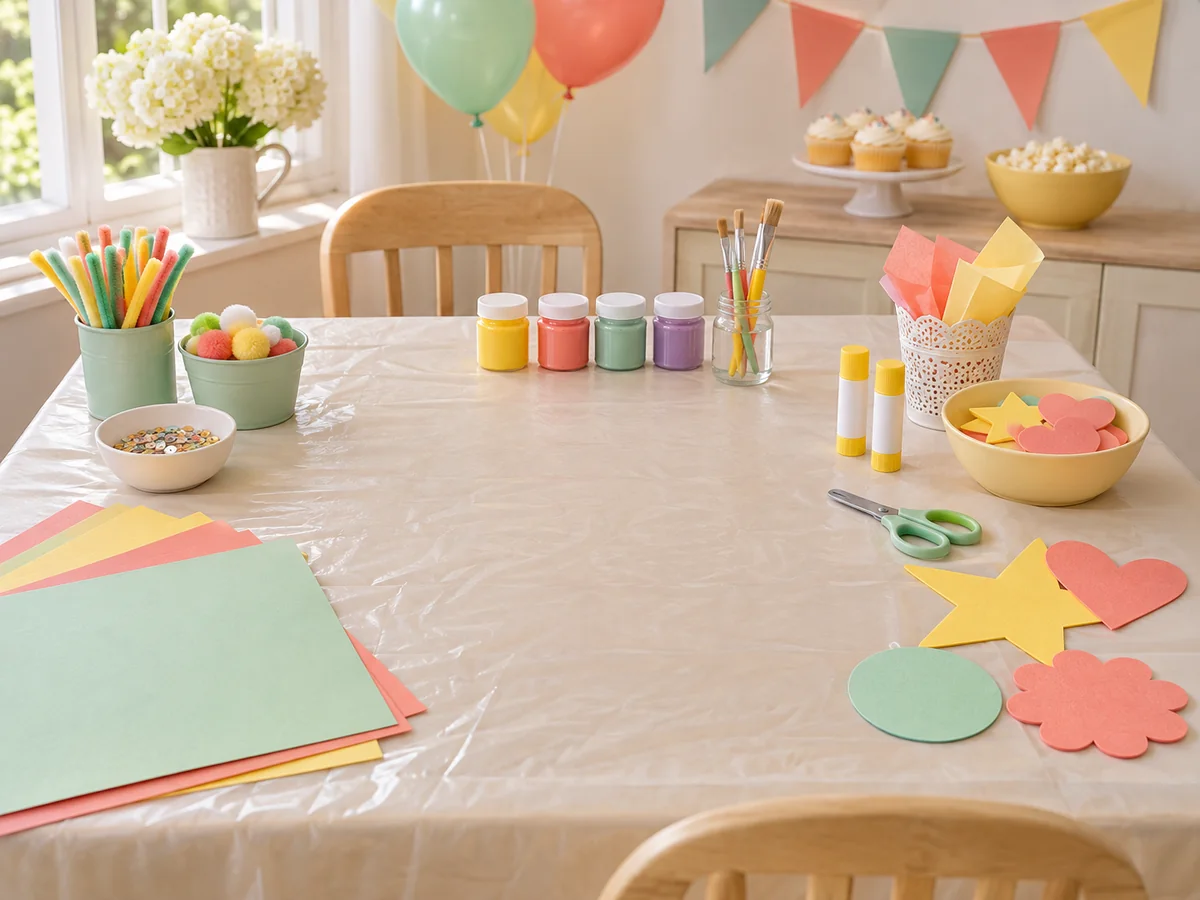
- Craft table: paper or card stock, pencils, crayons or markers, a finished example, a scrap bin or trash bag, and a place for finished work.
- Quiet games: two or three matching or card games the children already know, with each game's pieces kept together.
- Paper activities: one set of the sheets you've chosen for each child, plus three spare sets, kept in a tray so children who finish early can take another.
How do I keep craft mess out of the kitchen?
Quick answer: Keep all the craft supplies in the activity room, with one scrap bin and a place for finished projects, and give children a clear cleanup job when the timer goes off.
Paper and crayons mean nobody has to wait for glue to dry or cut anything out. Ask children to put their supplies back before they start a new activity.
A timer can tell children it's time to clean up, but they still have to do the cleaning. Explain the job before you start, for example putting pencils back and collecting loose pages.
Activities children can do with little help
For a thankful card, fold a sheet of paper in half. Children draw or write one thing they're thankful for inside, then decorate the front. A child who doesn't write yet can draw a person, a pet or a favorite thing. If you'd like a display, a helper can clip the finished cards to a string with mini clothespins.
For a hand turkey, trace around a child's hand. Add a beak and an eye to the thumb, and turn the fingers into feathers. Older children can write a funny fact on each feather, and younger children can color them in. Leave a finished example on the table so children can see what to do.
For memory match, lay the cards face down. Each player turns over two cards. If they match, the player keeps the pair. If not, turn both cards back over and the next player has a go. The game ends when every pair has been found. Use fewer pairs if you want a shorter game.
For a themed version, you can make Thanksgiving matching cards where partners match instead of identical pictures. Make the cards before the gathering and show the children which partners go together before anyone plays. Unmatched cards go back face down in the same places.
For I Spy, which needs no supplies, choose something everyone can see from their seats and say its color. The others guess. If they get stuck, tell them the answer and pass the turn to someone else.
Picture bingo is another game children can play sitting down, but someone has to call out the pictures. Prepare the boards before guests arrive. The Thanksgiving picture bingo page has 30 call names, a blank 5x5 board and a caller log, but you add the matching pictures yourself. Fill 24 squares on each board with different pictures and leave the free center square. Give each player or pair markers such as dried pasta, and choose the winning pattern before you start: a full line of five, or all four corners. The caller draws a card, says its name and holds the picture up for at least five seconds. Players cover the picture if it's on their board. When someone calls bingo, check their squares against the log. If you print any other game sheets, check before guests arrive which ones need preparing and which need an answer key.
Running games without interrupting the cook
The cook will be busy, so plan for someone else to run the games. Get everything ready before guests arrive, and agree on a stopping time in advance so nobody has to break off from cooking to end a game.
How can we play without interrupting the cook?
Quick answer: Ask another guest to explain the rules and keep the timer, and put the materials together before guests arrive.
Put cards, pencils and answer sheets in one place before guests arrive. Agree when games must stop so dinner can be served.
Younger children may still need help with reading or crafts, so make sure the person running the games knows that, or ask a second adult to help.
Games for children and grandparents together, and active games
When adults are free to join in, choose games that people can play sitting down. Offer active games separately, so guests who prefer to stay seated aren't left out.
If someone can lead and you have a separate space, you could add a movement break of about 20 minutes early in the afternoon. For example, play freeze dance: play music, pause it so everyone freezes, then start it again. Enjoy the poses without putting anyone out of the game. For a simple hunt, hide a few paper turkeys in the activity room before guests arrive. Show the children one, tell them how many to find, and keep a list of the hiding places so a helper can give hints.
Which games work when children and grandparents play together?
Quick answer: Start with picture bingo, a category round played out loud, or the thankful tree.
Everyone can play sitting down. Younger children can have a buddy to help with reading or writing. For a category round, split into two teams. Read out a category, such as "foods on our Thanksgiving table," and teams take turns giving one answer each. A new answer scores a point, and a team that repeats an answer or gets stuck passes the turn. The family games rules say to use a 30-second timer but don't say exactly how it works, so here is one way to use it: give each turn 30 seconds. If the timer runs out before the team answers, they score nothing and the turn passes to the other team. Reset the timer to 30 seconds at the start of every turn, and again when you read a new category. Play until a team reaches 10, making sure both teams have had the same number of turns. For the thankful tree, put branches in a vase with paper leaves, string and pencils. Guests write or draw one thing they're thankful for and hang the leaf. A buddy can write for younger children. Sharing at the thankful tree stays optional: hanging a leaf counts, and nobody has to read theirs aloud. The Thanksgiving games for the family page has both games in full.
Offer football separately to anyone who wants an active game.
When should we play backyard football?
Quick answer: Play before dinner, at a time when someone other than the cook can lead it.
One example schedule plays from 11:00 to 11:15 a.m. That time is only an example. Your cooking plans and when guests arrive should decide when you play.
Stop at the agreed time, even if neither team has scored three touchdowns.
What can we do if it rains?
Quick answer: Swap football for acting cards, a category round or paper football at a cleared table.
For acting cards, players take turns acting out a Thanksgiving prompt without words while their team has 60 seconds to guess. Anyone can act with a partner or pass. The prompts are on the Thanksgiving acting cards page. For paper football, fold a strip of paper into a small triangle and take turns flicking it across the table through an opponent's finger goalposts. Play the category round as described above. The full rules for all of these, including scoring, are on the Thanksgiving games for the family page. That page also has the waddle relay, where players carry a balloon between their knees to a basket and back. Only run it if you already have a suitable open space for it. You don't have to turn a crowded hallway into a playing area.
Example: a three-hour wait before dinner
This example runs from guests arriving at 1:00 p.m. to dinner at 4:00 p.m., which is 180 minutes. The steps below add up to 180 minutes: 15 + 45 + 45 + 30 + 15 + 20 + 10. The times show when you might offer each activity, not how long every child will stay interested. Keep the quiet activities available the whole time, and move the times to fit your own meal.
| Time | What to offer | Minutes |
|---|---|---|
| 1:00–1:15 | Welcome the children. Show them the activity room, where supplies go back and who they can ask for help. | 15 |
| 1:15–2:00 | Crafts: thankful cards or hand turkeys. If you have a helper, a movement break of about 20 minutes can replace part of this time. | 45 |
| 2:00–2:45 | Quiet games: memory match or picture bingo with a helper calling. Children can go back to unfinished drawings instead. | 45 |
| 2:45–3:15 | Paper activities: drawings, coloring sheets or word games. The person helping the readers keeps any answer keys. | 30 |
| 3:15–3:30 | Table jobs for children who want one, while the others keep playing. | 15 |
| 3:30–3:50 | A last quiet activity: a favorite game again, or time to finish pictures. | 20 |
| 3:50–4:00 | Tidy up, put projects aside and come to the table when dinner is ready. | 10 |
Can I use a movie or show before dinner?
Quick answer: Yes, if that suits your family. A 30-minute show near the end of the wait works, as long as you leave time to tidy up.
In the example schedule, use 3:15 to 3:20 to settle in and 3:20 to 3:50 for the show. Offer table jobs earlier to any child who wants one.
Check how long the show or film runs, so dinner doesn't interrupt it halfway through. If dinner runs late, play a familiar game again or bring out another paper activity.
A short seated game also works if the film ends before the food is ready. Choose games that need no supplies, and agree beforehand that the game ends when dinner is served, with or without a score. These games to play while waiting for food are easy to stop partway through.
Table jobs for children who want to help
Offer one job at a time to children who want it. They could fold a napkin for each seat, draw place cards, count rolls for a helper to serve, or put place cards where an adult points. Make it clear when the job is done: "Fold six napkins and put them in this basket" is easier to follow than "Help with dinner."
For a younger child, set out one folded napkin to copy. A child who writes can check names with an adult before making the place cards. Keep these jobs at the table, not in the kitchen. If a child would rather keep drawing, that's fine. The jobs are an offer, not a requirement.
What if extra children arrive?
Quick answer: Use your three spare sets of paper activities, add a game the children know, and let children take turns at the craft table if there aren't enough seats.
Extra paper helps, but also check whether you have enough space and enough adults to help. Supplies alone won't make every group easy to manage.
More children can also mean changing how a game runs. You might switch to a format where several teams play at once, or shorten turns so nobody waits too long. Check that the room has space for every team playing together. See which party games work for your group size.
Checklist: before guests arrive
- Check which children are coming, which of them read, and who can help them.
- Clear a space for crafts, games and paper activities away from the kitchen and the paths people use to carry food.
- Put out paper, crayons and a finished thankful card or hand turkey as an example.
- Choose two or three games the children know and keep each game's pieces together.
- Print one set of the sheets you've chosen for each child, plus three spare sets. Check which sheets need preparing and which need answer keys.
- Put a scrap bin by the craft table and choose a place for finished work.
- Agree who will explain the rules, keep the timer and lead any football game, and when games stop for dinner.
- Pick an indoor game to play if it rains.
- Set aside napkins and blank place cards for children who want a table job.
- Explain what children should put away when the cleanup timer goes off.