What food should I serve at a magic or wizard party?
Quick answer: Start with familiar food your child and guests already eat, then add the magic theme with names, labels and serving dishes. If the party runs over lunch or dinner, include a filling main such as spell book sandwiches. Between meals, fruit, a savory snack and one sweet can be enough. For example, you could serve crystal fruit gems, cheese stars with crackers, chocolate-dipped pretzel wands or star cake bites, and water with an optional potion drink. You don't need every idea. Check ingredients and serving arrangements with families before you shop.
Decide whether you're serving a meal or snacks
Look at the party time before you choose any themed food. If the party covers lunch or dinner, guests may arrive expecting a meal, so include something filling, such as sandwiches. If the party falls between meals, fruit, one savory snack and one sweet may be enough. Don't assume guests have already eaten. Tell families what you're serving so they can plan.
The theme comes from names, cards and dishes, not from unusual food. Wizards, potions, stars and spell books work without tying the menu to a particular movie. Ask your child which foods they want, because a clever name won't persuade a child to eat something they don't already like.
Pick one or two touches, such as potion labels or star-shaped cuts, rather than renaming every dish. Our guide on how to match party food to a theme has ideas from other themes. You can adapt them to your guests' food needs, or use just a snack, treat and drink between meals.
| Party type | Example menu (illustrative) | Notes |
|---|---|---|
| Wizard lunch or dinner | Spell book sandwiches, crystal fruit gems, star cake bites, water and a potion drink | Include a filling main |
| Wizard afternoon snacks | Plain pretzel wands, fruit cups, star cake bites, water | No main needed if guests will eat a meal elsewhere |
| Magic snack table | Cheese stars with crackers, fruit stars, chocolate-dipped pretzel wands or iced hat cookies, lemonade with frozen purple juice cubes | Choose one or two sweets, not all of them |
What do you serve at a magic or wizard kids party?
Quick answer: Serve familiar savory food with one or two themed treats. For example: spell book sandwiches, crystal fruit gems or fruit stars, cheese and crackers, wand pretzels or star cake bites, and water with an optional potion drink.
For a magic party, you could serve chocolate-dipped pretzel wands or iced hat cookies alongside fruit stars, cheese and crackers, and lemonade with frozen purple juice cubes. For a wizard party, a lunch could include spell book sandwiches, crystal fruit gems, one sweet such as wand pretzels or star cake bites, and water with an optional potion drink.
Choose the foods with your child and check requirements with families. You don't need to serve all of these ideas. A short menu of food guests will actually eat is easier to prepare and serve.
Magic and wizard food ideas to choose from
Pick a few ideas that fit together. Potion bottles and punch are alternatives, and so are pretzel wands and cake bites. You don't need a full portion of everything for every guest.
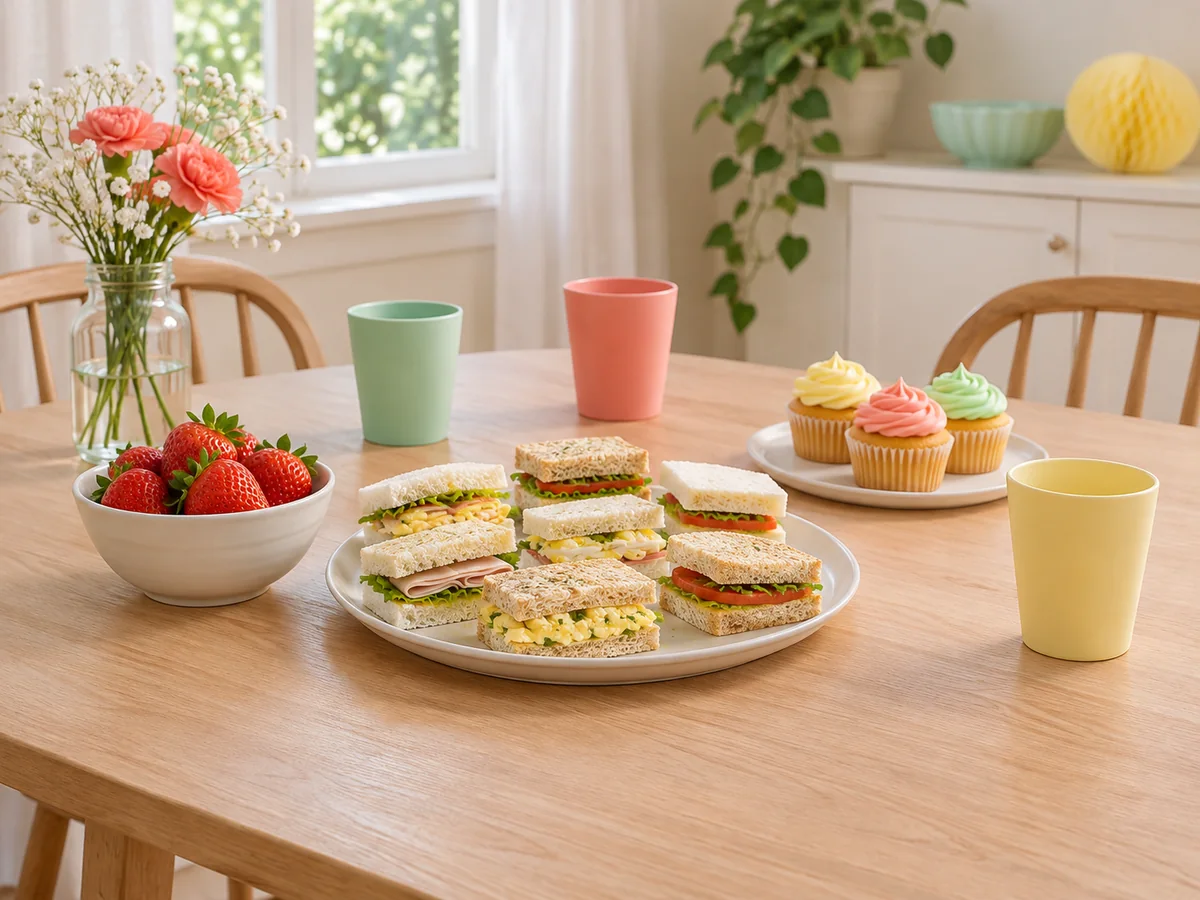
- Spell book sandwiches: cut sandwiches into quarters and stack them like little books. Turkey, cheese or a vegetable filling are suggestions. Give each filling its own tray and label, and stand folded paper 'book cover' cards beside the food rather than putting decorations into it.
- Wand pretzels: dip one end of a pretzel rod in melted chocolate and add star sprinkles before the coating sets. Follow the chocolate's melting directions and allow setting time. Plain rods labelled 'Wands' take less work.
- Hat cookies: if you buy the cones or cookies, you only need to ice and assemble them rather than follow a new baking recipe.
- Cheese stars: cut cheese into star shapes and serve with crackers.
- Crystal fruit gems or fruit stars: put fruit your guests can eat into small cups, or cut suitable fruit into stars. Portioning cups ahead gives you a count and saves passing a large bowl around.
- Star cake bites: cut a familiar or bought cake into small pieces, using a star cutter or star sprinkles. Count the pieces after cutting, because star shapes leave offcuts.
- Potion bottles: wrap small juice bottles in labels such as 'Moon Potion', keeping the actual drink name and ingredients visible.
- Cauldron punch: a purple sherbet punch in a serving bowl with a ladle. Choose a recipe first, because its ingredients, yield and directions decide what you buy and when you mix it.
- Purple lemonade: lemonade with frozen purple juice cubes.
Star shapes don't change whether a fruit suits a guest, so choose the fruit with caregivers first. Then decide how much goes in each cup. Our guide to preparing fruit and vegetable trays covers portions and preparation, and suggests gathering cups, utensils, labels and napkins ahead.
What are easy magic or wizard party snacks to make?
Quick answer: Pretzel rods (dipped in chocolate and sprinkles or left plain), cheese stars with crackers, popcorn and pretzels in labelled cups, fruit cups labelled Crystal Fruit Gems, and bought cake bites with star decorations are all simple.
Hat cookies take icing and assembly rather than baking if you buy the cones or cookies. Leave pretzels plain if you want to skip dipping. Allow setting or storage time according to the products you use.
Whatever you call the food, keep the real food name and ingredient information visible beside it.
Check food with families and think about young guests
Ask families what their child can eat before you choose products. Substitutions such as gluten-free bread for sandwiches, gluten-free pretzels, or dairy-free chocolate for wands are options to discuss. They don't prove that the finished dish suits a guest.
Check the filling, spread, pretzel, chocolate and sprinkles as well as the main ingredient. Leaving nuts off the menu doesn't mean the rest of the food meets a guest's needs. Agree on specific products and serving arrangements, including separate trays and utensils if a family asks for them. Keep any reserved serving out of the shared tray's spare-food count.
Several ideas on this menu are on the CDC's list of potential choking hazards for young children, including pretzels, popcorn, uncut grapes and berries, hard pieces of raw fruit or vegetables, and some hard or chewy candies. The CDC advises preparing food to suit each child's development and watching children while they eat. If younger children are coming, ask their caregivers how they want food served, or choose a different food. Agreeing with a caregiver doesn't make a choking hazard safe.
How do I check whether the food suits a guest with allergies, and adapt the menu?
Quick answer: Before you shop, ask the family about ingredients, specific products and serving arrangements. Share the menu, keep packaging available and follow their instructions. A swap or label on its own doesn't confirm a dish is suitable.
Before you choose any swaps or serving arrangements, agree on a plan with the family. Our guide to planning a party around a guest's food allergy suggests questions to ask. It also advises contacting the family before buying a substitute if you can't find the brand they approved.
Dairy-free chocolate, gluten-free bread or gluten-free pretzels may be options, but one substitution doesn't confirm that the rest of the food is suitable. Keep the chocolate, pretzel, sprinkle and bread packaging so you can answer questions on the day.
Labels help guests identify food. They don't replace an agreement with the family.
Work out how much food to buy
Count everyone who will eat: the birthday child, guests, siblings, other household members and any adults who stay. Add each person only once. Then decide what one portion of each food is, and add any extras on purpose.
Quantities for a meal differ from quantities for a snack table. A meal needs a filling main for everyone. On a snack table, people may take a little of several things, so you can divide portions between the options. The numbers below are illustrative shopping starting points, not predictions of what children will eat.
In this example, one main serving is one whole sandwich cut into four quarters. Fruit is half a US cup per person. One treat is one pretzel rod or one small cake piece. Check package counts and recipe yields before you shop.
Multiply each portion by the number of people eating, add any extras you want, and round up to whole packages. The party food quantity guide includes printable notes for recording drink serving sizes and how many whole sandwiches or pizzas you need.
| People eating | Whole sandwiches | Sandwich quarters | Prepared fruit | Small treats (total, includes extras) | First drinks |
|---|---|---|---|---|---|
| 8 | 8 | 32 | 4 US cups | 10 | 8, plus planned refills |
| 12 | 12 | 48 | 6 US cups | 15 | 12, plus planned refills |
| 20 | 20 | 80 | 10 US cups | 25 | 20, plus planned refills |
How do I work out drinks for a potion punch?
Quick answer: Multiply the number of planned pours by the size of each pour, including refills.
Illustrative example: 12 pours of 6 US fluid ounces is 72 fluid ounces, or 9 US cups. If everyone has a second pour, that doubles to 144 fluid ounces, or 18 US cups. This is shopping arithmetic, not a recommendation for how much a child should drink. Keep water available separately, and split your drink count between options rather than buying every drink for everyone.
Once you know the total, decide which drinks to offer and split your purchases between them, with water set out separately. Our guide to party drinks for kids compares options and shows the same pour math for cartons, whose volume you'd check separately.
Worked example: a wizard lunch for 12
Illustrative example: a party from 12:00 to 2:00 p.m. covers lunch. Twelve people will eat: nine children, including the birthday child, plus one sibling and two staying adults. Nobody else is added.
Menu: spell book sandwiches, crystal fruit gems (melon cups), wand pretzels as the only sweet, and water with bottled potion juice. There is no punch, so no punch mixing time is needed.
Amounts: 12 whole sandwiches cut into 48 quarters; 6 US cups of prepared melon (12 cups of half a cup); 15 pretzel wands (12 plus 3 spares); 12 juice bottles plus water for refills. If you serve birthday cake as well, you might make fewer wands or leave them plain.
Timing (illustrative): the night before, write the labels, gather trays, label the unopened bottles, and dip the wands if the product directions allow them to be made ahead. On party morning, prepare the melon and assemble the sandwiches at times that suit those foods, then keep them in the refrigerator until serving. At about 12:45, bring out the sandwiches and fruit. Clear the perishable food by 2:00, or by 1:45 if the room is above 90 F. These clear times assume the food stayed refrigerated until 12:45; if it spent time out during preparation, transport or setup, clear it earlier by that amount. The wands and unopened bottles don't need the same timing as the perishable food.
Leftovers: add up all the time each perishable dish has spent out of the refrigerator, including preparation, transport, setup and serving. If the total is still under two hours (one hour above 90 F), put it straight back in the refrigerator. If the total has reached that limit, throw it away. Putting food back in the refrigerator doesn't undo time it has already spent out.
For food that is still within its limit, the next steps are putting it away and clearing up. Our guide on what to do with leftover party food gives a checklist for checking each perishable dish's time out and storage directions before it goes back in the fridge.
Prepare ahead and keep food cold while serving
You can write labels, arrange serving supplies and make some treats ahead if the recipe or product directions allow it. Schedule sandwich assembly, fruit preparation and any punch mixing to suit the foods you've chosen. These are planning stages, not storage limits.
Treats, sandwiches and fruit each have their own timing. Our answer on what party food you can prepare ahead covers them one by one. For example, cupcakes and sandwich ingredients can be prepared early if their recipe or package allows, while fruit cups are made on party morning.
FDA buffet guidance says cold food should stay at 40 F or below. Perishable food shouldn't stay at room temperature for more than two hours, or one hour above 90 F. Add up all the time a dish spends out of the refrigerator, including preparation, transport and setup, not just the time on the table. Once a perishable dish passes that limit, throw it away rather than refrigerating it. Bring out fresh trays rather than adding food to a dish that's already been out, and keep any reserve trays in the refrigerator until you need them.
Put the real food name below each playful name. For example: 'Spell Books: turkey sandwiches', followed by the bread, turkey and spread you actually used. Don't copy ingredient details from an example onto a dish made with different products.
Wizard party food checklist
- Decide whether the party time calls for a meal or snacks.
- Count everyone eating once: the birthday child, guests, siblings, household members and staying adults.
- Choose a short menu with your child, with one drink option and one or two sweets.
- Ask families about ingredients, products and serving arrangements before you shop.
- Check whether younger children are coming and how their caregivers want food served.
- Work out quantities from the portions, package counts and recipe yields.
- Write cards with the theme name, real food name and ingredients.
- Plan when perishable food comes out and when you'll clear it, counting any earlier time out of the refrigerator.
- Throw away perishable leftovers that have passed the time limit; refrigerate the rest straight away.
- Ask someone to help with drinks and serving.