When should I move an outdoor party indoors or change the plan?
Quick answer: Before party day, decide what will end the outdoor plan, who will make that call and when families will hear about it. Then check that your indoor backup fits everyone who is coming, along with the activity, food and coats. On the day, go inside, or start inside, when the conditions you agreed on happen or when local alerts, venue rules or equipment instructions say so. If no space fits the whole group, delay, postpone or cancel before guests travel. Don't squeeze everyone into a room that only holds part of the party.
Decide before the party when you will go inside
Write down what will end the outdoor activity, who will make that decision and when you will check the forecast. For example, you might decide to serve food indoors if steady rain starts, or if guests keep having to hold their plates down in the wind. These are practical hosting decisions. They are not weather-safety thresholds.
A clear weather decision names four things: the person deciding, the conditions they will look at, the local guidance and venue or equipment requirements they will follow, and the deadline for contacting families. Saying we'll see on the day leaves all of that unanswered. Pick a deadline that gives families time to hear about any change before they leave home.
Keep the decision with your host notes so nobody has to remember a conversation. If conditions become dangerous, getting people indoors comes before finishing a game or rescuing supplies.
| What might change the party | What to decide beforehand |
|---|---|
| Rain during the party | Which activities can move indoors, and when you will tell guests about a change |
| Wind affecting the setup | Which equipment instructions need checking, and where everyone will gather instead |
| Heat making the outdoor plan unsuitable | Whether the indoor room is a workable alternative, or whether the party needs to be postponed |
| A local weather alert or warning | Who will check the instructions that apply and contact guests |
What weather means a party has to move indoors?
Quick answer: There is no universal party cutoff for wind or heat. Check local forecasts and alerts, venue requirements and equipment instructions, and agree separately what will end your own outdoor activity.
One wind speed or heat-index number can't show that every party setup is safe. Confirm equipment limits with the venue, rental company or manufacturer. Your own rule, such as steady rain making the planned game impractical, is a hosting choice. It doesn't mean that conditions short of it are safe.
Wind limits depend on the location and on each piece of equipment, so use the forecast, the venue and equipment instructions. A rule you set yourself as host is still not a safety threshold. The guide to changing an outdoor party plan for wind explains this.
Does a forecast below 60% mean we should stay outdoors?
Quick answer: No. The percentage suggested in the rain-plan guide is one way to organize your decision, not a guarantee of what will happen.
Look at the forecast for the hours of the party, the activities you have planned, the space available and any local guidance or equipment rules that apply. You can decide to start indoors even when the chance of rain is below that percentage, if that works better for your arrangements.
Should I keep checking the weather after the decision deadline?
Quick answer: You can keep checking, but send guests the confirmed arrangements at the time you promised.
If something then changes those arrangements, send another clear update and check that the families affected have seen it. Waiting past your own deadline usually leaves families unsure where to go.
What counts as a clear weather decision?
Quick answer: A written plan that names who decides, what conditions they will look at, which local guidance and venue or equipment requirements they will follow, and when families will hear.
Saying we'll see on the day leaves all four of those questions open. Write the plan down with your host notes so another adult can follow it. It is a hosting arrangement, not a safety threshold: it doesn't tell you which conditions are safe, so local alerts and equipment instructions still apply.
Check that the indoor room fits everyone
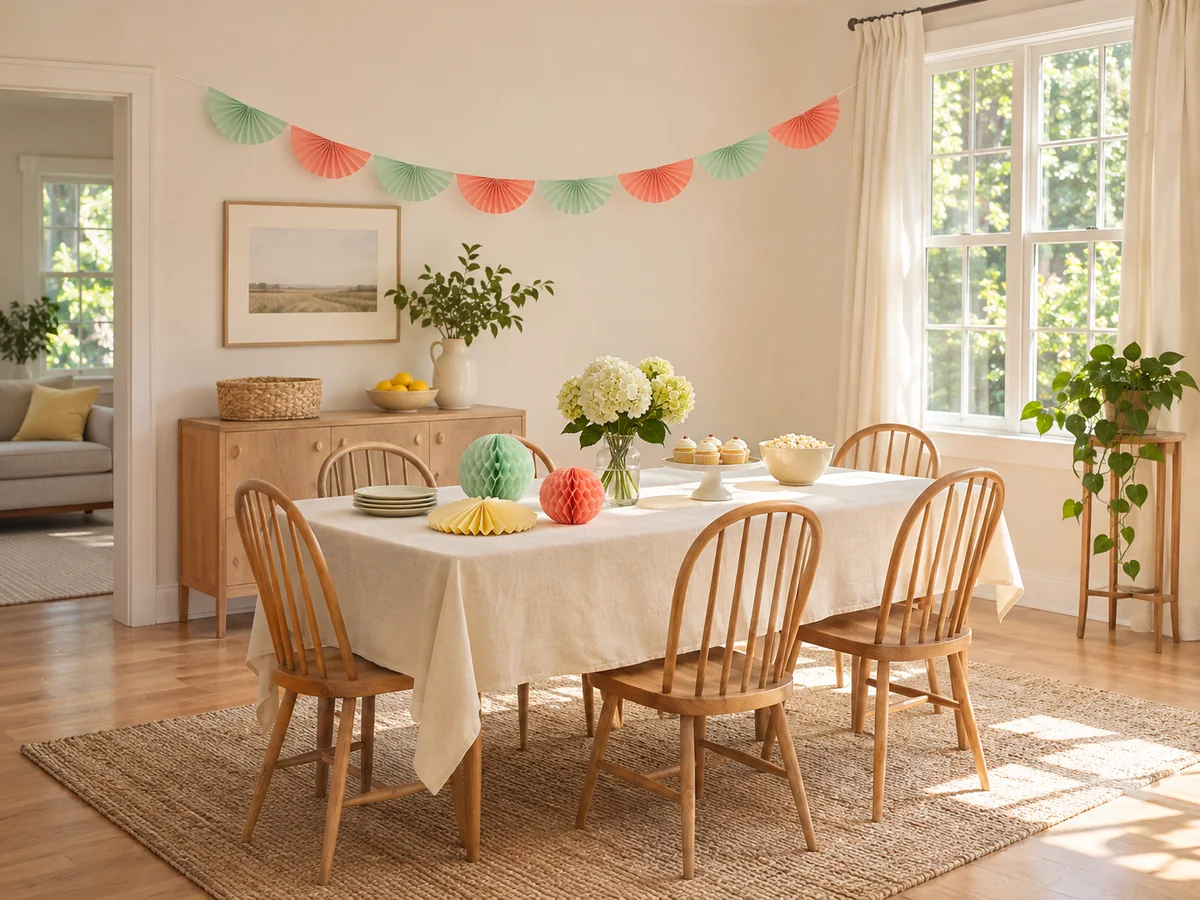
Check the room against the full head count: every child, including the birthday child, plus siblings, parents who are staying, hosts and helpers. Count each person once. Set out the chairs and tables you plan to use instead of picturing a crowd in an empty room.
Can everyone sit down or join the indoor activity? Can you serve food without blocking the entrance? Where will wet coats, bags and craft projects go? With the furniture in place, walk from the entrance to the seating, the food and the bathrooms, and check any access arrangements guests have asked for. Moving inside doesn't add bathrooms, so count the ones guests can actually use.
Decide what each activity needs. An outdoor game can use the yard, while food, seated activities and gift opening can use the indoor room. A single table can't hold a craft, spare decorations and the meal at the same time unless someone has time to clear it between uses.
What if my indoor space is too small for everyone?
Quick answer: A room that holds only part of the group is not a complete indoor plan. Shorten the guest list before inviting people, confirm another venue, or arrange to postpone.
Don't tell families the party is moving indoors until you know where the whole group can be. A covered food table doesn't give the whole party room to gather. If you are using another venue, you need confirmed availability and an address guests can find, and you need to tell families before they travel.
Does using two spaces mean I need another adult?
Quick answer: For a children's party, work out who stays with each group and who handles food and arrivals. If the plan needs you in two places at once, confirm help or keep the children together and use the spaces one after the other.
An adult who might be able to help doesn't solve the problem until they have agreed to it. The same goes for mixed ages. Offering a seated activity alongside the active game can ease crowding, but don't expect children to split up neatly by age. Decide who will help at each activity. If you can't cover both, run the activities one after the other.
How do I decide what goes outside and what goes inside?
Quick answer: Start with the space each activity needs. Outdoor games can use the yard, while food, seated activities and gift opening can use the indoor room.
Give each activity its space, then keep the route between the yard and the indoor room clear so the doorway doesn't get crowded. The indoor room still needs to fit the whole guest list. The guide to splitting a party between indoor and outdoor spaces explains how.
Before relying on the indoor room for that part of the party, check that it fits the whole guest list, not just the people at one activity. If rain ends the outdoor part, everyone will need to fit inside at the same time.
How do I keep younger and older children from crowding the same activity?
Quick answer: Offer a seated activity as well as the active game, and decide which adult will help at each one.
Don't assume children will divide neatly by age; some younger children will want the active game and some older ones will want to sit. If you can't cover both activities with confirmed adults, run them one after the other instead of side by side.
If there's no indoor backup
At a park or another place with no building you can use, decide your alternative when you book. That alternative might be a confirmed second location, a different date or cancellation. Tell families which one it is, and when they will hear the final decision, before party day.
Settle the details with the venue contact when you book: the confirmed alternative, what happens if you postpone, and when families will hear. The guide to an outdoor birthday party with no indoor backup also asks which bathroom guests can use.
Check bathrooms as part of that plan. Guests need a confirmed restroom on site, a booked portable unit, or a nearby building where guest access has been agreed. Check its opening hours and the route to it before you book the venue, and tell helpers where to send guests.
Is a rented tent an indoor backup?
Quick answer: No. Ask the supplier what cover the tent provides and which conditions limit its use.
If the party can't go ahead within those limits, fall back on your postponement or cancellation plan. Don't assume a tent can replace a building.
How far ahead should I book a tent or other shelter?
Quick answer: Start asking about two weeks before the party if you can, or earlier if the venue or supplier requires it.
Confirm availability, notice periods and prices directly with the supplier. There is no guarantee of a last-minute booking or rate.
Where can guests use the bathroom if there's no house nearby?
Quick answer: Use a confirmed restroom on site, a booked portable unit, or a nearby building where guest access has been agreed.
Check the opening hours and the route before you book the party venue, not on the day. Tell helpers where to send guests so nobody has to ask around.
How to keep the same party plan if it rains
Keep what works: the guest list, the meal or snacks, the cake and the finish time. Change only the parts that need the yard. A projector film can move to the TV, and yard games can become table games. Check seats and space before you promise guests the alternative. A projector alone isn't a complete backup plan for an outdoor movie party.
Pick a replacement you can start with supplies already in the room. You don't need to prepare every possible game. One main indoor activity and a short option for waiting times may be enough.
- Spotting hunt: write a new list of household objects to find indoors.
- Toss game: use rolled socks and a laundry basket if you have room, and keep the same turn and scoring rules.
- Tag, slope races and hose games: choose a different activity, since these don't have a sensible indoor version.
- Running games at an egg-themed party: swap them for a table activity or an indoor hide-and-seek with plastic eggs. Save an egg toss for a space with enough room where breakable items are out of the way.
- Geocaching or treasure hunt: have the indoor containers and replacement clue cards ready before guests arrive. Stop the outdoor hunt right away if thunder or driving rain interrupts it.
- Tie-dye: use a covered work area only if it fits everyone and meets the product's setup and handling directions. Otherwise keep the folding, games and cake, and arrange the dyeing for another time. Confirm the change with families, including who will dye the shirts and how they will get back to each guest.
- Foam darts: play indoors only if the cleared room and the equipment instructions allow it. The foam-dart party plan describes pump-action blasters, walking pace and five-minute rounds with boundaries set for the room. Otherwise switch to the seated activity you arranged in advance.
- Relay: turn it into a seated category game, such as taking turns naming an animal you might see at a park.
What can children do when the party moves indoors?
Quick answer: Try seated drawing and guessing, cup stacking at a table or a board game the children know.
Choose activities you already have supplies for, with enough places for everyone to join in. Keep paper and pencils out for anyone who wants something quieter. If the indoor activity finishes early, offer drawing prompts, a puzzle or a short seated game, repeat a game the children enjoyed, or serve the food earlier. Keep the finish time clear rather than filling every minute. A rained-out daytime party doesn't turn into a sleepover. Agree any overnight change with families first.
Should I change the food when the party moves indoors?
Quick answer: Keep the menu if you can prepare and serve it indoors with the help you have. Replace anything that relies on outdoor equipment you will no longer use.
Confirm food needs with families, and say clearly whether you are serving a meal or snacks. Put small duplicates, such as napkins and trash bags, wherever they will be useful. Keep one labelled spot for shared equipment, and write down who will bring it inside. You don't need two of everything.
Can I keep the original cake and pickup times?
Quick answer: Yes, if the new activities and food fit around them.
If you delay the start, decide separately whether pickup moves too. Don't assume families can stay an extra hour. Include the confirmed finish time in your rain-plan message.
How can we keep the same plan if it rains?
Quick answer: Keep the guest list and the meal, and move only the activity indoors. Check seats and space first, and tell guests where to arrive if the location changes.
A projector film can move to the TV, and yard games can become table games. Promise the indoor version only after you have checked that everyone has a seat and room to take part. If guests need to come to a different address or entrance, send that before they travel.
Do I need to prepare every replacement game?
Quick answer: No. Choose replacements only for the activities in your own party plan.
One main indoor activity and a short option for waiting times may be enough. Check the room and the supplies you already have before deciding which ones to prepare.
Do I need separate supplies for indoors and outdoors?
Quick answer: No. Duplicate small items such as napkins and trash bags where they help, and keep shared equipment in one labelled place.
Write down who will bring the shared equipment inside if the outdoor activity stops, so nobody has to leave the children to go looking for it. You don't need two of everything.
What if the indoor activity finishes early?
Quick answer: Offer drawing prompts, a puzzle or a short seated game, repeat a game the children enjoyed, or bring the food forward.
Keep the finish time clear rather than adding activities just to fill every minute. If the party is a sleepover families have already agreed to, plan the evening and the morning separately: dinner and snacks for the evening, then breakfast, gathering belongings and pickup for the morning. Rain doesn't turn a daytime party into a sleepover; confirm any overnight change with families first.
What if it rains during a backyard campout sleepover?
Quick answer: Use the indoor sleeping space you arranged before the party, and move the meals and games inside. If the whole group won't fit indoors, postpone or cancel before families travel.
This applies only to a sleepover families have already agreed to. Before sending invitations, check that the indoor space has room for everyone to sleep, not just to sit for an evening. Tell families in advance whether you will postpone or cancel if the group won't fit, and when you will contact them. Plan the evening and the morning separately so dinner, games, breakfast and pickup all have a place indoors.
Worked example: moving a backyard party inside
Example only. A backyard birthday runs from 2:00 to 4:00 p.m. Twelve children are invited, including the birthday child, and one younger sibling will also be there. Three parents are staying, and two hosts are running the party. That makes 13 children and 5 adults, 18 people in all. Before sending invitations, the hosts set out the living room with the table and chairs they plan to use and checked that all 18 people fit, with space for coats by the door and a clear route to the one bathroom.
Host A decides on the weather and contacts families. The deadline for contacting families is 10:00 a.m. on party day. Their own rule is that if steady rain starts, outdoor games end and drawing starts at the indoor table. Drawing paper, markers, plates and the cake stand are already set out inside.
The timeline below shows one routine move. It assumes the room is already prepared, two adults are available and conditions allow one of them to collect supplies. The four steps add up to 20 minutes. Use it to plan helper jobs, not as a pace you have to hit or as an emergency procedure. Get people indoors before supplies, and drop the timetable completely if conditions become dangerous.
| Time | Step | Who |
|---|---|---|
| 0:00 to 0:01 (1 min) | Announce the move: We're going inside now. We'll sit at the table and start a drawing. | Host A |
| 0:01 to 0:05 (4 min) | Bring guests through the prepared entrance, help anyone who needs it, check the guest list once everyone is inside. Keep the doorway clear. | Host A |
| 0:05 to 0:15 (10 min) | Host A starts and supervises the activity. Host B brings food, drinks, cake and needed supplies inside if conditions allow. | Host A with guests, Host B on supplies |
| 0:15 to 0:20 (5 min) | Decide whether to keep drawing or serve food, send any parent update, and confirm the 4:00 p.m. finish. | Hosts A and B |
Who should handle food and supplies during the move?
Quick answer: If you have confirmed help, make carrying food and supplies a separate job from watching the guests. People go indoors first, and supplies come in only when conditions allow.
Give specific directions, such as put the cake and plates on the kitchen counter, rather than sort out the food. If you are hosting alone, set out the indoor activity and serving supplies before guests arrive. Bring everyone in together, and leave outdoor jobs until you can do them without leaving the children unattended. The time a move takes depends on the room, guests' needs, the route and how much equipment there is, so don't promise a fixed time.
If you're hosting alone, set out cake plates, utensils and the indoor activity before anyone arrives, so there is less to carry when the group moves inside. Anything still outside can wait until you can fetch it without leaving the children. The guide to hosting a children's party without a co-host lists what to finish before guests arrive.
How do I move the party without making it feel like a failure?
Quick answer: Tell guests beforehand that you have an indoor activity ready. When you move, tell them where they are going and what happens next.
Something short is enough: We're going inside for food now. Please come through this door. A prepared room and clear directions give guests something to do without a long explanation, and you don't need to apologize for using the room you got ready.
How to tell guests the party has moved or changed
Before party day, tell parents what your options are (moving indoors, a different date or cancelling), when you will decide and how you will let them know. If families haven't arrived yet, send the confirmed location, entrance and directions as soon as you decide. If it's a drop-off party and children are already there, tell parents about any change to the address or pickup.
Post the update in the same thread as the invitation so families can find it. Fill in the real address, entrance, parking directions and finish time before you send it. For example: We're moving the party indoors. Please use the entrance and parking directions below. We'll have an indoor activity, food and cake. I'll confirm the address and finish time here too. Let me know if the change affects your plans or the arrangements you need.
What should I say if I cancel on the morning of the party?
Quick answer: Say clearly that today's party will not go ahead, and give the new date, times and location if you have confirmed them.
If you haven't set a new date, say whether you will send one later or are cancelling without rescheduling. Follow up with any family who hasn't seen the message.
Should you delay, postpone or cancel?
Moving indoors works when you have a suitable space, enough help and time to get it ready. If any of those is missing, postponing may be more practical than squeezing an outdoor party into the wrong room. A local weather warning means following the instructions that apply to your area. This guide can't tell you whether travel, the venue or outdoor equipment is suitable.
Don't base the decision on one kind of weather. What matters is whether you have a workable plan for the conditions and your guests, including getting there and home again.
Should I delay or cancel a party because of rain?
Quick answer: First check whether you have a suitable indoor location, enough help and time to prepare it. If you can't fit the group in, postponing or cancelling may be necessary.
Delaying the start by an hour may help, but confirm the delay with families and check any food orders before you rely on it.
Should I cancel instead of moving indoors?
Quick answer: It depends on the conditions, local instructions and whether the alternative venue and travel work. Postpone or cancel if you can't confirm a plan that works.
An ordinary change of activity can often be handled indoors, but a prepared room doesn't solve every weather problem.
Checklist for your rain plan
Fill this in before you send invitations, and keep guest contact details on the host's own copy.
- Indoor room or confirmed other address, checked with furniture in place
- Full head count: children, including the birthday child, siblings, staying adults and helpers, each counted once
- Indoor activity and supplies already in the room
- Where the food, cake, coats and bags will go
- Entrance, bathroom route and any access arrangements guests have asked for
- Who decides, what conditions end outdoor play, and the time families will hear
- Equipment, tent or venue instructions still to confirm
- Who brings guests in, who handles supplies, who sends updates
- Confirmed finish time and pickup arrangements
- What happens if the indoor plan can't be used: another venue, a new date or cancelling
Sources and further reading
- When to Move an Outdoor Party Indoors
- When to Activate the Rain Plan for an Outdoor Party
- The Rainy Day Party Plan
- Rainy Day Party Plan
- How to Split a Party Between Indoor and Outdoor Spaces
- Outdoor Birthday Party With No Indoor Backup
- 15th Birthday Party Ideas
- Backyard Campout Sleepover
- Outdoor Party Games That Use What's Already in the Yard
- Easter Party Games Beyond the Egg Hunt
- Geocaching birthday party plan
- Tie-dye birthday party plan
- How to Plan an After-School Birthday Party
- Foam-dart birthday party plan