What should I serve at a breakfast or brunch party?
Quick answer: Serve a small spread that's easy to put out: one main bite, a fresh side, a snack, a small treat and drinks. Base it on your confirmed guest count and on whether the party runs into a mealtime. If guests have already had breakfast, muffins, fruit or half bagels may be enough. Add a savory choice if everything else is sweet, and serve something more filling if the party runs toward lunch. Put coffee for staying adults in its own area, away from the children, and ask families about food needs before you shop.
How to decide what to serve at a morning party
A breakfast or brunch party doesn't need a full cooked meal. Start with two things: how many people you've confirmed, and whether the party overlaps a meal. A short party mid-morning, after guests have eaten breakfast, can get by with a few easy bites. A party that starts early, or one that runs toward noon, needs more filling food.
Once you know which kind of morning you're planning, our breakfast party menu gives combinations to choose from. If guests have already eaten, muffins, fruit or half bagels may be enough, with a savory option if everything else is sweet. Plan something more filling if the party runs toward lunch.
A light spread usually covers five things: a main bite, a fresh side, a snack, a small treat and drinks. Pick foods your guests can actually eat and that you can put out without standing at the stove. Whether guests need to eat with one hand depends on your setup. It helps when people are standing and holding a drink. It matters less if everyone has a seat at a table.
When you count guests, decide who is included. Your count may or may not include the birthday child, siblings, people who live in your home and parents who stay. Write down each group once so nobody is counted twice or left out. Count adults who want coffee separately, because the number of children doesn't tell you how many adults will stay.
What should I serve at a 10 a.m. party?
Quick answer: If guests have eaten breakfast, a few easy bites such as muffins, fruit or half bagels may be enough. Add a savory option if everything else is sweet, and plan something more filling if the party runs toward lunch.
At 10 a.m., some guests will have eaten recently and others won't have. A mix of sweet and savory food gives everyone a choice. If the party ends around noon, add something more substantial, such as a savory main bite, rather than relying on snacks alone.
For a worked example, our 10 a.m. birthday party menu plan includes a schedule. If it suits your party, the cake comes out around 11 a.m., once guests have had time to arrive and eat. Change the food to suit your guests, and keep a savory main bite if the party continues toward noon.
How much food to plan
Food amounts depend on whether you're serving a meal or a snack table. For a meal, plan enough of the main bite for everyone who will eat. For a snack table between meals, smaller amounts of several foods are often enough. Any per-person numbers you use are planning estimates. Adjust them for the other foods on the table, the guests and how long the party lasts.
Smaller trays help here. Bring out part of the food at the start and keep the rest back to refill. This makes it easier to match what people actually eat, and the table stays tidier.
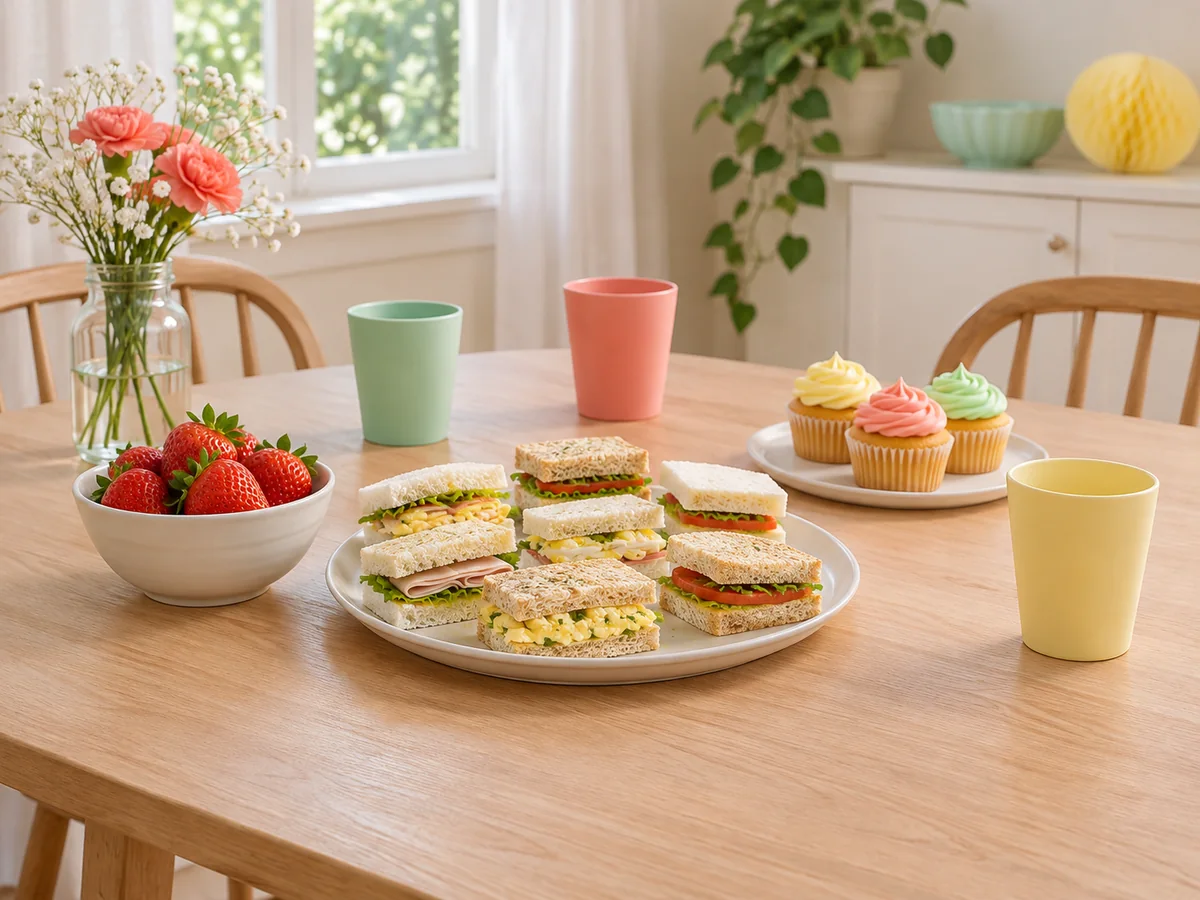
How much food should I serve at a breakfast or brunch party?
Quick answer: Start with your confirmed headcount and decide whether the party overlaps a meal. Treat any portion figures as starting estimates, then adjust for the party time, its length and the other food you're serving.
If the party runs toward lunch, plan a more substantial savory choice. If it falls between meals, a lighter spread may be enough. As one example from a coffee station plan, one or two mini muffins per adult gives 12 to 24 mini muffins for twelve adults. That's an example, not a rule.
Example: a 10 a.m. brunch birthday party
This example is for illustration only. Change the foods, numbers and times to fit your guests. It assumes 12 children, including the birthday child and one sibling. It also assumes 6 adults who are staying: you, plus 5 parents who said they'd stay for coffee. The party runs from 10:00 a.m. to 12:00 p.m., so it overlaps the run-up to lunch, which is why the menu includes a savory main bite.
Example menu: half bagels with cream cheese as the savory main bite, a fresh fruit tray as the side, mini muffins in two flavors as the snack, the birthday cake as the treat, and juice or water for the children. Coffee for the adults goes in a separate area. Check every item against the food needs families have told you about.
Coffee for this example: 6 adult drinkers plus 2 extra servings is 8 servings. At 8 fluid ounces each, that's 8 × 8 = 64 fluid ounces. Check that your brewer and carafe can hold that much.
In this schedule, the cream, the cream-cheese bagels and the fruit stay in the fridge until they're needed. Cream comes out with the coffee at 10:00, and the bagels and fruit come out at 10:15. When plates are cleared at 11:15, those foods go back in the fridge, so none of them sits out for more than about an hour and a quarter. Follow the storage directions on each food.
| Time (example) | What happens | Food and drinks |
|---|---|---|
| 9:35 to 9:45 a.m. | Brew coffee (10 minutes in this example; check your machine's cycle) | Coffee into the carafe |
| 9:45 to 10:00 a.m. | Finish setting up and check labels | Cups, sugar, napkins and mini muffins out; cream, bagels and fruit stay in the fridge |
| 10:00 to 10:15 a.m. | Guests arrive; a quiet drawing activity at the table | Coffee and cream for adults; children's drinks in their own area |
| 10:15 to 10:45 a.m. | Brunch | Half bagels and fruit tray from the fridge, plus mini muffins |
| 10:45 to 11:15 a.m. | Main activity | Refill drinks as needed |
| 11:15 to 11:35 a.m. | Clear plates and put leftover bagels, fruit and cream back in the fridge, then cake | Birthday cake |
| 11:35 a.m. to 12:00 p.m. | Pickup | Pack away the remaining leftovers |
When to serve food and what to prepare ahead
Eating comes before the most active part of the party in this example. Guests who arrive hungry get to eat first, and cake comes after the activity. If your venue or your guests need a different order, change it, and tell your helpers when food will be served.
Labels, serving trays, dry snacks, drink supplies and some desserts can be organized the day before. Prepare fresh fruit and cold foods closer to serving time, as their directions allow. A recipe that is meant to be made ahead can be made ahead. Follow the recipe or the package for storage. A prep schedule is not a storage rule.
A two-part list helps here. The night-before list covers labels, trays, dry snacks and drink supplies. The party-morning list covers fresh fruit and cold foods. Our guide to what party food you can prepare ahead explains why a dish's ingredients, directions and storage decide whether it can be made early.
Food safety guidance from the FDA says to keep cold food at 40°F or below, and not to leave perishable food at room temperature for more than 2 hours, or 1 hour when it's above 90°F.
Should I serve food before or after games?
Quick answer: If guests arrive hungry or the party overlaps a meal, serve the main food before the most active part of the party. For a shorter party between meals, snacks may be enough.
Choose the order that fits your activity, and leave clear time for cake and pickup. A quiet activity at the table can fill the time while guests are arriving.
To make sure there's time for cake, work backward from pickup. Write down the start time, the pickup time and any time the venue must be empty, then allow time for singing, serving and eating. Our guide to when to serve birthday cake or cupcakes includes a checklist for this.
Coffee and drinks for adults who stay
Count expected coffee drinkers separately. Use 8 fluid ounces per serving as a starting allowance, then add the number of refills you want to offer: coffee to make = (first servings + extra servings) × 8 fluid ounces. For eight adults and two extra servings, that's 80 fluid ounces. A coffee maker's marked 'cup' may be smaller than 8 fluid ounces, so check its usable capacity in fluid ounces.
Keep the coffee in an adult serving area away from play. Leave room to pour without blocking the door. Keep children's drinks in a separate area. A carafe means the brewer doesn't have to sit on the serving table, but the coffee is still hot. Putting it on a high surface alone does not remove the risks of hot drinks. Follow the instructions for your equipment.
How much coffee do I need for drop-off?
Quick answer: Plan 8 fluid ounces per expected coffee drinker, then add any refills you want to offer. For eight adults and two extra servings, that's 80 fluid ounces.
Raise the allowance if people pour larger cups or stay longer. If the coffee won't fit in one carafe, borrow a second one or ask a helper to brew a second batch.
What if only two or three parents stay?
Quick answer: For three adults having one 8-fluid-ounce serving each, plan 24 fluid ounces. Adding one extra serving makes 32 fluid ounces.
Check your brewer's minimum batch size. A single-serve brewer or pour-over also works, but someone will need to make each cup.
Should I brew coffee before parents arrive or as they arrive?
Quick answer: Aim to have coffee ready 15 minutes before the earliest arrival. Work backward from how long your machine takes to brew.
When you pour the coffee into the carafe, follow the carafe's instructions. Brewing ahead lets you greet guests, but you may still need a second batch.
Do I need to offer decaf or tea?
Quick answer: Ask the adults you expect to serve. A small, labeled carafe of decaf, or hot water with tea bags, can cover their preferences.
Label the regular coffee, the decaf and the hot water so nobody mixes them up.
Keeping the food table tidy
Use smaller trays and refill them, and use cups or ready-made portions for foods that are easier to carry that way. Keep napkins, wipes, a trash bin and recycling close to the table. Ask someone to clear used plates before dessert so the same table is ready for the birthday moment.
Setting the table in the order guests serve themselves also helps: plates first, then food portions, then drinks, so people can move along without getting in the way of refills or clearing. Our food table setup guide also suggests giving the refilling and plate-clearing jobs to specific people rather than leaving them for whoever notices.
For young children, take care with how food is prepared. The CDC lists whole grapes, hard raw fruit and vegetables, and popcorn as choking hazards for young children.
Asking guests about food needs
Ask families to tell you about food needs before you shop. Share what you plan to serve, label dishes with their known ingredients, and keep the packaging so guests can check it themselves.
Before you buy or swap a food, confirm the exact item, its ingredients and how it will be served with the family it affects. If you agree on an alternative, keep it separate with its own utensil, as the family asks. Don't promise that it's allergy-safe. A label such as dairy-free does not mean a food suits every guest.
Checklist before guests arrive
- Confirm the headcount and write down who it includes.
- Decide whether the party overlaps a meal, and choose a main bite, a fresh side, a snack, a treat and drinks.
- Collect food needs from families and confirm any alternatives with them.
- Work out the coffee amount and check your brewer and carafe capacity.
- Have coffee ready 15 minutes before the first arrival.
- Keep cold foods in the fridge until serving, and plan when they go back.
- Label dishes and drinks, and keep packaging nearby.
- Keep the adults' hot drinks separate from the children's drinks and the play area.
- Put out smaller trays and keep napkins, wipes and bins close.
- Tell helpers when food and cake will be served.