What party foods are easy to eat without making a mess?
Quick answer: Pick food that comes in small portions, doesn't need a spoon, doesn't drip sauce and stays together in one hand. Good examples are cheese and crackers in cups, ham and cheese roll-ups, popcorn in bags, plain pretzel rods and fruit cups. Before you choose the menu, decide where guests will eat. Keep sauces, dips, dark drinks and frosting at a table or covered surface, and have guests finish eating before games start again. No food is stain-proof, so plan a place to eat and a quick cleanup as well as the menu.
Decide where guests will eat before choosing the food
Where people eat affects mess as much as what they eat. A kitchen table, a hard-floor spot or a covered surface where guests can sit and put food down will catch more than any one food choice. If the only space is a carpeted room, set aside a corner covered with towels and give each guest a small tray or plate. Towels catch crumbs, but they can't stop spilled liquid from soaking through.
Keep the eating area away from the games, and keep the path to it clear. If only a few guests can sit at once, serve in small groups and set food aside for anyone who comes later, so they aren't left with leftovers.
If guests arrive at different times, decide how many full portions to set aside before serving starts, rather than saving whatever is left over. A food plan for guests arriving at different times also covers setting a time for cake and having containers ready for anyone who misses it.
Finger food doesn't have to mean eating while playing. It just means guests can eat without forks or plates. If people will be standing, food they can hold in one hand is useful, but it isn't a requirement when everyone can sit at a table.
Do I need to ban food from the living room?
Quick answer: No. You can set up a place to eat there if guests have room to sit and put food down. If that won't fit, serve food in the kitchen or another room.
Keep snacks apart from games that are going on. A child running with a cup of crackers spreads crumbs much further than one sitting in a set eating spot. If the living room can't fit a separate eating spot, bring everyone to the kitchen for food and go back to the living room afterward.
Do parents need real plates even if the kids don't?
Quick answer: Not automatically. Adults can eat the same hand-held menu, as long as you include them in your portion count. Offer plates or seating when a guest needs them or when an adult dish requires them.
If you're making something separate for adults that needs a fork, such as a salad or a dish with sauce, put it out with plates and somewhere to sit. Anyone who finds it hard to eat standing up should have a seat, whatever their age.
Which foods are easiest to eat without plates or utensils?
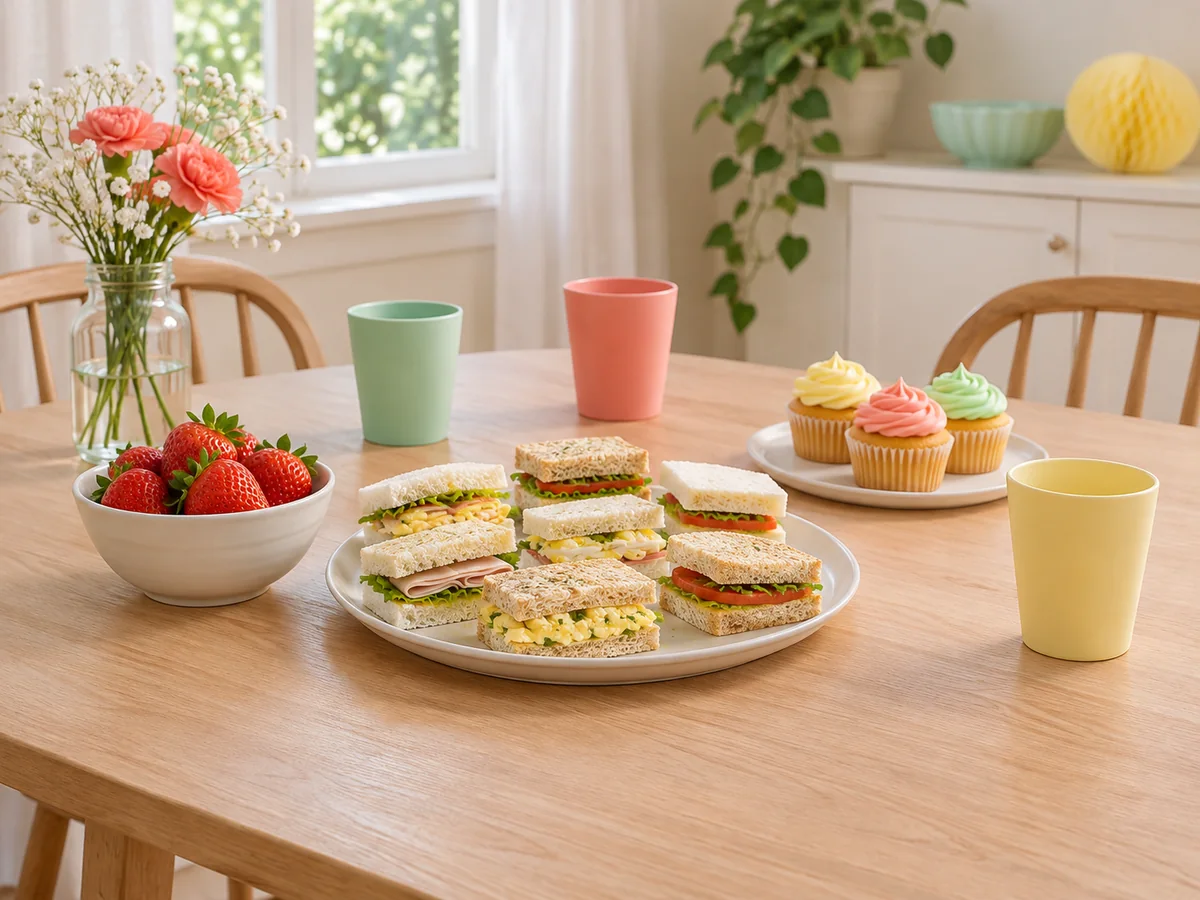
The easiest foods come in small, separate servings that hold together: cheese cubes and crackers in small cups, rolled ham and cheese slices, popcorn in small paper bags, pretzel rods, fruit cups and cupcakes. Portioning food into cups or bags lets you hand out one serving at a time instead of passing a big bowl around. It won't catch every crumb, though, and crackers still crumble however you serve them.
Serve sauces and dips on the side, or leave them off. You can hand out plain apple slices or plain pretzels in the carpeted room and keep caramel or cheese dip at the kitchen table. An individual dip cup holds one serving, but it can still spill.
Popcorn is a good example. Individual bags keep each serving together, but kernels still fall. If popcorn suits your guests, have them eat it in the eating area and pick up dropped kernels before games start again.
If you'd like guests to help themselves, plain popcorn in individual cups works much like bags. Our popcorn bar ideas suggest two or three optional toppings and a plain option. Keep any toppings at the eating area, and check that each one suits your guests before you offer it.
What should I avoid on a no-plate menu?
Quick answer: Avoid food that needs a spoon, drips sauce or falls apart in one hand. Loose pasta and dishes with a lot of sauce are hard to eat without something underneath.
If you want one of those dishes, provide utensils and a place to eat it rather than asking guests to manage without. You can mix the two: hand-held snacks for most of the party, and one dish at the table that needs a fork.
What foods stain carpet the most?
Quick answer: Keep red sauce, dark juice, chocolate syrup, sticky dips such as caramel, and frosting at the kitchen table or another eating surface.
Light-colored foods can still leave crumbs or residue. Color alone doesn't tell you what will be easiest to clean from your carpet. A light dip still needs somewhere to sit, and white frosting still smears.
How do skewers work for younger kids?
Quick answer: Check how the food is prepared, and whether picks are OK, with the families and the venue. If picks don't suit your group, choose another hand-held food, such as a small wrap.
Skewers and toothpicks still have to be held and thrown away, so count them when you clear up. Trimming the point doesn't settle whether picks suit a group. If you're unsure, leave them out. Roll-ups can go in cups instead of being held together with toothpicks.
Example snack menu for 12 guests
The amounts below are an illustrative example for 12 children, including the birthday child. Siblings, other children in the household and adults who are staying are not included. Add only the people who aren't already counted. Adjust for appetites, ages and the rest of the menu. Prep times are rough starting estimates, not tested timings.
To adapt this example, replace the 12 with your own numbers: children eating, adults eating, and any siblings or helpers not already included. Count each person only once. The party food quantity guide has a printable sheet for those numbers, which you can then multiply by the portions you've chosen.
These are snack-table amounts. If the party runs over a mealtime, include something more filling than snacks and cupcakes, and plan main-meal amounts separately. Pick a few of these foods rather than making all of them. The menu and break below use cheese and crackers, roll-ups, fruit cups, cupcakes and drinks.
| Food (illustrative) | Example amount for 12 | How the amount is worked out | Rough prep time | Serving note |
|---|---|---|---|---|
| Cheese and crackers | 24 small servings | 2 servings per guest x 12 = 24. Decide how many pieces go in each serving, then multiply by 24 for the shopping list | About 15 minutes | Serve in cups. Keep crackers separate until serving |
| Mini ham and cheese roll-ups | 36 roll-ups | 3 per guest x 12 = 36 | About 20 minutes | Serve in cups or on plates. Count any toothpicks when clearing up |
| Grape and melon cups | 12 cups | 1 per guest x 12 = 12 | About 20 minutes | Check fruit choices and how it's prepared with families |
| Vanilla cupcakes | 14 cupcakes | 12 guests + 2 extra = 14 | About 30 minutes to set up bought cupcakes (baking is extra) | Serve at the kitchen table or a covered surface |
| Water bottles or juice boxes | 12 drinks to start | 1 per guest x 12 = 12, with refills planned separately | About 5 minutes | Keep them at the eating area with a bin nearby |
| Other options: popcorn bags, apple slices, pretzel rods | 12 bags, 48 slices or 24 rods | 1 bag, 4 slices or 2 rods per guest x 12 | About 10 to 15 minutes each | Serve dips on the side, or leave them off for the carpeted room |
How to serve drinks and cake with less mess
Put drinks at the eating area. Bottles can be recapped, so ask guests to put the cap back on and leave the bottle there when they go back to games. A sealed juice box is easy to hand out, but once the straw is in it can't be resealed, and it can spill if squeezed or knocked over. Keep opened boxes at the eating area, with a bin nearby for empty boxes and straws.
Set up a small drink station at the eating area where guests can reach the drinks. Keep napkins nearby for spills, and ask someone to handle refills. Our guide to setting up a party drink station notes that sealed water bottles or juice boxes are the easiest choice when pouring is difficult.
Serve cake or cupcakes at the kitchen table or a covered surface where plates can rest. Bring everyone there for the candles, hand out dessert, then collect plates, wrappers and dropped crumbs before going back to the carpeted play area. Cupcakes mean you don't have to slice a cake, but frosting and crumbs still need clearing up.
Check guests' food needs and age before you shop
A food that's easy to hold isn't automatically right for every guest. The CDC lists whole grapes, hard raw fruit and vegetables, and popcorn as choking hazards for young children, and how food is prepared matters for their age. If young children are coming, check with their families which of the foods above suit them and how they should be prepared. Don't assume one version works for every age.
For food safety at a buffet, the FDA advises keeping cold food at 40 degrees F or below and leaving perishable food out at room temperature for no more than 2 hours, or 1 hour when it's above 90 degrees F. That applies to things like cheese, deli ham and cut fruit. Follow each recipe's or product's directions for preparation and storage. Where a recipe says you can make something ahead, follow those directions.
What if a guest has an allergy?
Quick answer: Check the ingredients and products you plan to use with the family before you shop, and agree how the food will be served.
Keep that information with the menu so another adult can follow the same arrangements. The color of a drink or topping doesn't tell you whether a guest can have it, and a list of ingredients alone doesn't make a dish allergen-free.
Planning for a short food break and a budget
This illustrative break runs from 2:00 to 2:30 p.m. with the example menu above. The blocks add up to 30 minutes (5 + 12 + 8 + 5). Allow longer if guests need more time to eat or the group is slow to move.
2:00 to 2:05: Bring guests to the eating area and hand out cups of cheese and crackers, roll-ups, fruit cups and drinks.
2:05 to 2:17: Guests eat the savory food and fruit. Keep any dips at the table and offer refills as needed.
2:17 to 2:25: Sing and serve the cupcakes. Leave time to eat them before asking anyone to move.
2:25 to 2:30: Collect plates, wrappers and empty drinks, put leftover food away following its directions, and check the floor for dropped food before games start again.
Can this menu work with a strict time limit?
Quick answer: Yes, if you choose food you can portion before serving and assign helpers to hand it out and clear up.
Another way to split 30 minutes is five minutes to put food out, fifteen to eat, seven for cupcakes and three to clear up. Check that both the venue and the menu can work within that time. If clearing up takes longer in your space, take time from another block rather than cutting eating short.
At a venue, check whether your 30 minutes starts when you can get into the room or when the food has to be out, and whether it includes clearing up. Once you've confirmed the venue rules and menu, our guide to serving party food in a 30-minute window covers who puts the food out, serves it and clears up.
Is finger food cheaper than a plated meal?
Quick answer: It depends on the menu. Skipping plates and forks doesn't necessarily lower the total.
Compare the full cost for the same number of guests: food, drinks, cups, bags, wrappers, picks, trays and individual dip portions. Individual packaging can change the total, so check your actual quantities and prices. Use what you already own where it works. Write the menu and serving supplies on one list so a helper can shop from it.
Checklist before you serve food
Run through these on the day before and the morning of the party.
- Confirm food needs, ingredients and how food will be served with any family who has shared food needs.
- Decide which sauces, dips and frosting stay at the table, and which foods will be served plain.
- Portion snacks into cups, bags or plates, and set aside servings for guests who arrive later.
- Check that every guest has somewhere to sit and put food down, away from the games.
- Put drinks at the eating area, with a spot for recapped bottles and opened juice boxes.
- Put napkins and a bin within reach, and agree who hands out food and who clears up before games start again.