How do I choose a simple party menu?
Quick answer: Start with when guests will eat and how many people are coming. If the party overlaps lunch or dinner, choose one main bite, add fruit or vegetables, the dessert and drinks. If it falls between meals, snacks, fruit, drinks and a small dessert may be enough. Then compare the full cost of homemade and store-bought options for your headcount, and cut duplicate extras before you make servings smaller.
Start with the party time and who is eating
The time on the invitation tells you what kind of menu you need. If the party runs over lunch or dinner, guests may arrive expecting a meal, so plan for more than sweets and snacks to graze on. If it falls between meals, for example in the middle of the afternoon, snacks, fruit, drinks and a small dessert may be enough. Tell families what you plan to serve so they know whether to feed children beforehand. A morning party could have muffins, bagels, yogurt tubes and fruit instead of a full breakfast.
Next, write down the confirmed guest list. Count the birthday child, any siblings or other children in your household who will eat, the invited children, and every adult who is staying. If you start from a class list, check whether the birthday child is already on it so you don't count them twice. Note any food requirements families have shared. If the headcount is still changing, wait for a more reliable number before you settle quantities.
What is a simple lunchtime birthday menu?
Quick answer: One main dish, such as pizza squares or mini sandwiches, plus fruit or vegetables, the birthday dessert and drinks, with water available.
Keeping to one main dish makes shopping, serving and refills easier. Check food requirements before you order, and include the adults who are staying in your count. If you are not sure the party time calls for a meal, see the related guides on start times and 2 p.m. parties.
Choose one item for each part of the menu
A simple menu usually has one item for each job: a main bite if you are serving a meal, a fruit or vegetable side, a snack, a dessert and drinks. Pick familiar foods that are easy to portion, then stop. Adding more varieties increases cost and preparation without necessarily feeding people better.
These are example options, not a fixed menu. Check ingredients and guests' needs before you choose any of them.
| Menu part | Example options | Things to check |
|---|---|---|
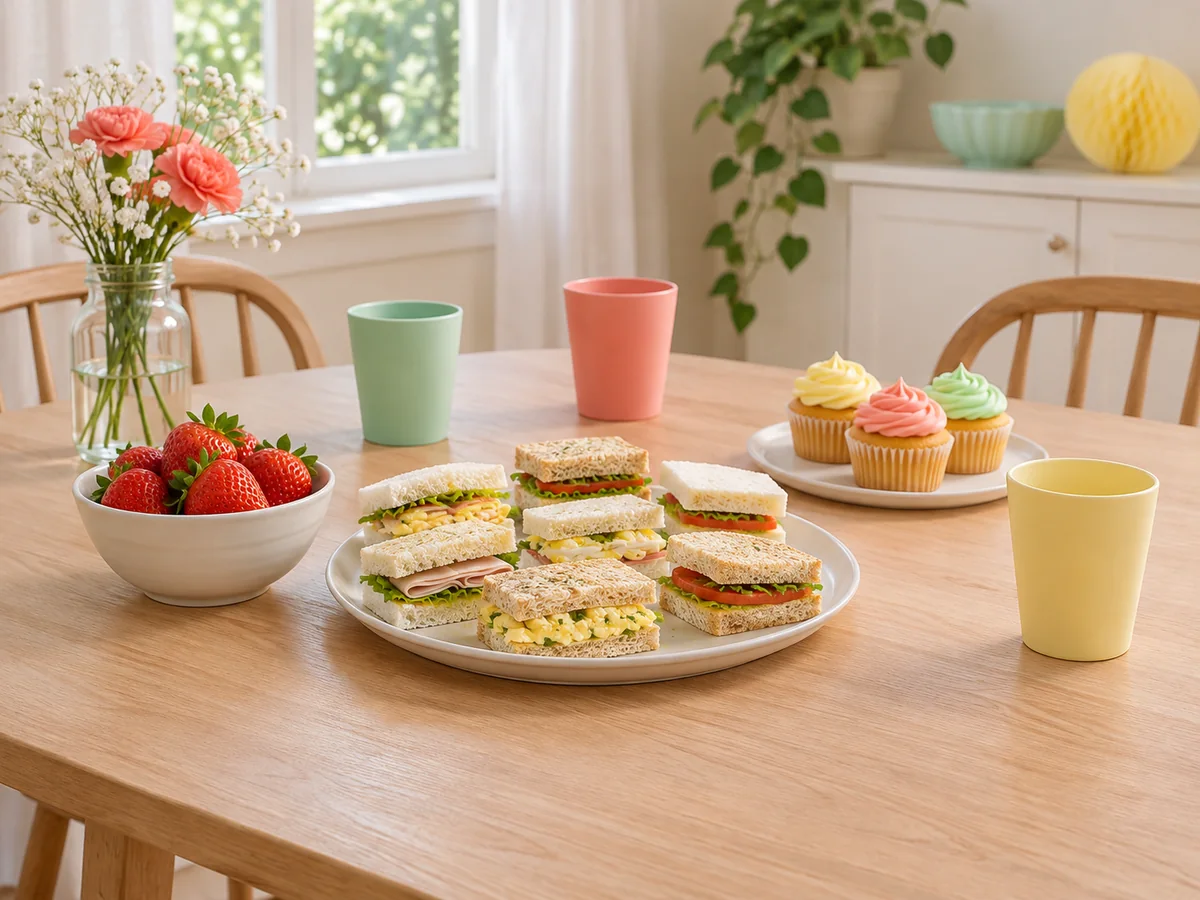
| Main bite (meal-time parties) | Pizza squares, mini turkey, cheese, sunbutter or vegetable sandwiches | Dairy and gluten before ordering pizza; label each sandwich type |
| Fruit or vegetables | Fruit cups; carrot, cucumber, pepper or snap pea cups | Guests' ages and how produce is cut; offer some vegetable cups without dip |
| Snack | Crackers, cheese, pretzels, popcorn cups | Popcorn and hard raw produce are choking hazards for young children |
| Dessert | Cupcakes or the birthday cake | Label dairy, egg, gluten or nuts when present |
| Drinks | Water plus one other drink | Keep water easy to find |
Is it worth turning the oven on?
Quick answer: Only if you want one hot snack. Otherwise, cold and room-temperature foods can make up the whole menu.
For a casual hangout, cheesy tortilla chips or frozen taquitos are simple hot options. Follow the recipe or package directions and serve them before the game or film starts. If pretzels, fruit, cheese and crackers already cover the snacks you want, you can skip the oven.
Decide what to make and what to buy
Neither homemade food nor store-bought food is always the cheaper or easier choice. The answer depends on your headcount, what you already have at home and how much preparation time you have. Compare the full cost for the same number of people, not the price of one package or one tray.
A mixed plan often works well. You could order the main bite and make a simple snack or dessert yourself, or buy a party tray and add fruit cups you prepare that morning.
Is homemade party food always cheaper than party trays?
Quick answer: No. Compare your complete shopping list with the tray quote for the same headcount.
Include ingredients you would buy just for the recipe, containers, any extra equipment and the time you have to prepare. A recipe that looks cheap can cost more once you add toppings and supplies you won't use again.
How can I compare cheap party food options?
Quick answer: Compare the total cost for the amount your guests need, including everything each option requires.
Add toppings, condiments, packaging and delivery charges, plus ingredients or equipment for homemade food. A large package can cost less per item but still leave food unused, so think about whether you'll use the rest. Write each option on a list with the quantity needed, the estimated cost and the package or supplier yield, then compare the totals.
Once your list has totals, you can add more candidates to compare. The budget party food ideas for feeding a crowd are options to price locally rather than dishes that will always cost less. For each one, include the extras it needs, how much of the package you'll actually use and how much preparation time it takes.
Work out how much food to buy
No single portion count fits every age, menu and party length. Quantities for a main meal are different from quantities for a snack table: when food replaces lunch, the main bite does most of the work; between meals, smaller amounts of several snacks may be enough. Use the starting estimates below, then check package, recipe or supplier yields against your own guest list.
Example starting estimates (illustrative, adjust for your party): 2 small pizza squares per child and 3 to 4 per adult; 1 to 2 mini sandwiches per child when sides are included; one cupcake per guest plus a few extra; one drink plus one refill per guest.
How much food should I plan for?
Quick answer: Decide whether the party replaces a meal, count the children and adults who are eating, then use portion estimates and check them against package or supplier yields.
Choose a main bite, sides, dessert and drinks that suit the meal plan. The example estimates on this page are a starting point, not a fixed menu for every crowd. For more detail, see the related guide on how much food to buy.
Worked example: a two-hour lunchtime birthday
This is an illustrative example. Your guests, foods and times will be different.
Headcount: 11 invited children plus the birthday child makes 12 children. Six parents are staying, making 18 people eating. No siblings are coming.
Menu: pizza squares, fruit cups, vegetable cups with some served without dip, cupcakes, water and juice.
Quantities using the example estimates: pizza squares for children, 12 x 2 = 24; for adults, 6 x 3 to 6 x 4 = 18 to 24; total 42 to 48 squares. Cupcakes: 18 guests plus a few extra, so about 20 to 22. Drinks: 18 people x 2 (one drink plus one refill) = 36 drinks, with water also available. Fruit and vegetable cups: about one each per child, plus some for adults if you want to offer them.
Schedule (12:00 to 2:00): 12:00 guests arrive and drinks are out. 12:15 lunch is served at the table: pizza squares, fruit cups and vegetable cups. 12:45 a helper clears plates and stores leftovers while games start. 1:30 cupcakes. 1:50 finish eating and clean up hands. 2:00 pickup.
In this schedule, the pizza and cold cups are on the table for about 30 minutes. FDA buffet guidance says perishable food should not sit at room temperature for more than 2 hours, or more than 1 hour above 90°F, and cold food should be kept at 40°F or below. Use those limits for your own timing rather than the length of the party.
Plan what to prepare ahead and when to serve
Here is a flexible order of tasks. Move them around to suit your menu and venue.
Two days before: shop for shelf-stable food, labels, plates, napkins, drinks and serving trays. The day before: write labels, set out serving trays, pack take-home treats, and prepare dips or desserts if their directions say they keep well overnight. Make fruit cups close to serving time and portion popcorn about 30 minutes before serving. About an hour before: set out drinks, trash and recycling, serving tools and the first room-temperature snacks. During the party: refill trays in smaller batches and clear sticky plates before dessert.
What can I prepare ahead?
Quick answer: Labels, shopping lists, serving trays, dry snacks and drink supplies can be done early. Some desserts and wrapped treats can be made the day before if their directions allow.
Prepare fresh, cold or hot foods according to their own recipe or product instructions. If a recipe supports cooking ahead, follow its storage directions; don't assume every dish keeps overnight.
It can help to split your menu into jobs for earlier days and jobs for party day. Our guide to what party food you can prepare ahead groups suggestions by menu. If you change a recipe or swap a product, follow the directions for that one instead of the guide's timing.
Should I serve food before or after games?
Quick answer: It depends on the meal you promised. If guests expect lunch or dinner, serve it before the busiest activity; at a snacks-and-cake party, you could play first and eat afterward.
Let the invitation time, the main activity and any fixed venue eating slot set the order. Check the venue's slot before setting activity times. Keep a seated eating break separate from running games, decide ahead when the game stops and who serves, and leave time to finish dessert before pickup. Tell helpers the actual serving time.
Can I leave all the snacks out for three hours?
Quick answer: Don't use the party length as a storage rule. Follow package or recipe directions and bring out small portions as people want them.
This matters most for refrigerated foods; FDA guidance limits perishable food to 2 hours at room temperature, or 1 hour above 90°F. Keep dry snacks closed between refills if that suits their storage directions, and store reserve food according to its directions instead of putting every refill on the table.
Plan for guest needs and a tidy food table
Ask families about food allergies and other requirements before you shop. Label dishes with clear ingredient information, keep separate options apart, and give each its own serving tool. For specific needs, follow the family's instructions and check product labels; don't call a food allergen-free just from its ingredient list.
Think about the ages of your guests. The CDC lists whole grapes, hard raw produce and popcorn among choking hazards for young children, so choose foods and how they are prepared to suit the children coming. Skip popcorn for toddlers and offer another snack instead.
How do I keep the food table from getting messy?
Quick answer: Serve smaller batches in cups or small trays, keep napkins, wipes, trash and recycling close, and give a helper the refill and clearing jobs.
Individual cups work well for fruit and vegetables. Keep refill portions separate, and put drinks beside the food or on a separate surface so guests don't lean over the trays. Have someone clear used plates and empty packaging before dessert so guests have room to eat, and so refilling doesn't interrupt every activity.
Do I need plates?
Quick answer: Not for everything. Cups or bowls and napkins may be enough for pretzels, gummies and popcorn portions.
Put out small plates for foods people would rather set down between bites, such as cheesy chips, chicken and rolls, or pizza. Choose serving supplies for the foods you're actually offering.
Cut costs without leaving guests short
If the total is too high, look for duplicates first, then reduce the number of varieties. Make servings smaller only after that. Keep the main bite if you promised a meal, and keep at least one choice every guest can eat.
What should I remove if the menu costs too much?
Quick answer: Remove duplicate extras first, then reduce the number of varieties before cutting each serving.
If cupcakes are already dessert, you may not need a separate take-home sweet. If fruit cups are on the table, a second fruit platter may not be necessary. Keep the menu suitable for the time of day.
What if I only have twenty dollars?
Quick answer: For a casual hangout, check what you already have, then price a salty snack, a sweet snack and drinks at your store.
Add something filling only if it fits the total or friends are expecting a meal. Prices and package sizes vary, so add up the total before you buy.
Simple party menu checklist
- Check whether the party time overlaps a meal and tell families what you'll serve.
- Count everyone eating: birthday child, siblings, invited guests and staying adults, without counting anyone twice.
- Collect food requirements before shopping.
- Pick one item for each part of the menu: main bite if needed, fruit or vegetables, snack, dessert, drinks.
- Compare full costs of homemade, store-bought or mixed options for your headcount.
- Check portion estimates against package or supplier yields.
- Write the serving time into the schedule and tell helpers.
- Label dishes, and keep separate options with their own serving tools.
- Put napkins, wipes, trash and recycling near the food, and choose a helper to refill and clear.