How do I run Minute-to-Win-It games for different ages?
Quick answer: Choose a few short challenges that use things you already have, such as cups, paper, balloons and spoons. Show each task, give players one practice try, then time a 60-second attempt and write down the result. Write out each game's full rules first: how it starts, what counts as finished, what happens after a mistake and how you reset. For young children, such as five-year-olds, try a six-cup pyramid built with both hands, keeping one balloon in the air or carrying a ball on a spoon along a short route. Make a task easier if it's too hard, and check that balloons and balls suit the children playing. For teens, let your teen help choose the games and music, and leave time for food and talking. Plan your time around how many people share each set of equipment, because turns at one shared set add up quickly.
How Minute-to-Win-It games work at a home party
Each game is one simple task with a 60-second limit, such as stacking cups into a pyramid, keeping a balloon off the floor or carrying a ball on a spoon. The clock is what makes it exciting, so the task itself can stay simple. One player or the whole group tries the task while someone keeps time, then you write down whether they did it.
These are home-party versions, so you can change a target, a distance or the number of cups to suit your guests. Explain any changes before anyone plays, and keep the rules the same for everyone whose scores you compare.
Is Balloon Keep-Up the official Defying Gravity challenge?
Quick answer: No. Balloon Keep-Up here is a version for home parties, not an official competition blueprint.
The version described here uses one balloon, a clear boundary and a 60-second goal. Treat it as a starting point you can adjust, not as the rules of any official show or competition.
Gather supplies from around the house
You don't need to buy a kit. Check your cupboards first and choose games that use what you already have. If a game needs something you don't have, skip it. A short block of games works fine without every item.
If a challenge needs something you're missing, swap in a different game that uses what's already in the house instead of buying a replacement. Prizes are optional too. You can choose one separately from the games or play without one. These budget party games that cost almost nothing give you more options.
Try the challenges yourself, or with your child, before buying extra equipment. You'll find out quickly whether a task is too easy, too hard or needs more space than you expected.
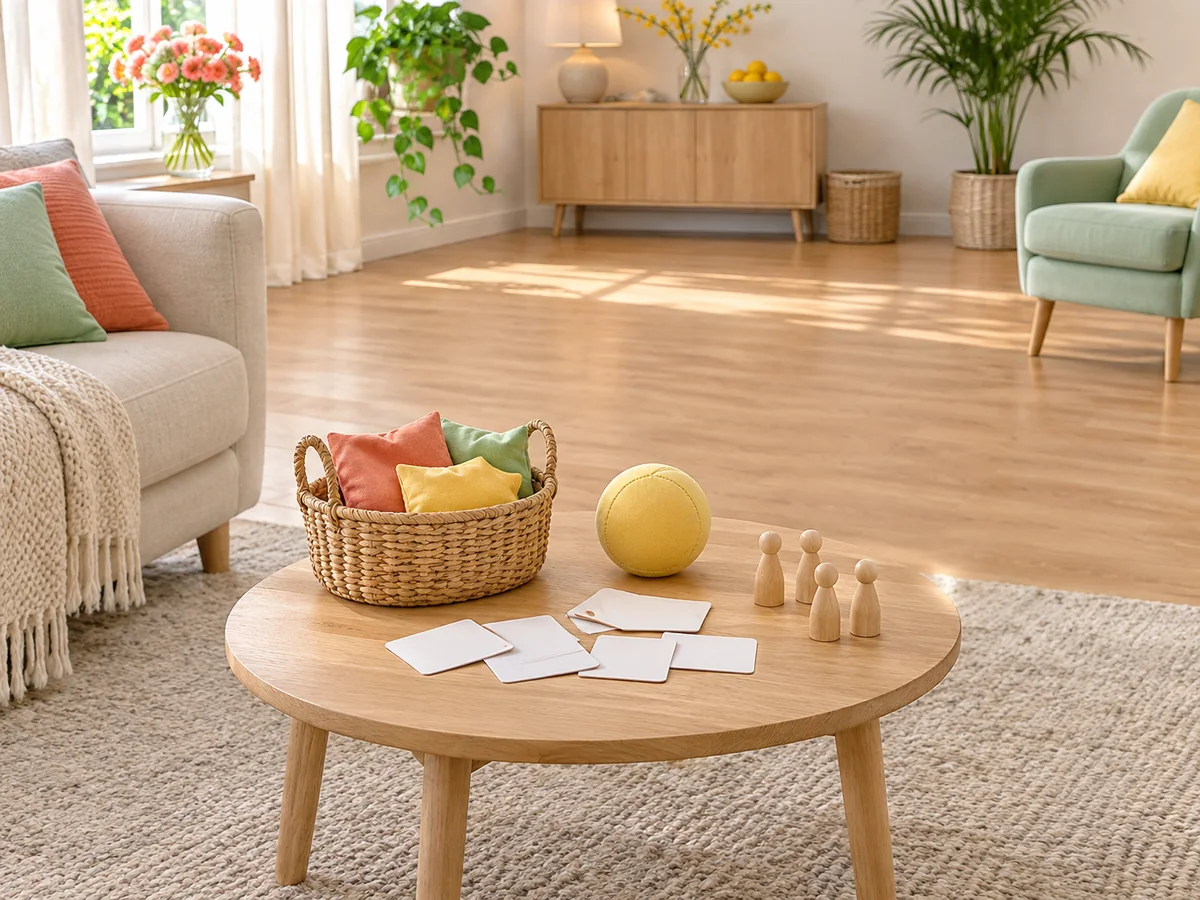
What household items do these games use?
Quick answer: Cups, spoons, balloons, cookies, straws, pom-poms, ping-pong balls and crackers or cheese puffs.
Check what you already have and skip games that need missing supplies. If any game uses food, check guests' food needs first, and don't assume every child can eat it.
Balloons and small balls need extra care with young children. Read the age warnings on the packaging, have an adult blow up and tie the balloons, keep uninflated balloons put away, and pick up any burst balloon pieces straight away. If a ball or balloon isn't suitable for the children playing, choose a different game, such as the cup or paper challenges below.
Choose games that suit your guests' ages
Age labels are only suggestions. What matters more is whether your guests can understand the task quickly and succeed with a bit of effort. Show the task first, watch the practice tries and make it easier if players are getting frustrated.
After watching the practice tries, compare tasks by how much reading, movement and waiting they ask of your guests. Our list of party games by age suggests what to play and how to run each game. It also suggests agreeing who will lead the games while food is served.
For teens, the challenges can be harder. For example, a ten-cup pyramid adds more stacking without changing the clock. If younger siblings join a teen party, give them an easier version and explain the different targets before play. Keep scores from different versions separate so nobody is compared unfairly.
When teens and younger siblings play together, separate targets can get hard to track. A shared game can be simpler. In Pass the Story, for example, you can run two stories with a different starter for each. These party games for a wide age range let everyone play the same game instead of comparing scores across versions.
| Group | Games to try | How to adjust them |
|---|---|---|
| Young children, such as five-year-olds | Six-cup pyramid with both hands, one-balloon keep-up, one ball on a spoon along a short route | Show the task first, shorten the route or lower the target if needed. Check balloon and ball packaging warnings and stay close while children play |
| Teens | Ten-cup pyramid, paper tower, paper-ball target or other challenges your teen picks | Let your teen choose, offer a practice try, let guests time or watch instead |
| Mixed ages | The same game with a different target for each group | Explain the targets before play and keep their scores separate |
What are easy minute-to-win-it games for five-year-olds?
Quick answer: Try a six-cup pyramid built with both hands, keeping one balloon in the air, or carrying one ball on a spoon along a short route.
Show each task before the timer starts and make it easier if needed, for example by shortening the route. These are suggestions, not age requirements, so go by what your guests can actually do.
The six-cup pyramid has full rules in the next section. For balloon keep-up, use the bounded version in the Minute to Win It games guide linked below. It uses one balloon, a clear boundary and a 60-second goal. The attempt ends if the balloon touches the floor, is held or leaves the boundary. Keeping the balloon up for the full minute earns 1 point; otherwise record 0, the same 1-and-0 scoring used in the next section. For the spoon game, mark a clear start and finish, and use the spoon rules in the Minute-to-Win-It games by age guide linked below. Before play, tell children what happens if the balloon touches the floor or the ball drops. A suggested age is not a safety check, so look at the balloon and ball warnings and stay close by while young children play.
How do I make the party feel age-appropriate?
Quick answer: For teens, let your teen help choose the games and music, keep the rules brief and leave room for food and conversation.
Explain the rules briefly, offer a practice try and let guests watch or help keep time if they'd rather not compete. Don't schedule contests for the whole evening. If your teen prefers to play together instead of against each other, skip individual totals and count how many successful tries the whole group gets.
How to run each round
Choose a playing surface and a place where waiting guests can sit or stand. Keep food, bags and the next game's supplies off that surface.
Before choosing indoor challenges, check where players will stand, where others will wait and how close play is to furniture. Put the waiting spot outside any throwing or rolling route. Indoor party games that keep play away from furniture help you match each challenge to the space you have.
Pick one scoring system and stick to it. The teen version uses 1 point for meeting the goal and 0 for an unfinished attempt, and the rules below use that system. Other versions of these games use a three-point system. For example, the balloon game in the by-age guide gives points for unsuccessful attempts and has no boundary rule, so don't combine it with the bounded balloon version. Either system works, but don't mix totals from both.
Six-cup stack: start with six identical plastic cups nested together. In 60 seconds, build a pyramid with rows of three, two and one, then nest all six cups again. If the pyramid falls, rebuild while the clock keeps running. Finishing both steps earns 1 point; otherwise record 0. Stop after one completed stack, and reset by nesting all six cups.
Ten-cup stack: the same game with ten identical cups nested together and rows of four, three, two and one. Build the pyramid, then nest all ten cups again. Rebuild a fallen tower in the time left. Both steps finished earns 1 point; otherwise 0. Reset by nesting all ten cups.
Paper tower, for a table: start with three sheets of paper and no tape. In 60 seconds, fold or roll them into a tower that stands without anyone holding it. You may rebuild while the clock runs. At the buzzer, take your hands away. A tower that stands for five seconds earns 1 point; otherwise record 0. Height doesn't count. Reset with three fresh sheets.
Paper-ball target, for a table: start with five crumpled paper balls and an empty bowl. Mark a throwing line and use the same bowl and distance for everyone. In 60 seconds, toss the balls one at a time. Each ball gets one throw, and misses stay out. Stop after five throws or at the buzzer. Three or more balls in the bowl earns 1 point; otherwise record 0. Reset by collecting all five balls and emptying the bowl.
- Show the task and explain what counts as a success and what happens after a mistake.
- Give players one unscored practice try.
- Start a 60-second timer. Everyone stops at the buzzer, apart from the paper tower's five-second standing check.
- Write down the result, put the supplies back where they started and call the next player.
- Give everyone a turn before moving to the next game. Add up the scores after the last game. If totals are tied, players share the win.
How long does each game take?
Quick answer: Each scored attempt lasts up to 60 seconds, but explaining, practice tries, player changes and resets all take extra time.
Illustrative example: six children sharing one cup set need six minutes for the scored turns alone, before you count anything else. To cut down the wait, set up three identical stations, such as three sets of cups, so three children play at once. Six children then need two rounds of turns instead of six, as long as an adult can watch all three stations. The Minute to Win It games guide linked below includes a 20-minute plan that uses three stations.
Plan how many games and how much time
How long the games take depends mostly on whether everyone plays at once or takes turns at shared equipment. Count your players first, including your own child if they're playing and any siblings who join in. Then count your equipment sets.
Once you have both numbers, decide whether everyone plays at once or in teams. Check that the room and equipment have space for every team playing at the same time. The FAQ Which party games work for our group size? helps you match player counts to formats that cut down on waiting.
Illustrative example: eight players taking turns at one shared set, with four games, need 4 times 8, or 32 minutes, of scored playing time alone. With two identical sets, two players can go at once, so the scored time drops to about 16 minutes, as long as you have room and someone to watch both attempts.
How many minute-to-win-it games do I need for a party?
Quick answer: It depends on your time and equipment. One example plan fits six games into 30 minutes, but only if everyone plays at once.
In that illustrative plan, 18 minutes go to the rounds and 12 minutes to setup, a short break, scores and awards, which adds up to 30 minutes. If players share equipment and take turns, allow more time or play fewer games.
The thirty minutes is only the games block, not the whole party. Fit it around arrivals, food and moving between activities, and allow time to demonstrate, reset supplies and let guests switch. Our answer on how many activities to plan for a party gives a one-hour example with a welcome, three games and a break.
What can guests do between turns?
Quick answer: They can talk, listen to music, help write down results or reset the equipment.
If people are waiting too long, play fewer games or add another identical set of equipment. A short spoken game is an option, but not every pause needs a new activity. A reset can just be a break for a drink or a chat.
Using teams
If you want teams, decide them or hold a draw before play starts so nobody is picked last in front of everyone. If the teams are uneven, compare the same number of scored attempts for each team instead of giving the larger team extra turns. Give guests who don't want to compete a job, such as keeping time or writing down scores.
Example: a two-hour teen party
This illustrative 120-minute plan assumes eight players, two identical sets of equipment and four challenges. If your teen is playing, count them as one of the eight. With only one set, play fewer games or allow a longer games block. Adjust the times after you've tried your chosen games.
- Don't add an extra game if it would run into pickup time.
- Serve food away from the game table, and add fruit, salty snacks, water and dessert as they suit your group.
- Match the menu to the party time and to any food needs guests have told you about.
| Time | What happens | Minutes |
|---|---|---|
| 0:00 to 0:15 | Arrivals and music; point out food, drinks and where to put bags | 15 |
| 0:15 to 0:25 | Show the first challenge and explain scoring and turn order | 10 |
| 0:25 to 0:50 | First two challenges; show the second task before its turns | 25 |
| 0:50 to 1:10 | Put the games away and serve the main dish, such as pizza, tacos, sliders or pasta | 20 |
| 1:10 to 1:35 | Last two challenges with a practice try each | 25 |
| 1:35 to 1:50 | Dessert, add up scores and hang out | 15 |
| 1:50 to 2:00 | Clear up and gather belongings before pickup | 10 |
What food works for this party?
Quick answer: Pizza, tacos, sliders or pasta can cover a meal, and fruit, salty snacks, water and dessert can round it out.
If the invitation covers lunch or dinner, serve a main dish instead of expecting snacks to be enough. Ask about food needs before shopping and serve food on a separate table from the games.
Agree on house rules and supervision
Before guests arrive, agree with your teen on the house rules and who will collect each guest. Write down the exact finish time and finish the games before pickup starts, so you're free to answer the door.
What rules should be clear before guests arrive?
Quick answer: Agree on which rooms and outdoor areas guests can use, where food goes, music volume, phone and photo rules, the finish time and pickup arrangements.
Also explain the game rules before each scored challenge, not just once at the start.
How much supervision should I provide?
Quick answer: Stay nearby and available, and step in when safety, noise or unkind behavior needs attention.
Know which rooms and outdoor areas are in use. Your teen can lead the games, but they shouldn't be left to handle arrivals, food and rides alone. For younger children, plan on more hands-on help with showing tasks and resetting equipment, and stay close whenever balloons or small balls are in use.
Checklist before the games start
- Choose your games and check that you have the supplies for each one.
- Check the age warnings on balloons and balls if young children are playing.
- Count your players and equipment sets, then work out how many separate turns you need.
- Write down each game's setup, goal, mistake rule, scoring and reset.
- Pick one scoring system and prepare a score sheet and pen.
- Test the timer.
- Decide teams in advance if you're using them, and plan a job for guests who'd rather not compete.
- Set up food on a separate table from the games.
- Confirm the house rules, finish time and pickup arrangements.